
Is There an Age Limit on an Expat Mortgage, and Whose Age Counts?
Updated: Sep 1
Find out whose age counts on a joint expat application, and how two separate age clocks decide your term.
Quick Answer
Yes, expat mortgages carry age limits, but there is no single industry figure, and on a joint application it is the oldest applicant's age that counts. Non-resident criteria run from repayment by age 70 at the tight end to 84 at the generous end, with lending into retirement assessed separately on evidenced income.
The practical effect of age is usually to shorten the term rather than to refuse the loan. A shorter term means a higher monthly payment, which turns an apparent eligibility problem into an affordability problem. That is a different question with different answers, and it is often solvable where an outright age ban would not be.
Living overseas tightens all of this. The pool of lenders that consider non-residents at all is small, and inside that pool the age caps are generally lower than the same lenders apply to UK residents. Criteria in this market changed repeatedly through 2025 and 2026, so treat everything here as correct as at August 2026 and check current criteria before you plan around it.

Reviewed by Ben Stephenson, FCA authorised (FRN 496907) · 25+ years' experience · 4.9★ on Google. Updated: 6 August 2026.
Who Is This Guide For
Best for couples with an age gap buying a UK retirement home from abroad, expats in their late fifties and sixties remortgaging a property they own, and overseas borrowers whose income is largely pension or drawdown, who need to know what term is realistically available.
Key Points
On joint cases the oldest applicant sets the term
Two clocks: end of term and evidenced income
Non-resident caps run from 70 to 84
Table of Contents
Whose age counts on a joint expat application, and what an age gap costs you
Two age clocks, not one: term end against the age your income must reach
When the older applicant's age cuts your loan to value, not just your term
Why there is no single expat mortgage age limit, and why an average would mislead
Proving pension, drawdown and investment income from outside the UK
Why retirement interest-only is effectively closed to expats
The pattern we see most often: the fifteen year term that quietly becomes nine
Whose age counts on a joint expat application, and what an age gap costs you
If you are applying with a partner, the age that shapes your mortgage is not the average of the two. Across published UK lender criteria the rule is close to universal: the oldest applicant's age sets the maximum term. Lenders write it in almost those words, that all loans must be repaid by the 81st birthday of the oldest applicant, or that on joint applications the eldest borrower's age is considered for maximum age limits.
It is worth stating flatly, because most commentary hedges it. It does not matter which of you earns more, or who is named first.
The squeeze on a couple with an age gap is arithmetic, not judgement. Take applicants aged 58 and 63 with a lender requiring repayment by the oldest applicant's 80th birthday. The younger could in principle have twenty two years. The couple has seventeen, and the resulting jump in monthly payment is what fails affordability.
There is one thing the rule does not do, and it is routinely conflated with the thing it does. The older applicant caps the term. The younger applicant's income can still carry the affordability. Those are separate tests, and a case that looks dead on the first can survive on the second.
We should also correct a claim that circulates widely in expat forums: that lenders set the term on the younger applicant's age where that applicant's income alone services the loan. We searched the published criteria of roughly eighteen UK lenders, including the main expat providers, and could not find one publishing that as a rule. If it happens at all it is unpublished underwriter discretion, not something to plan a purchase around.
One further test sits behind joint later life cases. Some lenders ask whether the survivor could keep paying if the other borrower died, and one applies that test to standard lending beyond age 76. The equivalent guidance for retirement interest-only sits at MCOB 11.6.15G(4), and the FCA has consulted on removing it in CP26/18 (FCA, 2026). That is a consultation, not a rule change.
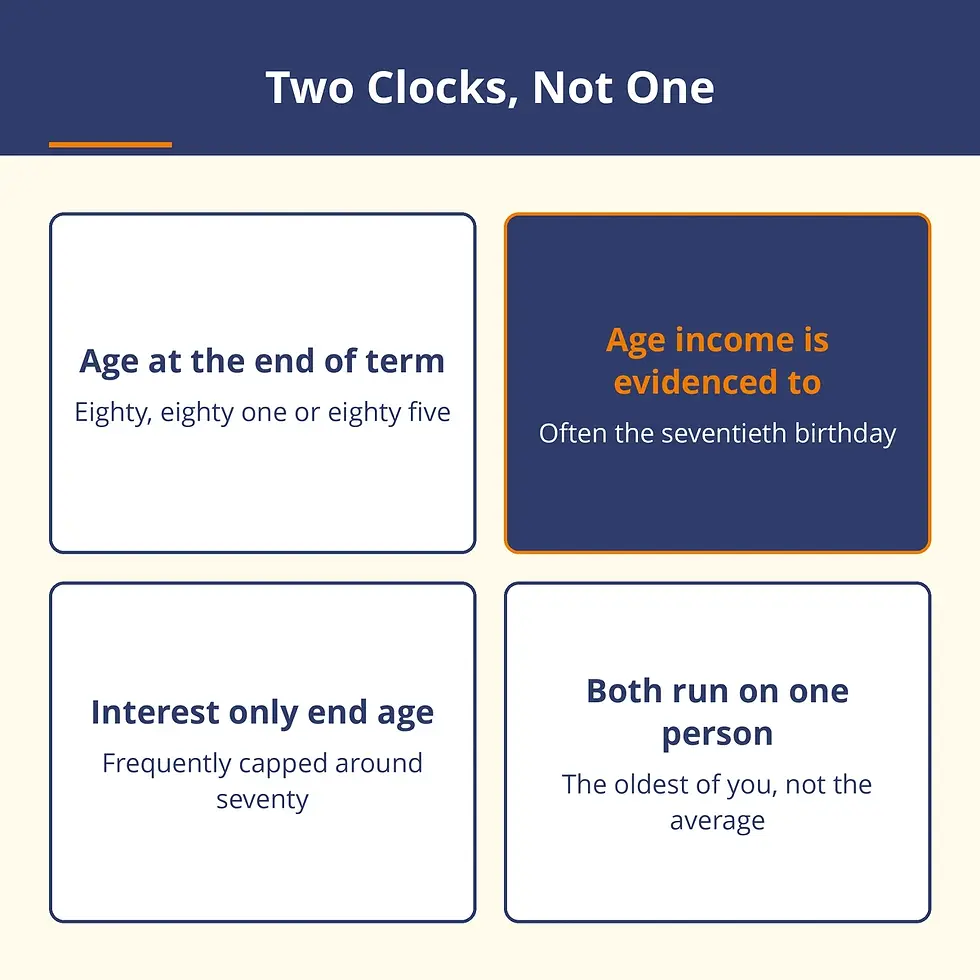
Two age clocks, not one: term end against the age your income must reach
Most borrowers plan against one number, the maximum age at the end of the term. There is almost always a second and earlier number, and it is the one that decides cases: the age up to which your income has to be evidenced.
The clearest published example is a lender that allows a term running to the oldest applicant's 80th birthday while requiring affordability to be evidenced to the oldest applicant's 70th. Both numbers do different jobs. The 80 controls how long the loan may run, the 70 controls which income counts while it runs.
The age clock | What it actually controls |
Maximum age at end of term | The latest date the balance may still be outstanding, which fixes your longest available term |
Age to which income must be evidenced | The point beyond which earned income stops counting and retirement income has to be proved, which fixes your affordability |
Plan against the wrong clock and you build a case that collapses at underwriting. A 63 year old applying for a seventeen year term at that lender is inside the end of term cap, but the earned income assumption only survives seven of those seventeen years. From the eighth year the lender wants to see retirement income covering the payment.
The governing regulation is proportionate rather than prohibitive. MCOB 11.6.15G asks firms to take a prudent and proportionate approach to income beyond the expected retirement date, and adds that the closer the customer is to retiring, the more robust the evidence of retirement income should be (FCA, 2026). That is a proximity test, not an age ban.
Lenders operationalise it in two recurring ways. A ten year proximity trigger is common: inside roughly a decade of retirement, hard evidence of retirement income is usually required, while outside it evidence of pension contributions often suffices. Alongside it sits the lower of test, where several lenders assess affordability on the lower of current income and projected retirement income.
Together they are why an expat in their late fifties can find their case assessed on a retirement income figure they thought was years away. Our note on switching from repayment to interest only covers the payment side.
When the older applicant's age cuts your loan to value, not just your term
Here is the part almost nobody sees coming. At some lenders age does not only shorten the term. It reduces the maximum loan to value you can borrow at.
One building society states in its published criteria that maximum LTVs are calculated on the oldest applicant's age, on their next birthday. That is a materially different constraint from a term cap. An age gap can cut the size of the loan, not just the number of years, before any affordability calculation begins.
The pattern shows up in several forms. One lender publishes 80% where the term extends past retirement but 70% where the applicant is already retired. Another publishes 80% where earned income is present during the term and 70% on pension income alone. A third caps residential borrowers over 70 at 75%.
The consequence is a deposit conversation you may not have planned for. If you budgeted on a 20% deposit and the lender's age banding drops you to 70% LTV, you need another 10% of the purchase price in cash. On a £500,000 house that is £50,000, and it tends to surface at the point where it is hardest to find.
So ask early whether the lender's LTV grid is age banded, because it is not always visible on a headline criteria page.
Why there is no single expat mortgage age limit, and why an average would mislead
The most repeated claim in this subject is that there is a standard industry age limit. There is not, and the spread in published criteria is wide enough that any single number is wrong by construction. Verified end of term ages across UK residential criteria include 75, 80, 81, 85 and 86, alongside two societies publishing no maximum age at all, and one that lends to 95 on repayment.
An average of that range would be useless. It would sit in the high seventies, which describes no lender's actual policy and misleads both a 55 year old with headroom and a 72 year old who needs the handful of lenders at the generous end.
Two related myths deserve the same treatment. The first is that you cannot borrow past 70. UK Finance (2025) recorded 33,130 new loans advanced to borrowers aged 55 and over in a single quarter, including 4,780 to borrowers aged 70 and over, with the value up 3% year on year. That count spans more than one product type, so treat it directionally, but the market is not closed.
The second myth is that age at application is what matters. At nearly every lender the binding constraint is age at the end of the term. Application age caps are frequently generous or absent, while term end caps are firm.
Then there is the split most borrowers miss entirely. Repayment and interest only do not share an age limit. Across multiple lenders the interest only cap sits five to fifteen years earlier, with pairings such as 80 against 70 and 85 against 70 published. If interest only is part of your plan, our guide to interest only minimum income requirements explains the other gate you have to clear.
One more correction, because it affects the tight end. Two of the expat lenders we reviewed set a minimum age of 21 rather than 18. Expat criteria tighten at both ends of the age range.

How living overseas tightens every one of these caps
Everything above describes the UK resident market. Non-residency narrows it twice over, and the second narrowing is the one people underestimate.
The first narrowing is at the residency gate, before age is tested. Many lenders at the generous end of the age range require applicants to have lived in the UK for the last two years, or to be UK taxpayers paid in sterling, or simply state that expats are not accepted.
The second narrowing happens inside the expat pool itself. The cleanest proof is one lender applying two different age caps to the same borrower profile depending only on residency. Its UK resident later life product allows a term ending at age 80. Its expat residential product requires repayment before the client's 70th birthday or declared retirement age, whichever is lower.
That is a ten year haircut on maximum age at term end, at one lender, on published criteria, purely for living abroad. It is why applying a UK resident age assumption to an expat case produces plans that do not survive underwriting.
It is not universal, though. At the generous end, one non-resident specialist publishes a maximum age of 75 at the start of the mortgage and 84 at expiry. So the expat spread runs from repayment by 70 to expiry at 84, and which end you land at depends on lender selection more than on your own file.
An illustrative composite: a couple in their late fifties and early sixties buying from the UAE
The following is an illustrative composite built from the pattern we see, not a real client, and the figures are indicative only. A couple aged 58 and 63 living in the UAE wanted a fifteen year term on a £620,000 UK house they intended to retire into, with a £180,000 deposit and a £440,000 loan at 71% LTV. Their first choice lender capped the term at the older applicant's 70th birthday because of their non-resident status, cutting the available term to seven years and pushing the payment beyond what the case could support.
Placed with a lender in the non-resident specialist tier, the fifteen year term was available, ending before the older applicant's 78th birthday. Affordability was assessed on the younger applicant's employment income to their declared retirement age and on evidenced UK pension income beyond it, and the case was stress tested at an illustrative rate several percentage points above the illustrative pay rate, as lenders routinely test a higher rate than the one you actually pay.
Proving pension, drawdown and investment income from outside the UK
If the term cap is the first hurdle, income evidence is the second, and for a retired or nearly retired expat it is usually the harder one. The problem is rarely the amount of your retirement income. It is whether the lender counts it at all.
Here is the finding clients most need to hear, verified from published expat criteria. One expat lender states that foreign income that is from a foreign pension is excluded from the affordability assessment entirely. The same lender accepts a UK pension, but specifies an annuity rather than investment or SIPP based provision.
That has three separate edges. A foreign state or occupational pension may count for nothing. A UK pension in payment as an annuity may count in full. A UK pension held as a self invested or drawdown arrangement may fall outside the acceptable list even though it is a UK pension.
That is a different problem from being too old. An applicant of 62 with a substantial overseas pension can find their assessed income is effectively zero at a lender that excludes foreign pension income, which collapses the term through affordability rather than through the age cap. Combine that with the lower of test described earlier and the arithmetic gets unforgiving.
Currency adds a further layer. Some expat lenders require income in sterling outright, while others operate a defined multi-currency list. Where a sterling mortgage is serviced from income in another currency, the FCA foreign currency loan rules in MCOB 2A.3 apply, including a right to convert the loan into an alternative currency on specified conditions (FCA, 2026). Note too that the percentage discount lenders supposedly apply to foreign income is not something we could locate in any primary criteria document.
The evidence to gather early is the same list every time. Pension statements, contribution history where the scheme is still building, proof of income already in payment, and clarity on whether each element is UK or overseas. One lender states plainly that it does not accept projections at all.
Anything touching how your pension or drawdown income is taxed as a non-resident sits outside what we can advise on, and a qualified tax adviser is the right person for that. For affordability our interest is narrower: what the income is, where it comes from, and whether the lender counts it. Our expat mortgages page sets out the wider framework.
Why retirement interest-only is effectively closed to expats
This deserves a plain answer rather than a hopeful one, because a lot of published advice points older expats towards retirement interest-only. It is the wrong signpost.
The FCA Handbook defines it as an interest-only mortgage restricted to older customers above a specified age, where the lender cannot seek full repayment until a specified life event occurs (FCA, 2026). It was introduced as a regulated mortgage contract under PS18/20 and sits within MCOB with its own affordability treatment. Crucially, it is an owner-occupier product.
That single word is what closes the door. Published criteria require the property to be the borrower's main residence, with lenders variously stating that both applicants must use the property as their main residence, or that the product is available to UK residents only. An expat, by definition, does not occupy the UK property as a main residence, so the core eligibility condition fails at the first question.
We could not identify a single UK lender offering retirement interest-only to a non-resident. We state that as what our search found rather than as an absolute, but the reason behind it is not a criteria preference that might soften next quarter. It is the definition of the product.
Scale supports the same conclusion. The FCA recorded 3,002 retirement interest-only sales across the whole of 2025 (FCA, 2026), and UK Finance (2025) recorded 305 advanced in a single quarter, down 2.6% year on year. It is a small market for UK residents and, on the evidence, not a market at all for non-residents.
So what is left? Three routes carry the weight: an ordinary repayment term ending inside the lender's cap, standard interest-only with a credible repayment strategy, or a buy to let, where age caps are markedly looser and several lenders publish no maximum age. If the property is being let rather than lived in, our guide to buy to let mortgages in retirement is the better starting point.
The pattern we see most often: the fifteen year term that quietly becomes nine
Across later life expat enquiries one shape recurs so consistently that we now check for it in the first conversation. The client has done their homework, found a published end of term age they qualify against, and budgeted on the term that number implies. The term they actually get is materially shorter, and the reason is never the number they researched.
It collapses at one of three points. The oldest applicant's age binds rather than the average. The income evidencing clock cuts in years before the end of term clock. Or the expat version of the criteria applies a lower cap than the resident version they read.
Often two of the three apply at once. A couple researches an end of term age of 80, assumes the younger applicant's income carries a fifteen year term, then finds the lender needs earned income evidenced only to the older applicant's 70th birthday and applies a lower expat cap on top. Fifteen years becomes nine and the case no longer fits.
The second pattern is the deposit surprise from age banded LTV. Clients who modelled the term correctly still get caught by a maximum LTV calculated on the older applicant's age, and need tens of thousands more in cash weeks before exchange. The third is the foreign pension exclusion, which surfaces late because it only appears when income evidence is reviewed.
None of these is a reason not to proceed. All three are reasons to establish at the outset which lender you are being placed with and what that lender's two clocks say. That is a placement exercise rather than a shopping exercise, which is why a specialist broker tends to be worth the involvement on later life expat cases. Criteria in this market moved repeatedly through 2025 and 2026, so check anything you read, including this, against current criteria.
FAQs
On a joint expat mortgage, whose age sets the maximum term?
The oldest applicant's, in almost all published UK lender criteria. Lenders variously state that the loan must be repaid by the oldest applicant's stated birthday, or that the eldest borrower's age is used for maximum age limits. Your ages are not averaged, and the higher earner's age does not override it.
Is there a standard age limit on expat mortgages?
No. Published end of term ages in the UK residential market include 75, 80, 81, 85 and 86, with some lenders publishing no maximum at all, while non-resident criteria we reviewed run from repayment by 70 to expiry at 84. Any single quoted figure is describing one lender, not the market.
Can I get a retirement interest-only mortgage as an expat?
On the evidence available, no. Retirement interest-only is an owner-occupier product whose criteria require the mortgaged property to be your main residence, and most providers restrict it to UK residents. We could not identify any UK lender offering it to a non-resident, and the reason is structural rather than a criteria preference likely to change soon.
Does being 65 or 70 mean I am too old to apply?
Usually not. Application age caps are often generous or absent, and the binding constraint at nearly every lender is age at the end of the term. In practice age shortens the term available to you, which raises the monthly payment, so it becomes an affordability question rather than an eligibility refusal.
Will my overseas pension count towards affordability?
It depends entirely on the lender. At least one expat lender's published criteria exclude foreign pension income from the affordability assessment altogether while accepting a UK annuity pension, and some lenders require income in sterling. Establish which of your income sources a given lender counts before you build a budget around them.
Why does an interest-only expat mortgage have a lower age limit?
Because lenders consistently publish an earlier cap for interest-only than for repayment, typically five to fifteen years earlier. Published pairings include 80 for repayment against 70 for interest-only at several lenders. If any part of your loan is interest-only, the earlier cap is generally the one that applies to the whole case.
Can age affect how much I can borrow, not just for how long?
Yes, at some lenders. One building society's published criteria state that maximum loan to values are calculated on the oldest applicant's age, and several lenders step the maximum LTV down once an applicant is retired or past a set age. That can mean a larger deposit is needed, so it is worth confirming early.
Summary
There is no universal age limit on an expat mortgage. On joint applications the older borrower fixes the term, and a second, earlier clock governs how long your income has to be evidenced for. Non-resident caps are tighter than resident ones, and retirement interest-only is realistically unavailable overseas. Age usually shortens the term rather than blocking the loan, so it is worth getting a specialist view before you commit to a purchase timetable.
Updated: 6 August 2026
Written by Ben Stephenson, CeMAP-qualified Mortgage Broker.
Manor Mortgages Direct is FCA authorised, FRN 496907, has traded for 25 years, is highly positively reviewed, 4.9 rated on Google, and has helped thousands secure the right mortgage. Bristol-based mortgage brokers, assisting clients nationwide.
Sources
Financial Conduct Authority (2026) - https://www.handbook.fca.org.uk/handbook/MCOB/11/6.html - accessed 6 August 2026
Financial Conduct Authority (2026) - https://www.handbook.fca.org.uk/handbook/glossary/G3559r.html - accessed 6 August 2026
Financial Conduct Authority (2026) - https://www.fca.org.uk/publication/consultation/cp26-18.pdf - accessed 6 August 2026
Financial Conduct Authority (2026) - https://www.handbook.fca.org.uk/handbook/MCOB/2A/?view=chapter - accessed 6 August 2026
Financial Conduct Authority (2018) - https://www.fca.org.uk/publication/policy/ps18-20.pdf - accessed 6 August 2026
UK Finance (2025) - https://www.ukfinance.org.uk/system/files/2025-09/20250826%20UKF%20Later%20Life%20Lending%20Update.pdf - accessed 6 August 2026
UK Finance (2026) - https://www.ukfinance.org.uk/data-and-research/data/mortgages/later-life-lending - accessed 6 August 2026
Related Guides