
Bristol Mortgage Help for Awkward Property Stock
Updated: Sep 8
Learn how construction type, tenure and cladding decide which Bristol mortgage lenders can consider your home, and when the specialist tier helps.
Quick Answer
A Bristol mortgage on an unusual property depends less on you and more on the building. High street lenders often decline non-standard construction, short leases, flats above hot food premises and blocks awaiting cladding sign-off, while the specialist tier may lend. Loan size, deposit and survey findings usually decide the outcome.
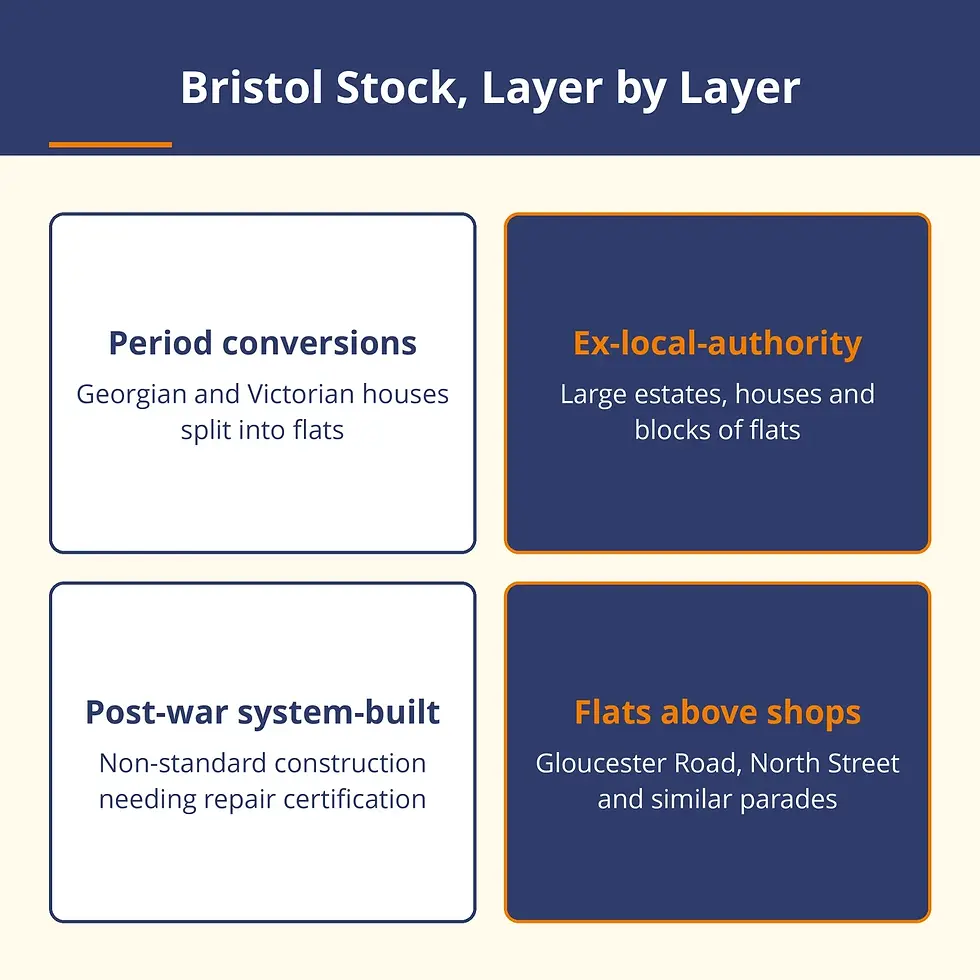
Bristol's stock spans Georgian and Victorian conversions, flats above busy shopping streets, large ex-local-authority estates and post-war system-built homes. Each of those carries its own lender criteria, and two borrowers with identical finances can face very different lender lists. The variables that matter most are construction type, lease length, block height and what the external wall paperwork says. None of that appears on an affordability calculator.
The practical response is to establish the property facts before an application, not after a valuation goes wrong. That means the construction system and any repair certification, the exact years left on the lease, the service charge and major works position, and the EWS1 or equivalent for multi-storey blocks. A specialist lender in Bristol may consider evidence that an automated high street process rejects. Manor Mortgages Direct advises on this from Portishead, with fees of £99 research, £99 on application and a completion fee that varies with complexity.
Reviewed by Ben Stephenson, FCA-authorised mortgage adviser (FRN 496907) · 25+ years' experience · 4.9★ on Google. Updated: 1 September 2026.
Who Is This Guide For
Best for buyers, home movers and remortgagers across Bristol and North Somerset who are looking at conversion flats, ex-local-authority property, system-built or steel-framed houses, flats above commercial units, short leases, or blocks where cladding and external wall assessments are still unresolved.
Key Points
Construction type often matters more than your income
Leases under 80 years can narrow lender choice sharply
EWS1 assessments typically last five years per block
Table of Contents

The Building Decides More Than You Think
Most people preparing to buy in Bristol spend their energy on the borrower side of the equation. They tidy the bank statements, close the unused credit card and check the deposit has cleared. Then the valuation lands, and the problem turns out to be the house.
Lending decisions rest on two questions running in parallel. Can you afford the loan, and is the property acceptable security for it. The second question is where Bristol trips people up, because the city's housing stock is far more varied than the national average.
A three-storey Victorian conversion in Montpelier, a maisonette over a bakery on Gloucester Road, a former council flat in Southmead and a 1950s steel-framed semi on the city fringe are four completely different lending propositions. The borrower could be identical in each case. The list of lenders able to consider the application may not be.
That is the whole subject of this article. Not your income, not your credit file, but the bricks, panels, leases and neighbours that decide which part of the market can lend. Our Bristol mortgage page has the wider picture on lending across the city and North Somerset.

A City Built in Layers: Bristol's Stock Area by Area
Bristol grew in bursts, and each burst left a different construction problem behind. The Georgian and early Victorian terraces of Clifton, Kingsdown and Cotham carry listed status, party wall complexity and, in many cases, subdivision into flats over the past sixty years. Those conversions are often perfectly lendable, but the lease, the freehold arrangement and the share of the building each flat owns can vary wildly between two doors on the same street.
Move east and south and the picture changes. Montpelier, St Andrews, Totterdown and Bedminster are dominated by late Victorian and Edwardian terraces, many converted into two or three flats, frequently without a formal management company. Bristol also has a long tradition of self-managed conversions where the leaseholders jointly own the freehold, which some lenders treat comfortably and others question.
Then there are the post-war estates. Southmead, Hartcliffe, Knowle West and Lawrence Weston contain large volumes of former council housing, some traditionally built and some system-built using the concrete and steel methods of the late 1940s and 1950s. Alongside them sit the mid-century blocks and the newer city centre and harbourside developments where cladding questions have been live since 2017.
North Somerset adds another layer again. Portishead, Clevedon and Nailsea mix older cottages, some with cob or stone construction inland, with two decades of new-build marina and estate housing. According to Office for National Statistics figures drawn from Land Registry data, the average Bristol property was around £357,000 in June 2026, with flats averaging roughly £246,000 and terraced homes around £388,000, a gap that reflects exactly this mix of stock.
Construction Type and When a Bristol Mortgage Needs the Specialist Tier
Lenders describe a property as standard construction when it has brick or stone walls with a tiled or slate pitched roof. Almost everything else falls into a broad category called non-standard, and the label covers a very wide spread of risk. Timber frame from a reputable modern system is not the same proposition as a 1948 precast concrete house, yet both may sit outside a high street lender's default criteria.
Building Research Establishment work on non-traditional housing sets out the scale of what was built. Cast in-situ concrete accounts for roughly 300,000 dwellings, with one no-fines system alone responsible for around 300,000 units. Precast reinforced concrete systems include roughly 30,000 Cornish units, 26,000 Airey homes and 22,000 Wates dwellings. Steel frame systems include around 35,000 homes built to the British Iron and Steel Federation design.
The important distinction is between non-standard and designated defective. Part XVI of the Housing Act 1985 lets the Secretary of State designate classes of dwelling as defective where a design or construction fault has become generally known and has substantially reduced values. Several precast reinforced concrete systems were designated on those grounds, largely because of carbonation and chloride problems in the concrete. The Building Research Establishment material indicates that no steel or timber systems were designated under that legislation.
That matters at the mortgage desk. A designated property that has been repaired to an approved scheme, with the paperwork to prove it, can often be financed, while an unrepaired one may only attract cash buyers. Our page on mortgages for non-standard construction sets out the usual evidence trail, and there is a separate guide covering steel-framed BISF properties specifically.
Where a high street lender declines on construction alone, manual-underwriting building societies and the specialist tier often take a different view. They tend to ask for more: a full building survey rather than a valuation, sometimes a structural engineer's report, and evidence of any repair scheme certification. A lower maximum loan to value is common, and the survey tends to carry real weight.
Property feature | What a lender typically examines |
Precast reinforced concrete | Whether the type is designated defective and repaired to an approved scheme |
Steel frame from the 1940s and 1950s | Frame condition, cladding, any structural report and remaining life |
Timber frame | Age, system used, external skin and any damp or movement history |
Cob, stone or rubble walls | Thickness, damp, previous repairs and insurability |
Flat or felt roof over a large area | Proportion of total roof area and remaining life |
Leasehold, Short Leases and the Reform Timetable
Bristol's conversion flats are overwhelmingly leasehold, and lease length quietly governs lender appetite. Many lenders work to a rule of thumb that the lease should have a set number of years remaining at the end of the mortgage term, often somewhere between 30 and 70 years depending on the lender. That means a 95-year lease can be comfortable on a 25-year term and awkward on a 40-year one.
The pressure point is 80 years. Below that threshold, lease extension has historically become more expensive because of marriage value, and lender lists start to thin. Under roughly 70 years the mainstream options narrow further, and under 60 years many buyers find themselves looking at bridging, cash or a small number of specialist arrangements. We cover the practical options in our guide to mortgages on a property with a short lease under 60 years.
Reform is coming, but slowly, and it is important not to plan around provisions that are not yet live. The Leasehold and Freehold Reform Act 2024 received Royal Assent in May 2024. The commencement regulations that took effect on 31 January 2025 removed the two-year ownership qualifying period, so a leaseholder can now start a statutory lease extension or freehold purchase claim without having owned the flat for two years first.
The headline items are still pending. The move to 990-year extensions and the abolition of marriage value in the statutory valuation have not been brought into force at the time of writing, and the government has been consulting on the deferment and capitalisation rates that underpin any new calculation. Anyone buying a short-lease flat in Clifton or Cotham should treat those changes as unconfirmed and price the extension on today's rules, taking specialist legal advice on the figures.
Freehold houses have their own quirks in Bristol. Rentcharges attached to older terraces, shared drives without formal rights of way, and flying freeholds in stepped Totterdown streets can all generate lender queries even where the construction is entirely ordinary.
Flats Above Shops on Gloucester Road and North Street
Gloucester Road, North Street and Church Road are three of the most characterful high streets in the country, and they are lined with flats sitting directly above commercial units. These properties are usually cheaper per square foot than an equivalent flat on a residential street, which is precisely why first-time buyers gravitate towards them.
Lender caution here is about resale and nuisance rather than structure. The concerns tend to be smell, noise, fire risk from cooking, hours of operation, and how easily the flat could be sold again if the commercial tenant changed. A flat above a quiet accountancy office is a different proposition from a flat above a late-night takeaway sharing a party wall with the extraction system.
Several factors tend to soften the position. A separate street entrance to the residential part carries real weight, as does a lease that clearly separates the residential and commercial demises. Lenders often look more comfortably at a single unit above a single shop than at a flat within a large mixed-use block, and many decline properties above premises serving hot food altogether.
The number of flats above the commercial unit also matters. Blocks of one to four flats above a parade of shops are frequently acceptable to the specialist tier, while larger mixed schemes with retail podiums may need a lender comfortable with that specific configuration. Our page on getting a mortgage for a flat above a shop goes through the criteria in more detail.
Practical point for buyers on these roads. Find out the exact use class and trading hours of the ground floor unit before you offer, because that single fact often determines whether a case is straightforward or needs a lender approached specifically for it.
Ex-Local-Authority Flats and Houses in Bristol
Right to Buy has put a large amount of former council housing into private hands across Southmead, Hartcliffe, Knowle West, Lawrence Weston and dozens of smaller estates. Ex-local-authority houses are usually the easier case. If the construction is traditional brick and the property is a house rather than a flat, many high street lenders treat it much like any other home.
Flats are where the criteria bite. Common conditions include a maximum block height, often somewhere around four to six storeys before the case narrows, a requirement that a meaningful proportion of the block is already privately owned, and reluctance around deck access or balcony access blocks where front doors open onto an external walkway. Some lenders set a minimum percentage of private ownership in the block; others assess it case by case through the valuer.
Other recurring points include whether the block has a lift, whether it is served by a single staircase, the condition of communal areas, and any large planned works billed to leaseholders through the service charge. A significant pending major works bill can affect both the valuation and the affordability assessment.
There is also the pre-emption issue. Right to Buy leases and transfers often contain clauses requiring repayment of discount on early resale, or giving the former landlord first refusal for a period. These are usually handled by the conveyancer, but they can delay an offer if they surface late. Our guide on whether lenders offer mortgages on ex-local-authority properties sets out what tends to be acceptable.
None of this makes an ex-council flat a bad buy. Many are generously proportioned, well built and considerably better value than a comparable private block. The point is simply that the lender list is shorter, and finding out which lenders fit before you commit saves a great deal of wasted time and money.
Cladding, EWS1 and Multi-Storey Blocks
Bristol's harbourside, city centre and university-adjacent developments include a number of blocks caught up in external wall system questions since 2017. If you are buying a flat in a multi-storey block with any form of cladding, rendered panel system or extensive balcony arrangement, this is the first thing to check.
The EWS1 form is a valuation and lending document, not a fire safety certificate. RICS is clear that it does not replace a fire risk assessment. It applies to the whole block rather than an individual flat, it is signed by a suitably qualified professional, and it is generally treated as valid for five years unless works change the conclusions.
RICS has published an updated standard for secured lending valuation in multi-storey, multi-occupancy residential buildings with cladding, which takes effect on 1 November 2026. It sets out proportionate criteria based on building height, distinguishing buildings over six storeys, buildings of five or six storeys, and buildings of four storeys or fewer, with thresholds around visible cladding, curtain wall glazing and certain balcony arrangements. The updated standard also allows an executive summary of a Fire Risk Appraisal of External Walls to stand in for an EWS1 in some situations.
Alongside that sits the Building Safety Act 2022 regime, with its 11 metre and 18 metre thresholds and its leaseholder protections against certain remediation costs. Buyers should ask the managing agent three things early: whether an EWS1 or equivalent exists, what it says, and whether the building is enrolled in any remediation scheme. A block awaiting assessment can be difficult to finance regardless of how strong the borrower is.
Common Myths About Bristol's Awkward Stock
The first myth is that non-standard construction means unmortgageable. It does not. It means fewer lenders, more evidence and often a lower maximum loan to value, which is a different problem with a different solution.
The second is that a valuation decline is the end of the road. A valuation is one lender's view through one surveyor on one day. Another lender using a different panel and different criteria may reach a different conclusion, although repeated applications carry cost and should not be made casually.
The third is that a short lease can be dealt with after completion. In practice, lease extension is far easier to price and negotiate before exchange, often with the seller serving notice and assigning the benefit to the buyer.
The fourth is that ex-council automatically means no. Ex-local-authority houses of traditional construction are frequently mainstream cases, and it is the flats, the block height and the deck access that create the narrowing.
The fifth is that a specialist lender is simply an expensive last resort. The specialist tier exists because manual underwriting can consider evidence that an automated system rejects, and the trade-off between rate and acceptance is a decision to make deliberately rather than by accident.
Here is an illustrative composite drawn from the kinds of cases we see, with figures rounded and anonymised. A couple with a combined income of around £74,000 agreed a purchase at £268,000 on a 1950s steel-framed semi near Lawrence Weston, with a £47,000 deposit at roughly 82% loan to value. The first lender's valuer flagged the construction type and the case stalled, so the file moved to a manual-underwriting building society that accepted a structural engineer's report confirming the frame condition.
That society lent at the same 82% loan to value, assessing affordability on a stress rate set several percentage points above the initial pay rate rather than on the pay rate itself. These figures are illustrative only and are not a quotation or a promise of any particular outcome.
What to Pin Down Before the Valuer Calls
Almost every awkward property case improves when the evidence arrives early. The estate agent, the seller and the managing agent between them usually hold everything a lender needs, but nobody asks until the valuation has already gone wrong.
Start with the construction. If the property is anything other than brick or stone with a pitched tiled roof, find out what system it is and whether it has been repaired or reinforced. For designated types, the repair scheme certification is the single most valuable document in the file.
Then the tenure. Get the exact number of years left on the lease, the ground rent and its review pattern, the service charge history and any planned major works. For a flat in a block over four storeys, ask about the external wall assessment at the same time.
Being local helps here. Manor Mortgages Direct has been advising from Portishead for around 25 years, and we see the same estates, the same conversion patterns and the same block-level issues repeatedly across Bristol and North Somerset. Face-to-face appointments are available locally if you would rather go through the paperwork in person. Our fees are £99 for research, £99 payable on application and a completion fee that varies with the complexity of the case, so the service is not free, and we set the costs out in writing before you commit to anything.
The practical aim is simple. Establish what the building is, what the tenure says and what the block's paperwork shows, then match those facts to lenders whose criteria already accommodate them rather than testing them one application at a time.
Document to gather | Why a lender may want it |
Construction details or system name | Establishes whether standard, non-standard or designated defective |
Repair scheme certificate | Evidences an approved repair on a designated property |
Lease with years remaining | Determines whether the term fits lender minimums |
Service charge and major works statements | Affects affordability and the valuer's view of the block |
EWS1 or FRAEW summary | Addresses external wall risk for multi-storey blocks |
Ground floor use class and hours | Clarifies risk for a flat above commercial premises |
FAQs
Is a non-standard construction house in Bristol harder to mortgage than a Victorian terrace?
Often, yes, but harder is not the same as impossible. A brick Victorian terrace fits almost every lender's default criteria, while a precast concrete or steel-framed home may need a lender that underwrites manually. Expect a shorter lender list, more survey evidence and sometimes a lower maximum loan to value.
What lease length do lenders usually want on a Bristol conversion flat?
Most lenders set a minimum number of years remaining at the end of the mortgage term, commonly somewhere between 30 and 70 years depending on the lender. In practice, leases above 90 years are usually straightforward, those between 70 and 85 years start to attract questions, and those under 60 years typically need specialist handling or an extension arranged before completion.
Has the Leasehold and Freehold Reform Act 2024 fixed short leases yet?
Only partly. The commencement regulations effective 31 January 2025 removed the two-year ownership qualifying period for statutory lease extension and freehold purchase claims. The 990-year extension term and the abolition of marriage value in the valuation had not been brought into force at the time of writing, and consultation on the underlying rates was still running, so treat those as unconfirmed.
Can I get a mortgage on a flat above a shop on Gloucester Road?
It can often be arranged, and the detail decides it. Lenders tend to look at the use class of the ground floor unit, its trading hours, whether the flat has its own separate street entrance, and how many flats sit above the commercial space. Properties above premises serving hot food are the most restricted category.
Do lenders treat ex-local-authority houses differently from ex-council flats?
Generally yes. A traditionally built former council house is frequently a mainstream case, while flats face additional conditions around block height, deck or balcony access, lift and staircase arrangements, and the proportion of the block already in private ownership. Pending major works billed through the service charge can also affect both valuation and affordability.
What should I ask about cladding before buying a flat in a Bristol block?
Ask the managing agent whether an EWS1 form or a Fire Risk Appraisal of External Walls summary exists, what rating it gives, and whether the building is in any remediation programme. An EWS1 covers the whole block, is signed by a suitably qualified professional and is generally treated as valid for five years. RICS is clear it is a valuation and lending document, not a fire safety certificate.
Summary
Bristol's mixed stock means the property, not just the borrower, decides lender choice. Construction type, lease length, block height, deck access, ground floor use class and external wall paperwork each narrow or widen the list. Gathering that evidence before an application, rather than after a valuation, tends to save time and cost. Where high street criteria do not fit, manual-underwriting building societies and the specialist tier may still consider the case.
Reviewed by Ben Stephenson, FCA-authorised mortgage adviser, CeMAP-qualified.
Manor Mortgages Direct is FCA authorised, FRN 496907, has traded for 25 years, is highly positively reviewed, 4.9 rated on Google, and has helped thousands secure the right mortgage. Bristol-based mortgage brokers, assisting clients nationwide.
Sources
Housing Act 1985, Part XVI (defective dwellings, designation, reinstatement grant and repurchase): https://www.legislation.gov.uk/ukpga/1985/68/part/XVI
Building Research Establishment, Non-traditional housing in the UK (system types and build volumes; no steel or timber systems designated defective): https://www.collier-stevens.co.uk/wordpress/wp-content/uploads/2019/01/pdf_pub_misc_NontradhousingBR.pdf.pdf
RICS, Secured lending valuation of properties in multi-storey, multi-occupancy residential buildings with cladding, 2nd edition, effective 1 November 2026: https://www.rics.org/profession-standards/rics-standards-and-guidance/sector-standards/valuation-standards/valuation-of-properties-in-multi-storey-multi-occupancy-residential-buildings-with-cladding
RICS, Cladding External Wall System (EWS) FAQs (five-year validity, per block, signatory requirements): https://www.rics.org/news-insights/current-topics-campaigns/fire-safety/cladding-external-wall-system-ews-faqs
Leasehold and Freehold Reform Act 2024: https://www.legislation.gov.uk/ukpga/2024/22/contents
Leasehold and Freehold Reform Act 2024 (Commencement No. 2 and Transitional Provision) Regulations 2025, in force 31 January 2025, removing the two-year ownership requirement
Leasehold Advisory Service, Leasehold and Freehold Reform Act 2024 (status of 990-year extensions and marriage value): https://www.lease-advice.org/article/leasehold-and-freehold-reform-act-2024/
Office for National Statistics housing prices, Bristol, City of (average £357,000, June 2026 provisional): https://www.ons.gov.uk/visualisations/housingpriceslocal/E06000023/
House of Commons Library, The Cladding External Wall System (EWS): https://commonslibrary.parliament.uk/research-briefings/cbp-10763/
Related Guides