
Can You Get a Buy-to-Let Mortgage With Bad Credit in 2026?
Yes, you can usually get a buy-to-let mortgage with bad credit. A buy-to-let is judged largely on the rent, not just on you, so a strong rental income can outweigh a credit blemish that would worry a residential lender.
Quick Answer
Yes, in most cases. Buy-to-let lending is assessed differently from a residential mortgage: the main test is whether the rent covers the mortgage with a healthy margin, and your personal credit, while still relevant, carries less weight. A specialist buy-to-let lender reached through a broker looks at the rental cover, the deposit and the type, age and size of your credit issue. A historic, satisfied default barely registers; a recent CCJ or several recent problems narrow the field to specialist lenders and usually mean a larger deposit and a higher rate, but a deal is very often still there. The result is that a credit issue which feels fatal for a home loan is often just a detail on a buy-to-let. Crucially, none of this depends on your credit score being good, only on the rent stacking up and the issue being something a specialist can work with.
Reviewed by Ben Stephenson, FCA authorised (FRN 496907) · 25+ years' experience · 4.9★ on Google. Updated: 20 June 2026.
Who This Guide Is For
Best for would-be and existing landlords who have a default, CCJ, missed payments or a low credit score and assume it rules out a buy-to-let. It suits both first-time landlords buying an investment property and portfolio landlords adding to their holdings. It is not aimed at anyone in current, active financial difficulty, where the priority is stabilising things first, but for most historic or modest credit issues a buy-to-let is very achievable. If you have been turned down by a high-street buy-to-let lender, that decline rarely reflects the whole market, only that one lender's automated rules. Whether you are buying your first rental or your fifth, the same logic applies: the property carries the case, whether your credit issue is a single default or something more involved.
Key Points
The rent does most of the work: rental cover is the main test, not your credit score
Type, age and size of the issue matter more than the fact you have adverse credit
Expect a bigger deposit and a higher rate with heavier adverse, but the deal is usually still there
Table of Contents

Buy-to-let has two tests, and rent does most of the work
The single most useful thing to understand about buy-to-let is that it is judged on two separate things, and they are not weighted equally. The first and main test is the rent: the lender works out whether the expected rental income covers the mortgage payment with a comfortable margin. The second test is you, your credit history, deposit and experience as a landlord. On a residential mortgage your income and credit are everything; on a buy-to-let, the property's earning power carries most of the load. The rental stress test, where lenders check the rent covers the mortgage at a higher notional rate, is the real gatekeeper, and it pays no attention to your credit score at all. Picture two landlords with the same modest default: on a residential mortgage they would both struggle, but on a buy-to-let the one with the stronger-renting property sails through while the credit issue fades into the background.
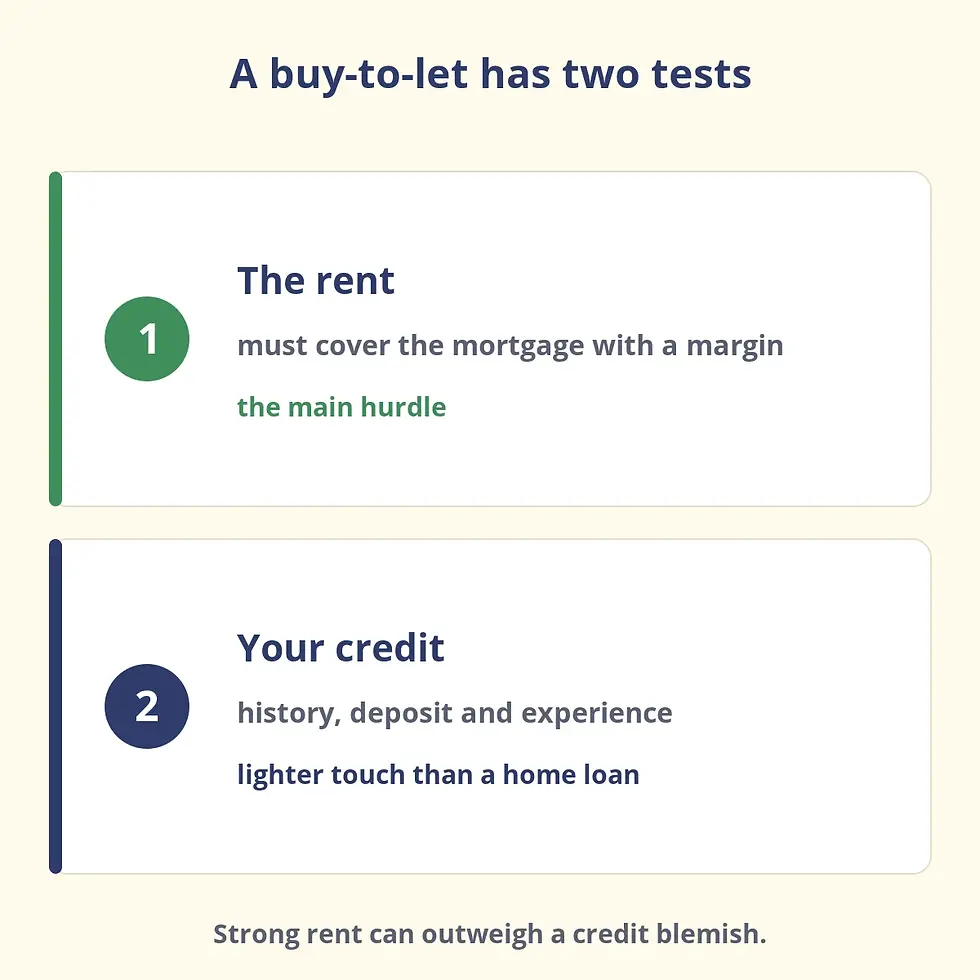
This is why bad credit is far less of a barrier on a buy-to-let than people expect. A default or a CCJ that might give a residential underwriter pause matters less when the case really turns on whether the rent stacks up. It does not make your credit irrelevant, but it does mean a strong rental income can carry a case that your personal file alone would not. For many landlords, that single difference is what turns a flat no into a workable yes. It also means two buy-to-let cases with identical credit can get very different answers purely because one property rents better than the other, which is not how residential lending works at all. For landlords who have been knocked back once and concluded the door is shut, that reframing alone often changes everything.
How bad credit actually affects a buy-to-let
Where adverse credit does bite is on two things: the deposit and the rate. A clean-credit landlord can often buy with a 20 to 25% deposit at the sharpest rates. Add a recent default or CCJ and the lender list narrows to specialists, who typically want a larger deposit, often 25 to 35%, and charge a somewhat higher rate to reflect the extra risk. A broker who places bad credit mortgages will know which lenders price adverse credit most keenly, which is where the real saving is. The gap between a high-street decline and a well-placed specialist deal is often a few hundred pounds a year, not the wall of refusals people fear. A bigger deposit is the simplest lever you have, because it directly lowers the lender's risk and often unlocks both more lenders and a better rate, and on a typical case lifting it from 25 to 30% can be the difference between a handful of lenders and a genuinely competitive panel.
The nature of the credit issue still drives everything. As with any adverse case, type, age and whether the issue is satisfied matter most. A small, historic, satisfied default is treated very gently; a recent CCJ, missed payments across several accounts, or anything still outstanding pushes you toward the more specialist end. The encouraging part is that buy-to-let specialists are used to exactly this, so even a fairly recent issue rarely closes the door, it just shapes the deposit and rate. Lenders in this space have seen every kind of credit history and price accordingly, rather than simply saying no, which is the key difference from the high street. It is a market built around real-world credit histories, not perfect ones.
Timing helps too. Adverse credit ages off over six years, and lenders treat an issue that is two or three years old far more kindly than one from the last few months. If a purchase is not urgent, letting a recent default or CCJ age, and keeping everything clean in the meantime, can widen your options and improve the rate, though for many landlords the numbers still work today. Even a year of clean conduct after a blip can noticeably soften how a lender views the application, so it is always worth running both scenarios, applying now versus waiting, so the decision is based on real figures rather than a vague sense that you should hold off.
What a lender checks: rental cover and your credit
When a buy-to-let case lands on an underwriter's desk, they run through a fairly predictable checklist. The table sets out what they look at and what helps on a bad-credit case. None of these are promises, and every lender sets its own thresholds, but the shape is consistent across the market. Understanding the checklist in advance lets you prepare the case properly, which is half the battle on an adverse application, and each item is something you can influence, from the deposit you put down to how you evidence the rent and your experience.
What the lender checks | What helps on a bad-credit buy-to-let |
Rental cover (the stress test) | Rent comfortably above the mortgage, often 125 to 145% at a stressed rate |
Deposit | Usually 25% or more, and heavier adverse often means a bigger one |
The credit issue itself | Type, age and whether it is satisfied; a historic satisfied default is far easier than a recent CCJ |
Your wider profile | Existing portfolio, rental experience and income all reassure a lender |
The takeaway is that a bad-credit buy-to-let is rarely won or lost on the credit issue alone. A property with strong rental cover and a sensible deposit gives a specialist lender plenty to say yes to, even with a default or CCJ on file. The job is to match the case to a lender whose criteria fit your particular issue, rather than letting a high-street computer decline it on sight. A broker does this matching for a living, and on a bad-credit buy-to-let it is the single biggest factor in getting a yes at a sensible rate. The same property and the same credit issue can produce a clean approval at one lender and an instant decline at another, purely down to whose rules you happen to meet, so going direct to the wrong lender simply burns a credit search and dents your file.
Case study: a landlord with a recent default
The following is an illustrative example, not a quote or a guaranteed outcome. A landlord wanted to add a second rental property but had a default of around 900 pounds registered fourteen months earlier, after a dispute with a former business supplier. A high-street buy-to-let lender had declined him, and he assumed his landlord days were over. He had assumed, as many do, that one high-street no meant the whole market had closed to him. The property itself was sound, in a strong rental area, with a tenant ready to move in.
In reality the case was very placeable. The new property had strong rental cover, he had a 30% deposit ready, and he already ran one tenancy successfully. We satisfied ourselves the default was a one-off, then placed the case with a specialist buy-to-let lender comfortable with a recent default at that level. It completed at a rate only modestly above the cleanest deals, with the rental income doing exactly the heavy lifting the model is built around. Had he carried several recent CCJs rather than one isolated default, the deposit and rate would have been steeper, but the principle holds: strong rent plus a sensible deposit reassures a lender far more than a clean file alone. The wider lesson is that a single recent issue, properly explained and paired with a strong property, is a very different proposition from a pattern of ongoing problems, and we see this pattern most weeks, with the outcome far more often a yes than landlords expect when they first call.
Lender appetite by landlord profile
It helps to picture where you sit on the spectrum of landlord profiles, because that, more than anything, decides how many lenders will look at you. The graphic shows roughly how appetite changes as the credit picture gets heavier. Knowing your tier is genuinely useful, because it sets realistic expectations on deposit and rate before you ever speak to a lender, and helps you judge whether to act now or take a few months to strengthen your position first.

A clean-credit or near-prime landlord has the run of the market. Old, satisfied issues barely dent that, with a wide choice still available. A recent default or CCJ moves you into specialist territory, where fewer but still plenty of lenders compete, usually for a bigger deposit. Several recent problems together narrow things to a handful of niche specialists, but even then a viable deal often exists, especially where the rental cover is strong. The practical point is that almost every profile has a home; the profile simply sets the deposit, the rate and how hard the case is to place. Very few landlord profiles are genuinely unplaceable; what changes is the size of the deposit and the keenness of the rate, not whether a door exists at all. That is the most reassuring thing we can tell a worried landlord: the question is almost never whether you can borrow, but on what terms. Getting those terms right is exactly where a specialist broker earns their keep.
Because buy-to-let lending is its own world, it is worth working with someone who knows both the adverse-credit and the landlord side. Our wider buy-to-let mortgage work covers portfolios, limited-company structures and more, and the same specialists handle bad-credit cases day in, day out.
FAQs
Can I get a buy-to-let mortgage with a default or CCJ?
Usually yes. Buy-to-let turns mainly on rental cover, so a default or CCJ matters less than on a residential mortgage. A specialist lender reached through a broker weighs the type, age and size of the issue. A historic, satisfied default is treated gently; a recent CCJ narrows the lender list and usually means a larger deposit and a higher rate, but a deal is very often still available.
How big a deposit do I need for a bad-credit buy-to-let?
Typically 25% or more, and heavier or more recent adverse credit often pushes that toward 30 to 35%. The bigger deposit lowers the lender's risk and widens your choice. With a strong deposit and good rental cover, even a recent default or CCJ is usually placeable with a specialist.
Will bad credit mean a higher buy-to-let rate?
Often, yes, but not dramatically if the issue is historic or satisfied. A recent CCJ or several missed payments will sit on a specialist rate above the cleanest deals, while an old, satisfied default may cost very little extra. A broker who knows the adverse buy-to-let market will find the keenest rate for your profile.
Does my personal income matter for a buy-to-let with bad credit?
It matters less than the rent, but it still helps. Most lenders want to see some personal income, and a few set a minimum, but the rental cover is the main test. A solid income and landlord experience reassure a lender and can offset a credit blemish.
Can a limited company buy-to-let help if I have bad credit?
Sometimes. Lending through a limited company does not erase your personal credit, since directors are still checked, but some landlords find the structure and lender choice helpful. It is one option among several; the right route depends on your wider tax and portfolio position, which is worth discussing case by case.
Summary
You can usually get a buy-to-let mortgage with bad credit, because the rent does most of the work. Rental cover is the main test, and your personal credit, while still relevant, carries less weight than it would on a home loan. A default or CCJ tends to mean a larger deposit and a somewhat higher rate rather than a flat no, and the right specialist, matched to your profile by a broker, is where the workable deal is found.
Updated: 20 June 2026
Written by Ben Stephenson, CeMAP-qualified Mortgage Broker.
Manor Mortgages Direct is FCA authorised, FRN 496907, has traded for 25 years, is highly positively reviewed, 4.9 rated on Google, and has helped thousands secure the right mortgage. Bristol-based mortgage brokers, assisting clients nationwide.
Sources
MoneyHelper, Buy-to-let mortgages explained, https://www.moneyhelper.org.uk/en/homes/buying-a-home/buy-to-let-mortgages, accessed 20 June 2026
GOV.UK, Check your credit rating, https://www.gov.uk/check-your-credit-rating, accessed 20 June 2026
Hero photo: Block of Residential Flats, England, by John P Reeves, via Geograph / Wikimedia Commons, licensed CC BY-SA 2.0
Related Guides