
Does a CCJ Over Four Years Old Still Affect a Mortgage Application?
Find out why a four-year-old judgment is often not the real obstacle, and see what on your rebuilt file is.
Quick Answer
Yes, it can. A CCJ over four years old sits inside the six year window that many lenders count, so it remains on your credit file and inside published criteria. By this stage, though, the sparse credit file the judgment left behind is often the bigger obstacle.
The judgment itself becomes a placement question. At four years the same CCJ can be outside one lender's counting window, tolerable at a second if it is small and satisfied, and outside policy at a third. Nothing about the judgment changed. The lender did.
The file around it is a separate problem with a separate fix. Years of avoiding credit after a judgment leave a scorecard with almost nothing positive to weigh. Rebuilding that evidence takes months rather than weeks, which is why it pays to start before you apply.

Reviewed by Ben Stephenson, FCA authorised (FRN 496907) · 25+ years' experience · 4.9★ on Google. Updated: 31 July 2026.
Who Is This Guide For
Best for remortgagors approaching the end of a fixed rate, home movers with a judgment from their early twenties, and first-time buyers who stopped using credit entirely after a CCJ, and who have all waited patiently and are still being declined without a clear explanation.
Key Points
A CCJ stays visible for six years from judgment date
Paying after one month endorses it, never cancels it
Thin files give scorecards no evidence of recovery
Table of Contents
What Actually Changes at Six Years, and What Quietly Does Not
Why One Lender Ignores a Four-Year-Old CCJ and Another Refuses It
Rebuilt but Thin: Why Four Clean Years Since the Judgment Can Read Worse Than Adverse
What Genuinely Rebuilds a File After a Judgment, and What Does Not
The CCJ You Never Satisfied, Still Outstanding at Four Years
Record Numbers on the Register: Where a Four-Year-Old Judgment Sits Now
Four Years On From the Judgment and Still Being Declined
You waited. You paid what was owed, or the matter resolved itself, and you have kept things tidy since.
Then an application comes back declined and nobody gives you a straight answer as to why. The instinct is to blame the judgment.
Four years in, that is often only half the story. The CCJ is still on your file, because the rules keep it there for six years from the date of the judgment. What varies enormously by this stage is how much weight any given lender puts on it.
Something else has been happening quietly. The accounts behind the judgment closed, and you stopped applying for credit because being declined is unpleasant. That decision, which felt responsible at the time, can leave a file an automated scorecard struggles to read.
So there are two problems stacked on top of each other. One is a placement problem, solved by applying to the right lender. The other is a rebuilding problem, solved only by time and specific actions. Treating them as one thing is why so many people at the four-year mark feel stuck.
This post deals with judgments only. If your adverse credit is a default rather than a CCJ, our guide to older defaults covers that ground properly.
What Actually Changes at Six Years, and What Quietly Does Not
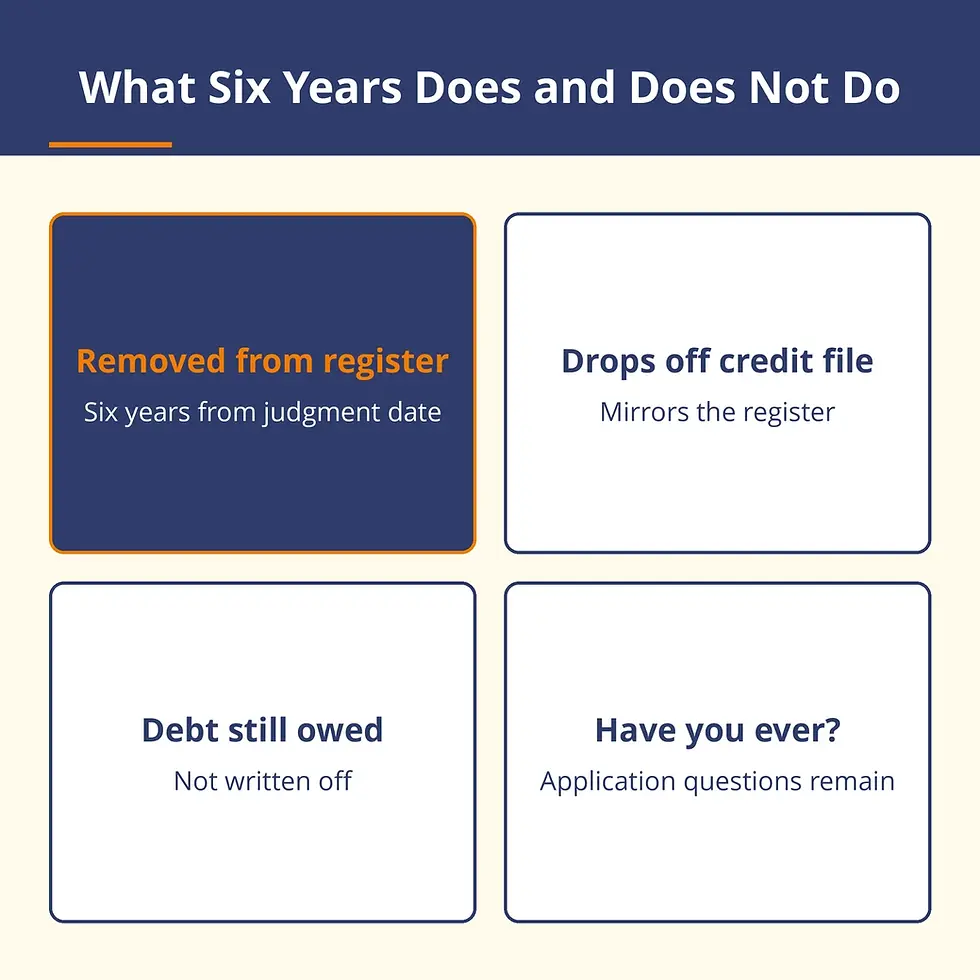
The most repeated line about judgments is that they disappear after six years. It is close enough to be useful, and wrong in three ways that matter to a mortgage application.
Start with what is true. Under the 2005 Regulations governing the Register, the removal clock is tied to the day judgment was entered and nothing restarts it. That is statute rather than lender policy, and nobody has to apply for it. Registry Trust (2026) maintains the Register and passes validated data to the credit reference agencies.
The first error is the word "disappears". Experian (2026) publishes a retention table stating that judgment data is held for eleven years in total: six years for live decision-making, plus a further five years for profiling and statistical analysis. The record leaves live lending decisions at six years, so a lender running a credit search does not see it, but it has not been erased from existence.
The second error is more damaging. A judgment debt does not become statute-barred, and National Debtline (2026) states that once a creditor holds a county court judgment, the Limitation Act puts no time limit on enforcing it. What changes at six years is procedure: under the Civil Procedure Rules, a writ or warrant cannot be issued without the court's permission once six years have passed.
The third error is the one nobody writes about. The question outlives the record. Some lenders' application forms ask whether you have ever had a county court judgment registered against you, with no time limit attached, alongside a declaration that the form contains all material facts.
A fourth point catches people out constantly. The six years runs from the date of the judgment, not the date you paid, and Registry Trust (2026) is explicit on that. Paying at year four neither restarts nor shortens the clock.
What people are usually told | What actually happens at six years |
The CCJ disappears | The Register entry is removed by law six years from the judgment date, and credit files stop showing it for lending decisions |
The record is deleted everywhere | One credit reference agency states it retains judgment data for eleven years in total, six for live decisions and five more for profiling and statistics |
The debt is written off | A judgment debt does not become statute-barred, so the balance remains owed |
Creditors can no longer act | Enforcement after six years needs the court's permission, which is a hurdle rather than a bar |
The clock runs from when you paid | The clock runs from the date of the judgment, whatever date the money changed hands |
Lenders can no longer ask | Some application forms ask whether you have ever had a judgment, with no time limit attached |
Why One Lender Ignores a Four-Year-Old CCJ and Another Refuses It
We checked four current published criteria sets at the time of writing. Against a satisfied CCJ registered four years ago, they landed in three different places. One counts any judgment registered in the last six years and treats yours as outside policy.
A second allows a single satisfied judgment inside six years provided the value is no more than £500, so yours passes or fails on amount alone. A third counts only the last three years, which puts a four-year-old judgment outside the window entirely.
Read that again. The same judgment, the same borrower, the same day: one no, one maybe depending on the amount, one not counted. Your credit history did not change between those three decisions.
That is a placement problem rather than a credit problem. It is also why a scattergun approach is expensive. Each formal application leaves a footprint, and a run of declines makes the next lender's scorecard read your file as someone shopping in distress.
One wrinkle is worth knowing. Criteria differ on whether the clock runs from the date the judgment was registered or the date it was satisfied, and no lender source we found spells out the intended reading where the wording is ambiguous. If you are weighing up whether to settle an unpaid judgment, take advice on sequencing first.
None of this argues for giving up on the mainstream, and plenty of people with a four-year-old judgment are placeable at ordinary pricing.
Where the high street does not work, the specialist tier often does, and specialist pricing typically sits above high street pricing. That premium is a real cost, and sometimes waiting a further year is the better financial answer. Sometimes it is not, and a fair comparison beats a guess.
The Question That Never Ages Out: Have You Ever Had a CCJ?
People mean two quite different things when they say a lender can still see an old judgment.
The first is real and common at four years. A judgment can sit outside a lender's published counting window and still be on your credit file in plain sight. If a lender counts three years and yours is four years old, it does not breach the written criteria, but the underwriter reading the file can see it, along with the closed accounts around it.
Published criteria set the pass mark. They do not blindfold the person reading.
That is often the mechanism that gets a marginal case over the line. Some lenders publish that their underwriters have discretion to request more information, and at least one advertises a route for cases outside written policy, decided by a human rather than a score. A short, factual explanation of what happened and what has changed is worth preparing before you apply.
The second situation is the post-six-year one, where the file genuinely is clean. The judgment has gone from the Register and from live decisioning, but the application form has not gone anywhere. Answer the "have you ever" question honestly.
We found no evidence that a disclosed, off-file judgment causes a decline on its own. Non-disclosure on a binding declaration is a materially worse problem than an old CCJ.
It is also worth understanding why your decline may have arrived with no explanation. One lender's declaration states that the credit score is determined by automated means, that the application may be rejected if the score falls short, and that the applicant may request a review of that automated decision.
The scorecard reads the file, not the story. If a machine declined you, asking for a person to review it is a legitimate step rather than a favour.
Rebuilt but Thin: Why Four Clean Years Since the Judgment Can Read Worse Than Adverse
This is the section most people need and almost nobody writes, so we are going to state it without softening.
After a CCJ, the sensible-sounding advice is to stop borrowing: cut up the cards, go cash-only, prove you do not need credit. Four years later you arrive with a clean conscience and a file holding one ageing judgment, a cluster of dead accounts, a two or three year hole, and a thin recent layer.
Now think about what a scorecard does. It predicts future behaviour from recorded evidence. A file with an old judgment and four years of active, well-run accounts contains evidence of recovery. A file with an old judgment and almost nothing since contains only the judgment.
You have done nothing wrong. You have also given the model nothing to weigh against the one bad entry. That is the counter-intuitive heart of the four-year problem, and it explains watching someone with messier credit collect an offer while you collect a decline.
The supporting mechanics are documented. TransUnion (2026) puts it bluntly: where lenders have no record of your previous credit performance, you are an unknown risk. Experian (2026) states that a score cannot even be calculated until you have held an active account for three to six months.
The FCA (2023) found in its credit information market study that thinner files raise the risk of records being mismatched between agencies, and warned that incomplete data can restrict access to credit for people whose risk is overstated or simply not understood. An Experian plc (2022) analysis put the UK's credit invisible population at just over five million, around nine per cent of adults.
One honest limit: no published source states that a thin file scores lower than an adverse one, and we are not going to pretend otherwise. What the evidence supports is the chain above, and our guide to how much credit history you need explains how lenders read an absence of information.
A Midlands Remortgage With a Four-and-a-Half-Year-Old Judgment: An Illustrative Composite
The following is an illustrative composite rather than a real client. A PAYE professional in the Midlands earning £46,000, with a property valued at £285,000 and a mortgage balance of £213,750, so roughly 25 per cent equity, and a CCJ for £610 registered four and a half years earlier and satisfied around eighteen months after that.
A remortgage application to a mainstream lender was declined by an automated score. The judgment sat inside that lender's six year counting window, and her file since carried one dormant credit card and a mobile contract, so there was little positive evidence to weigh against it.
Placed instead with a lender whose published criteria count only the last three years, the judgment fell outside the window. Affordability was assessed at a stress rate materially higher than the pay rate on the product itself, which is standard practice, and the case passed comfortably on her income. The variable was lender selection, not anything she had done in between.
What Genuinely Rebuilds a File After a Judgment, and What Does Not
Here is where the effort actually pays, based on what the sources support rather than forum folklore.
The actions with evidence behind them
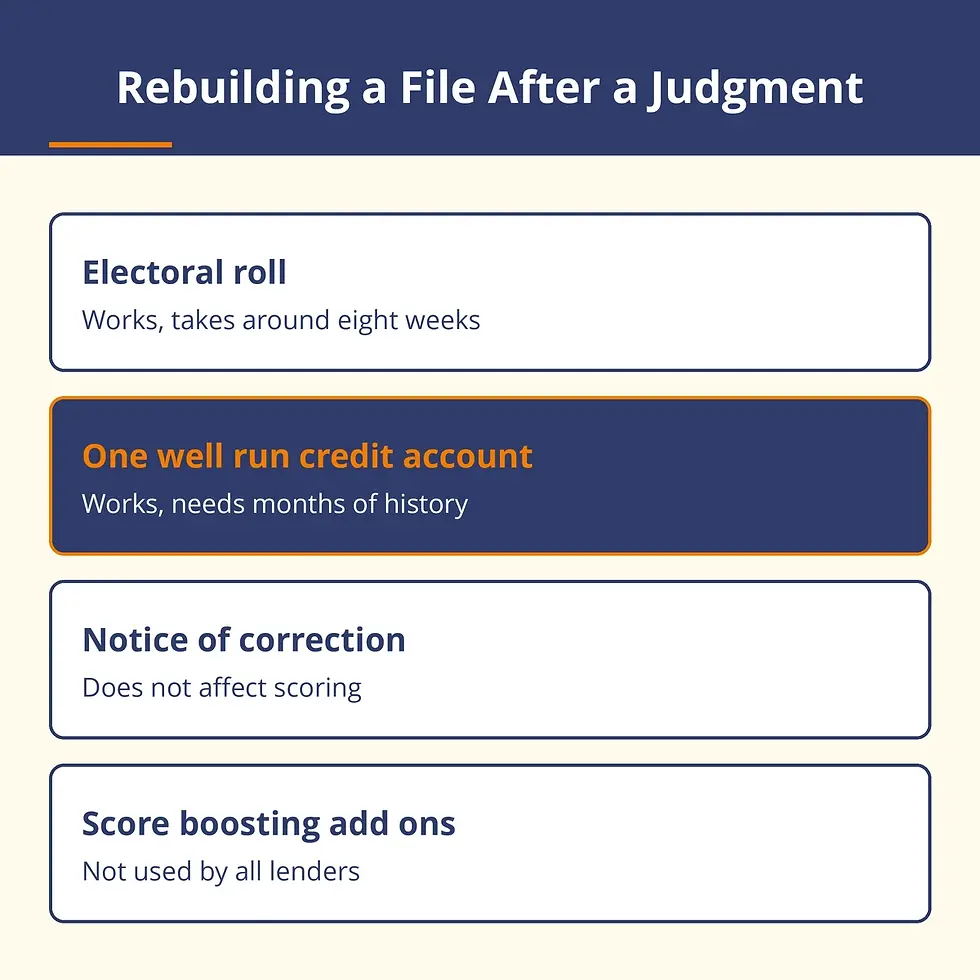
Register on the electoral roll at your current address, the fastest single win. MoneyHelper (2026) notes that councils send voter data monthly, so the effect can show within about eight weeks.
Run a current account well, then add a low-limit card from a regulated provider. Experian (2026) is direct that paying it off in full and on time each month builds positive history.
Put Direct Debits on everything payable that way. Missed payments through simple disorganisation are the most avoidable damage of all.
Get your rent counted. Experian (2026) confirms rent payments can be added to your credit history through a rent reporting service, provided they are made on time and in full.
Allow months, not weeks. Experian (2026) states it may take up to six months to start seeing the benefit, which is why starting before you apply matters more than any single tactic.
The actions the evidence does not support
Paying the judgment does not remove it. Cancellation applies only where the debt was satisfied within one calendar month of the judgment. After that the entry is endorsed as satisfied and stays for the full six years.
A Notice of Correction does not raise your score. Experian (2026) says so directly, and it forces a human to read the file, which slows the application. Useful for explaining a disputed judgment, useless as a scoring tactic.
Score-boosting tools are a bonus, not a plan. Experian (2026) states on its own page that not all lenders use its Boost product and not all scores increase with it. It affects one agency's score, not the shared record.
CCJ removal services cannot wipe an accurate judgment. There are only three lawful exits before six years: satisfaction within one calendar month, a set aside on proper grounds, or a consent order or correction of an error.
The score you check is probably not the score the lender used. Experian (2026) states that no single score is the right one, that lenders may check any or all three agencies alongside their own data, and that it is always the lender who makes the decision. The FCA (2023) found the three large agencies held consistent information on default counts for only around 30 per cent of matched individuals.
So check all three files before you apply, not one. Our notes on improving a credit score go further on sequencing.
The CCJ You Never Satisfied, Still Outstanding at Four Years
If your judgment still shows as unsatisfied, this section matters more than everything above it.
Satisfied versus unsatisfied is the hardest binary in adverse credit criteria. Every published criteria set we checked treated an unsatisfied judgment as an absolute bar, with no value threshold and no tolerance for age inside six years. Small does not help. Old does not help.
Registry Trust (2026) reported that around 4.1 million consumer judgments in England and Wales remain unsatisfied, which is precisely why lenders find the marker so useful as a screen.
Paying at four years does not remove the entry and does not shorten the six years, and Registry Trust (2026) warns that simply paying does not necessarily mean the record gets marked as satisfied. What it does do is convert an absolute bar into a conditional one across multiple lenders. That is the difference between no and possibly.
There is also a reason to settle that has nothing to do with criteria. An unsatisfied judgment is a live claim, and the enforcement options include a charging order against property. Buying or remortgaging while a judgment sits unpaid means holding an asset a creditor can apply to secure against.
Get the paperwork right, and mind the timing trap
Registry Trust (2026) sets out the process: pay in full and keep proof, contact the issuing court with the case number and evidence, ask for the judgment to be marked satisfied and Registry Trust notified, then apply for a certificate of satisfaction using form N443. StepChange (2026) gives the fee as £15, though court fee schedules are revised periodically, so check the current figure.
Now the trap, which causes more avoidable declines than anything else at this stage. Registry Trust (2026) advises allowing four to eight weeks for the court, the Register and credit files to update, and agency refresh cycles sit on top of that. Someone who pays on the Monday and applies on the Friday still reads as unsatisfied to the lender's credit search.
Pay, obtain the certificate, wait for the files to update, verify the change yourself on the official public register search, then apply.
Scotland works to the same six years and the same one calendar month rule, but the paperwork differs: the Scottish Courts and Tribunals Service (2026) confirms the court does not issue the certificate there. If money worries are the live issue rather than house-hunting, StepChange, National Debtline and Citizens Advice give free debt advice.
Record Numbers on the Register: Where a Four-Year-Old Judgment Sits Now
The specific thing that has changed is volume.
Registry Trust (2026) recorded 370,871 new consumer and commercial judgments in Q2 2026, up 26.5 per cent on the same quarter a year earlier. Consumer judgments in England and Wales alone came to 322,076 in that quarter, up 34.5 per cent year on year. The Register now holds 5,672,871 records in total.
Two things follow. This is no longer an unusual file for an underwriter to see, and 45 per cent of England and Wales consumer judgments are for amounts under £500, so the "it was only £340" borrower is the typical case rather than the exception.
Criteria are also reviewed and reissued frequently against that backdrop: one published document we read carried an effective date only a fortnight old. A rule that excluded you last year may not exclude you now, and the reverse is equally possible.
None of that changes the mechanics: six years from the judgment date, endorsement rather than cancellation after one month, and a file that needs positive evidence on it. It does mean the market is handling adverse credit at a scale it has not seen for some years, and our overview of bad credit mortgages sets out where the tiers sit.
FAQs
Does a CCJ from four years ago still show on my credit file?
Yes. Judgments stay on the Register and on your credit file for six years from the date of the judgment, so one registered four years ago has around two years to run. Paying it does not remove it or shorten that period, though it can change how lenders treat it.
Is it too late to pay a CCJ that is four and a half years old?
No, and it is usually still worth doing. Paying does not cancel the entry, because cancellation applies only where the debt was satisfied within one calendar month of the judgment. What it does is move you from an absolute bar at most lenders to a conditional one, and it removes live enforcement exposure.
Can a lender ask about a CCJ that has already dropped off my credit file?
Yes. Some lenders' application forms ask whether you have ever had a county court judgment registered against you, with no time limit, alongside a declaration that the application contains all material facts. Answer honestly. We found no evidence that disclosing an old, off-file judgment causes a decline by itself.
How long should I wait after paying a CCJ before applying for a mortgage?
Registry Trust advises allowing four to eight weeks for the court, the Register and credit files to update, and agency refresh cycles can add more. Applying within days of paying means the lender's search still shows the judgment as unsatisfied. Confirm the change on all three credit files first.
My credit score has recovered, so why was I still declined?
The score you see is probably not the one the lender used. Lenders may check any or all three credit reference agencies, add their own data, and apply their own scorecard, and the agencies frequently disagree with each other on the underlying records. A decline can also be produced automatically, in which case you may be entitled to ask for a human review.
I stopped using credit completely after my CCJ. Is that a problem?
It can be. A scorecard predicts from recorded evidence, and a file with an old judgment and very little activity since gives it nothing positive to weigh. Registering on the electoral roll, running a current account well and holding a low-limit card cleared in full each month rebuild that evidence, typically over several months.
Does a Scottish decree work the same way as a CCJ?
Largely, yes. A decree stays on the Register and your credit file for six years from the original judgment date, and the same one calendar month rule applies. The administration differs: the court does not issue a certificate of satisfaction in Scotland, and a letter from the pursuer is sent to Registry Trust instead.
Summary
A judgment over four years old is still on your file and still inside the counting windows many lenders use, so it can affect an application. By this stage, though, it is often a placement question rather than a credit one, while the sparse file left behind does the quieter damage. Rebuild the evidence, settle anything unsatisfied properly, and get the timing right. A conversation before you apply is worth more than another decline.
Updated: 31 July 2026
Written by Ben Stephenson, CeMAP-qualified Mortgage Broker.
Manor Mortgages Direct is FCA authorised, FRN 496907, has traded for 25 years, is highly positively reviewed, 4.9 rated on Google, and has helped thousands secure the right mortgage. Bristol-based mortgage brokers, assisting clients nationwide.
Sources
legislation.gov.uk (2005) The Register of Judgments, Orders and Fines Regulations 2005, reg 26 - https://www.legislation.gov.uk/uksi/2005/3595/regulation/26/made - accessed 31 July 2026
legislation.gov.uk (2005) The Register of Judgments, Orders and Fines Regulations 2005, reg 11 - https://www.legislation.gov.uk/uksi/2005/3595/regulation/11/made - accessed 31 July 2026
legislation.gov.uk (1980) Limitation Act 1980, s.24 - https://www.legislation.gov.uk/ukpga/1980/58/section/24 - accessed 31 July 2026
legislation.gov.uk (1998) Civil Procedure Rules 1998, Part 83 - https://www.legislation.gov.uk/uksi/1998/3132/part/83 - accessed 31 July 2026
GOV.UK (2006) Form N443: Application for a certificate of satisfaction or cancellation - https://www.gov.uk/government/publications/form-n443-application-for-a-certificate-of-satisfaction-or-cancellation - accessed 31 July 2026
Registry Trust (2026) The Ultimate Guide to County Court Judgments - https://www.registry-trust.org.uk/court-judgments/ccj-guide - accessed 31 July 2026
Registry Trust (2026) Q2 2026 Judgment Statistics Summary - https://www.registry-trust.org.uk/court-judgment-statistics/q2-2026-summary - accessed 31 July 2026
Registry Trust (2026) Q4 2025 Judgment Statistics Summary - https://www.registry-trust.org.uk/court-judgment-statistics/q4-2025-summary - accessed 31 July 2026
Experian (2026) CRAIN Data Retention Periods - https://www.experian.co.uk/legal/crain/data-retention-periods/ - accessed 31 July 2026
Equifax (2026) CRAIN Data Retention Summary - https://www.equifax.co.uk/crain/retention - accessed 31 July 2026
Experian (2026) County court judgements (CCJs) and your credit score - https://www.experian.co.uk/consumer/guides/ccjs.html - accessed 31 July 2026
Experian (2026) Why is my credit score different on different sites? - https://www.experian.co.uk/consumer/guides/why-is-my-credit-score-different-on-different-sites.html - accessed 31 July 2026
Experian (2026) How to build credit and credit history - https://www.experian.co.uk/consumer/guides/building-credit.html - accessed 31 July 2026
Experian (2026) Notice of Correction - https://www.experian.co.uk/consumer/guides/notice-of-correction.html - accessed 31 July 2026
Experian (2026) Experian Boost - https://www.experian.co.uk/consumer/experian-boost.html - accessed 31 July 2026
Experian plc (2022) Meet the 5 million credit invisible Brits - https://www.experianplc.com/newsroom/press-releases/2022/meet-the-5-million-credit-invisible-brits-still-at-risk-of-exclusion-from-the-financial-system - accessed 31 July 2026
TransUnion (2026) Credit Invisibles and Thin Files Explained - https://www.transunion.co.uk/consumer/credit-invisibles - accessed 31 July 2026
TransUnion (2026) How long do CCJs stay on your credit file? - https://www.transunion.co.uk/consumer/credit-education/how-long-do-ccjs-stay-on-your-credit-file - accessed 31 July 2026
FCA (2023) Credit Information Market Study Final Report MS19/1.3 - https://www.fca.org.uk/publication/market-studies/ms-19-1-3.pdf - accessed 31 July 2026
National Debtline (2026) Statute barred debts (England and Wales) - https://nationaldebtline.org/get-information/guides/statute-barred-debts-ew/ - accessed 31 July 2026
StepChange Debt Charity (2026) How long does a CCJ stay on my credit file? - https://www.stepchange.org/debt-info/ccj/how-long-does-a-ccj-last.aspx - accessed 31 July 2026
MoneyHelper (2026) How to improve your credit score - https://www.moneyhelper.org.uk/en/everyday-money/credit-and-purchases/how-to-improve-your-credit-score - accessed 31 July 2026
Scottish Courts and Tribunals Service (2026) Money judgments and certificates of satisfaction FAQs - https://www.scotcourts.gov.uk/taking-action/frequently-asked-questions/money-judgments-and-certificates-of-satisfaction-faqs/ - accessed 31 July 2026
Related Guides