
Can You Get a Mortgage With More Than One CCJ on Your File?
Find out how underwriters apply the root cause test to multiple judgments, and why the number on your file misleads.
Quick Answer
Yes, more than one CCJ can still be mortgageable. Most published criteria gate judgments on total value, on age, and on whether each one is satisfied, rather than on the number. What decides a case is usually whether every judgment traces back to a single cause that has demonstrably ended.
Count is also the number most likely to be wrong. One problem debt commonly appears twice on a credit report, once as a default against the account and once as a judgment in the public records section. Readers count entries and assume each one is a separate failure. Recounting by underlying debt is the first useful thing you can do.
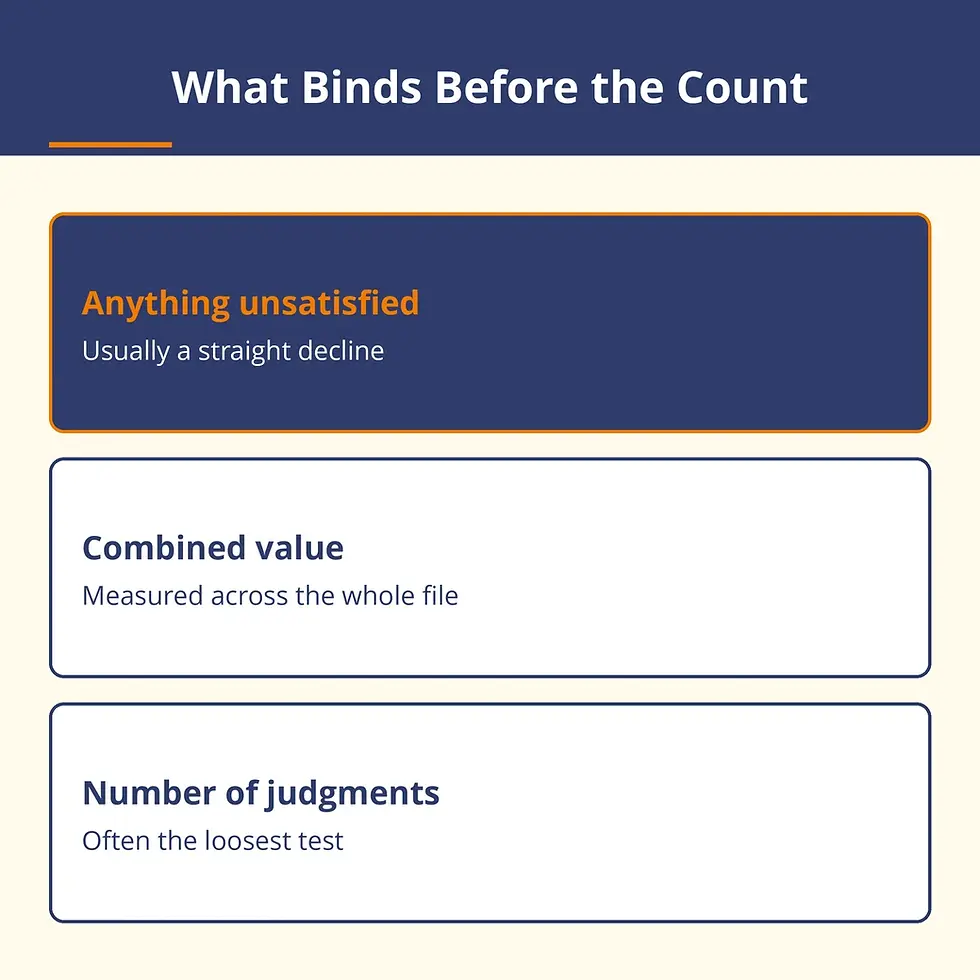
Where a lender does apply numbers, value tends to bind before count, and one unsatisfied judgment of any size can outweigh good news about everything else. A single outstanding judgment blocks at most mainstream lenders regardless of how many others you have cleared. The specialist tier is more flexible, though it usually costs more.
Reviewed by Ben Stephenson, FCA authorised (FRN 496907) · 25+ years' experience · 4.9★ on Google. Updated: 31 July 2026.
Who Is This Guide For
Best for company directors carrying guarantee debts from a failed venture, separated borrowers holding judgments on joint accounts, and anyone who found several judgments at once after a house move, who need to know whether the number itself blocks a mortgage.
Key Points
One problem debt often shows twice on your file
Total value binds before the number of judgments
One unsatisfied judgment outweighs several satisfied ones
Table of Contents

Why the Number of CCJs Is the Weakest Signal on Your File
If you are carrying two, three or five judgments, the number is the thing you can state in one breath. It is also the thing most published lending criteria test last. Value, age and satisfaction status come first.
There is a second reason the number misleads, covered next: your report frequently shows more adverse entries than you have problem debts.
The question that carries real weight is simpler. An underwriter is establishing whether your judgments trace back to one identifiable event that has demonstrably ended, or whether they describe a way of handling money that has not changed. Two files can show the same number and get opposite answers.
Telling those two files apart is what the rest of this is about. If you are still working out whether any lender can help at all, our overview of mortgages with bad credit is the better starting point.

Your Credit File Probably Shows One Problem Debt Twice
Start by recounting: the count you are worried about may not be real. A single debt that ended in court normally appears in two places. The original agreement carries a default in the credit account section, and the judgment that followed sits separately under public records, as Debt Camel (2026) explains.
One broken agreement therefore presents as two adverse entries, so somebody with three problem debts can count six and think their position twice as serious as it is. That is a filing convention, not a second failure.
Joint liability inflates the count from another direction. A judgment against two people jointly appears on both credit files, so a separated couple can each be carrying what is really one judgment. Experian (2026) confirms that a joint judgment also creates a financial association, and that companies may check an associate's credit history when deciding whether to approve you.
So the first step is a recount by underlying debt, not by entry. Pull your report from more than one credit reference agency and map each adverse item back to the account or court claim it came from. Two entries pointing at one debt are one problem, and you should be able to show which pair up.
Default count is a separate question with its own thresholds, and we cover it in how many defaults you can have and still get a mortgage.
A Judgment and a Default Are Different Instruments
Most readers use the two words interchangeably. Lenders do not. A default is a lender's report about a contract; a judgment is a court's decision about a debt.
Who decided. A default is recorded by your creditor, unilaterally, with no hearing. A judgment is entered by the county court after you have had an opportunity, typically fourteen days, to respond, as National Debtline (2026) sets out.
Where it sits. A default lives in the credit account section, attached to the agreement. A judgment is registered under the Register of Judgments, Orders and Fines Regulations 2005 and shows in public records.
When the clock starts. A default drops off six years from the default date; a judgment six years from the date of judgment, under regulation 26.
What paying changes. Paying a defaulted debt does not shorten the six years. Paying a judgment within one calendar month of the judgment date cancels the register entry; paying later leaves it endorsed as satisfied for the rest of the six years, under regulation 11.
Industry reporting principles state that a default may occur at three months in arrears and should normally be recorded by six, as quoted by Debt Camel (2026). Section 87 of the Consumer Credit Act 1974 requires a default notice first on a regulated agreement, a contractual step. A judgment is a judicial one, enforceable by warrant, attachment of earnings or a charging order.
Criteria treat them as different animals. One lender's criteria, on a single page, allow one satisfied judgment up to a few hundred pounds while allowing twice as many satisfied defaults at several times that aggregate value.
The Root-Cause Test an Underwriter Applies to Multiple Judgments
Strip the assessment back and three questions do the work. What caused these judgments? Is there a date on which that cause ended? What has the file shown since?
The end date is the pivot. It lets an underwriter treat everything before it as history and everything after it as evidence. Without one, every judgment stays live, because nothing says the conditions that produced them have gone.
Demonstrably ended means paperwork, not narrative. A dissolution date, a decree absolute, a death certificate, a return-to-work letter, a completion statement for a house move: each puts a date on the end of the cause. An explanation with no document behind it is only an assertion.
The opposite file has no single cause. Judgments arriving across several years, from unconnected everyday credit, with nothing external to point at, read as an ongoing risk rather than a closed episode. That file is not unmortgageable, but it is priced for a risk that is still open.
Be clear about what is policy and what is judgment. No published criteria we reviewed name root cause as a test; they test value, age and satisfaction. Root cause decides the human part, which is why these cases belong with lenders that read a file rather than score it, as we explain in what happens when an application goes to manual review.
Root cause behind the judgments | Evidence that puts a date on its end |
Company failure with personal guarantees | Liquidation or dissolution date, correspondence settling each guarantee |
Separation or divorce | Decree absolute or separation agreement, joint accounts closed, disassociation lodged with the agencies |
Bereavement | Death certificate, dates joint facilities were closed or transferred |
Illness or time out of work | Return-to-work date, end of a fixed sick-pay period, employer or occupational health letter |
Claims served on an address you had left | Tenancy end or completion date for the move, dated redirection or set-aside paperwork |
No single identifiable cause | Nothing to date, and that absence is itself the finding |
When One Business Failure or Separation Produced Every Judgment
Personal guarantees after a company folds
A limited company's debts are not personally the director's, but a signed personal guarantee changes that. A trading company often carries several lines backed by separate guarantees, asset finance, trade credit, a lease, and in the cases we see each is litigated separately when the company fails.
That is how one insolvency produces three or four judgments within months. The count reflects how many creditors held a guarantee, not how many times the borrower's finances failed. Where the company is gone, the guarantees settled and the borrower trading again through a solvent vehicle, the cause has a documented end.
Separation, joint debt and a live financial association
On a joint debt each party is liable for the whole balance, so a separation can leave one person exposed to debts they were not servicing, and judgments can follow on facilities the borrower barely recognises.
The association created by joint credit or a joint judgment stays on your file until you ask the agencies to remove it, and it can put an ex-partner's adverse history in front of your underwriter, according to Experian (2026). Lodging a disassociation is part of the preparation.
Bereavement and illness
Where debts are joint the surviving person becomes liable for them, while sole-name debts with no assets behind them are not owed by anyone else, per National Debtline (2026). A survivor can inherit several full balances at once, alongside a fall in income, and a death certificate is about as clean an end date as underwriting offers.
Illness works the same way where recovery has a date, such as a return to work. Where it does not, the evidence comes from what the file has done since.
Claims served on an address you had left
The Ministry of Justice (2017) publicly acknowledged claims being sent to consumers at incorrect addresses, and announced measures to strike judgments from the register where the person was unaware and the debt is resolved. That statement is several years old, but the problem is officially recognised.
One un-notified house move hits every creditor holding the old address at once, and each can obtain judgment in default, which is why most people find the whole set together on a report pulled after a refusal. The remedy is a set aside on form N244, with a court fee of £321, and attendance at the hearing is mandatory, per GOV.UK (2026). Be careful with the advice you read: a set aside cures not having been heard, not owing the money, and without a valid defence the creditor can simply apply again, as Debt Camel (2026) warns.
Case study: three judgments from a venture that folded
A company director in Yorkshire came to us with three judgments totalling £4,120, all from personal guarantees crystallised when his construction business was wound up between two and a half and three years earlier. He had a 20 percent deposit of £57,000 on a £285,000 purchase, 80 percent loan to value, and £61,000 of income from a new company in its second year. All three were satisfied fourteen months earlier, and we evidenced the liquidation date, the guarantee settlements and clean conduct since.
The case was placed in the specialist tier and assessed on a stress rate well above the product's pay rate, the pay rate being what he actually paid and the stress rate only the affordability test. This is an illustrative composite, with indicative figures.
Two or More Judgments From the Same Creditor
Seeing one company's name twice in the public records section prompts a common fear: that the same debt has been counted twice. As a matter of law it should not have been. Once a creditor obtains judgment, the original cause of action merges into that judgment and cannot be sued on again, a doctrine restated by the Court of Appeal in Zavarco v Nasir, reported by Pinsent Masons (2021).
So two judgments from one creditor should mean two distinct debts: two agreements, two accounts or two guarantees. If they relate to the same debt, that is an error, and the set-aside route above is the way to challenge it. Duplicates do happen, usually where a debt has been sold on and the purchaser sues without the earlier judgment surfacing.
What follows is our experience rather than published policy: we found no criterion distinguishing same-creditor judgments from different-creditor ones.
Judgments from several different creditors are consistent with one shock hitting several accounts at once, which is what the root-cause test looks for. Two from the same creditor cannot be one debt, so they describe two agreements with one counterparty that both ran to court. That is harder to explain as a single external event, unless you can show it was one: two guarantees to the same finance house crystallised by the same insolvency, or two joint facilities with the same bank caught by the same separation.
Same-creditor judgments are not automatically worse. They are automatically more in need of an explanation with documents attached.
Total Value Binds Before Count, and It Is Measured More Widely
Across the published criteria we reviewed, judgments are far more often gated by aggregate value and age than by number. Where a count appears it usually sits beside a value cap, and that cap is commonly the one a real applicant fails.
The two tests are also measured on different scopes. One building society accepts one judgment registered in the last three years, but requires the total value of all judgments on the report to be under a few hundred pounds, with no time limit on that total. The count is windowed, the value is not, so you can pass on count and fail on the value of something five years old.
Some criteria drop the count entirely. One specialist credit-repair tier accepts judgments over twelve months old up to several thousand pounds in aggregate, with no cap on how many. Another product caps the number of defaults explicitly and imposes no number cap on judgments at all.
So the claim that more than one judgment ends the conversation is not correct. What ends it, more often, is a total.
The arithmetic makes it obvious. Three judgments of £180 each is three items and £540; one of £2,400 is a single item and more than four times the value. Against several thresholds we reviewed, the three small ones pass where the single larger one does not.
One negative finding is worth stating. We could not find any published criterion operating a rolling quota of the form "no more than one judgment in any twenty-four months". Where twenty-four months appears, it is a lookback to zero on certain products, or a quota on missed payments rather than judgments. Treat confident claims about rolling quotas with suspicion, and check the criteria against your own file, which is what a specialist adviser is for.
All Satisfied, or a Mix? One Outstanding Judgment Governs
This is the second thing that matters more than count, and it is close to binary. Mainstream criteria repeatedly require every judgment to be satisfied at application, in language such as "no judgments of any value that are currently unsatisfied". A £40 outstanding judgment can block where a £500 satisfied one passes.
With a mix, the number of satisfied judgments is close to irrelevant, because the outstanding one governs. Four satisfied and one unsatisfied is generally assessed as an applicant with an unsatisfied judgment, and no amount of good news about the other four changes that.
Turned round, that is a plan: moving one item from unsatisfied to satisfied can flip a case from decline to consideration, while cutting your count from five to four often changes nothing. If money is limited, this is where it goes.
Exceptions exist. Of the criteria we reviewed, one mid-tier product accepts a small unsatisfied judgment inside three years, and another draws no distinction between satisfied and unsatisfied at all. Both sit outside the high street.
Evidencing satisfaction takes time. A certificate of satisfaction is applied for on form N443 with a £19 fee, per judgment, so four judgments means four applications, per GOV.UK (2026).
Here is the correction that catches most people. Paying does not remove a judgment unless it was paid in full within one calendar month of the judgment date, in which case the entry is cancelled. Pay any later and the entry survives its whole term, simply relabelled to show the money has been handed over. Satisfying it changes the endorsement, not the clock, and the month runs from the judgment date, not from the day you found out.
Read against the root-cause test, all-satisfied is the signature of a cause that has ended: clearing the judgments took capacity the borrower did not have when they arose. A mix reads as either partial recovery or as clearing whoever chased hardest, and the underwriter's question is which. Settled conduct since is the substance of showing stable finances.
The Signals an Underwriter Reads First on a Multi-Judgment File
Before anyone reads your explanation, a few specific things get looked at.
Any unsatisfied judgment, at any value. Checked before the count, and it can end the assessment on its own.
The aggregate value of every judgment on the report, including ones outside the count window, because value is often summed across the file.
The date of the most recent judgment, which sets which product tiers are available.
A judgment dated after the event you say caused them. This is the most damaging single item on such a file, because it contradicts the end date your case rests on.
A live financial association with an ex-partner carrying adverse history of their own.
New credit applications and searches in the last three to six months, which read as pressure rather than recovery.
Current account conduct, specifically unarranged overdraft use and returned direct debits in recent statements.
A satisfaction dated days before the application, where the money came from a source the statements do not evidence.
A mismatch between what you declared and what the search shows. Undisclosed judgments do more damage than the judgments themselves.
Most of those are preparation problems, not credit problems. Holding off on new credit, keeping the current account clean for six months, lodging a disassociation and obtaining certificates in advance deals with most of the list without changing one entry.
Be realistic about the trade-off. The specialist tier typically means a higher rate than the high street, often with a lender or product fee on top, a real cost in pounds per month. What it buys is a decision made by a person reading a documented cause rather than a system counting entries.
Treat that as a staging post. Judgments drop off six years from their own dates, so the file improves in steps, and a remortgage against a cleaner file is the usual route back.
FAQs
How many CCJs can you have and still get a mortgage?
There is no published maximum that applies across the market. Several sets of lending criteria set no cap on the number of judgments at all, governing them instead by how old they are and by their combined value. What matters far more than the number is whether any judgment is still unsatisfied and what the total comes to.
Do lenders count my CCJs or add up their value?
Usually both, but the value test tends to bind first. Many criteria pair a count limit with a total value cap, and the value is often summed across every judgment on the credit report while the count is only measured inside a window of three or six years. That means an older judgment can fail you on value even where it falls outside the counting window.
Do two CCJs from the same company mean I owe the same debt twice?
No. Once a creditor obtains judgment, the original claim merges into that judgment and cannot be sued on again, so two judgments from one creditor should represent two separate agreements. If they genuinely relate to the same debt, that is an error and you can apply to have one set aside. Duplicates most often arise where a debt has been sold and the purchaser sues without the earlier judgment surfacing.
Does paying a CCJ remove it from my credit file?
Only if you paid it in full within one calendar month of the date of judgment, in which case the register entry is cancelled. Pay after that and the entry is endorsed as satisfied but remains for six years from the judgment date. Satisfying a judgment changes how it reads, not how long it stays.
Do all my CCJs need to be satisfied before I apply?
For most mainstream lenders, yes, and the requirement is usually absolute regardless of value. A small number of specialist products accept a modest unsatisfied judgment, or draw no distinction at all, but they are the exception and they sit outside the high street. Where funds are limited, clearing the outstanding one generally does more for your application than reducing the count.
Is a CCJ worse than a default?
They are different things measured differently, though judgments are generally treated as the graver item per pound. A default is your creditor's record that an agreement broke down; a judgment is a court's decision that the money is owed. On the same lender's criteria you often see judgments allowed in smaller numbers and at lower values than defaults, and one problem debt can produce both.
Summary
Carrying several judgments does not close off a mortgage. Lenders look first at whether anything is still outstanding, then at the combined value and age, and only then at how many there are. Underneath all of it sits one question: did these come from a single event that is provably over? If you can date that ending and evidence it, the number matters much less than you fear. It is worth talking it through before you apply.
Updated: 31 July 2026
Written by Ben Stephenson, CeMAP-qualified Mortgage Broker.
Manor Mortgages Direct is FCA authorised, FRN 496907, has traded for 25 years, is highly positively reviewed, 4.9 rated on Google, and has helped thousands secure the right mortgage. Bristol-based mortgage brokers, assisting clients nationwide.
Sources
legislation.gov.uk (2005) - https://www.legislation.gov.uk/uksi/2005/3595/regulation/11 - accessed 31 July 2026
legislation.gov.uk (2005) - https://www.legislation.gov.uk/uksi/2005/3595/regulation/26 - accessed 31 July 2026
legislation.gov.uk (1974) - https://www.legislation.gov.uk/ukpga/1974/39/section/87 - accessed 31 July 2026
GOV.UK (2026) - https://www.gov.uk/county-court-judgments-ccj-for-debt/cancel-the-judgment - accessed 31 July 2026
GOV.UK (2026) - https://gov.uk/county-court-judgments-ccj-for-debt/ccjs-and-your-credit-rating - accessed 31 July 2026
Ministry of Justice (2017) - https://www.gov.uk/government/news/action-to-make-the-process-fairer-on-debt-rulings - accessed 31 July 2026
National Debtline (2026) - https://nationaldebtline.org/get-information/guides/county-court-judgements-ew/ - accessed 31 July 2026
National Debtline (2026) - https://nationaldebtline.org/get-information/guides/debts-after-death-ew/ - accessed 31 July 2026
Debt Camel (2026) - https://debtcamel.co.uk/worried-about-debt/ccj/ - accessed 31 July 2026
Debt Camel (2026) - https://debtcamel.co.uk/help-ccj/ - accessed 31 July 2026
Experian (2026) - https://www.experian.co.uk/consumer/guides/financial-association.html - accessed 31 July 2026
Pinsent Masons (2021) - https://www.pinsentmasons.com/out-law/news/uk-appeal-court-clarifies-doctrine-of-merger - accessed 31 July 2026
Related Guides