
Does a Personal Loan Used for Your Business Affect a UK Mortgage?
Updated: Sep 8
See how a personal loan taken for your business is assessed, and what evidence can change the outcome.
Quick Answer
Usually yes. A personal loan taken in your own name and spent on the business is your contractual commitment, and affordability rules define that by who signed, not who repays. Some lenders will weigh independent evidence that the business services it, but the outcome still depends on the lender and the strength of that evidence.
The regulator's definition of committed expenditure turns on who is contractually liable, not on which account makes the payment, so your signature on the agreement is normally decisive. A minority of lenders will look at a business-serviced commitment on its own merits where the evidence is independent and documentary, such as company bank statements and an accountant's letter. None of the published criteria reviewed for this piece set out a policy that excludes such a commitment as standard, so treat any exclusion as an underwriter's judgement rather than an entitlement you can claim.
This article explains where that position comes from, what a business-serviced commitment can cost you in borrowing power when it counts in full, and what evidence carries most weight with an underwriter. It also sets out what a personal guarantee does and does not do to your credit file. Nothing here is a substitute for advice from a qualified tax adviser on how a business debt was structured.
Reviewed by Ben Stephenson, FCA-authorised mortgage adviser (FRN 496907) · 25+ years' experience · 4.9★ on Google. Updated: 1 September 2026.
Who Is This Guide For
Best for limited company directors, sole traders, and business partners who borrowed personally to fund stock, equipment or working capital and now need a lender to look past the account the payment leaves from before applying.
Key Points
Committed expenditure is defined by contract, not payer
Every £100 a month costs about £12,000 to £15,000
Personal guarantees leave a search, not a debt entry
Table of Contents
Which way the money travelled, and why it matters more than the amount
This piece is about money going into the business. You borrowed personally, in your own name, and the funds ended up in the company or in the sole trade. That covers a personal loan spent on stock or equipment, a personal credit card carrying supplier costs, an overdraft absorbing a slow month, a vehicle on personal finance that spends its life on company work, and money raised on the family home and lent in. The common thread is that the liability is yours and the benefit is the business's.
The opposite direction, money coming out of the company to you, is a separate topic with separate rules, and we have written it up in full in our piece on the director's loan account and your mortgage. It behaves differently at almost every point, so we are linking to it rather than repeating it here. If you want the wider picture of how trading income is read first, our guide to self-employed mortgages covers the income side of the same application.
There is a genuine terminology trap between the two. The phrase "director's loan" is used by lenders for both directions. One large lender's published criteria uses it to mean the injection going in, the funds a director puts into a limited company, and treats the repayment of that injection as the applicant's own savings rather than as new borrowing.
Another lender's criteria uses the same phrase for the loan running the other way, out of the company to the director, and prices the outstanding balance into affordability as a monthly deduction. We retrieved the first of those through a summarising fetch rather than raw source text, so treat the detail as needing confirmation, but the collision itself is real and it causes more confusion in a first conversation than almost anything else on this subject. When you say "director's loan" to an underwriter, say which way the money went.
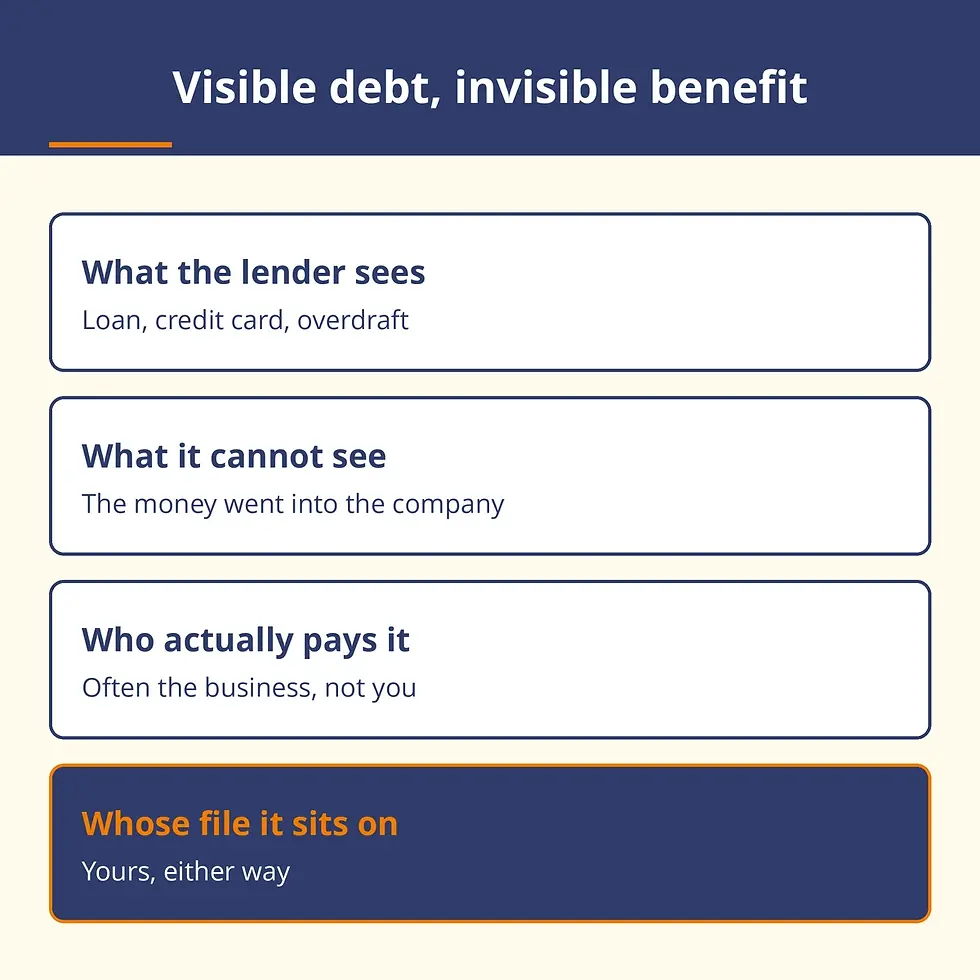
Visible debt, invisible benefit
Two published frameworks, pulling in opposite directions, explain everything else in this article.
The first is the FCA's affordability rule. MCOB 11.6.5R requires a lender to take full account of your income net of income tax and national insurance and, as a minimum, your committed expenditure alongside basic essential expenditure and quality-of-living costs. MCOB 11.6.10R then defines committed expenditure as your credit and other contractual commitments that will continue after the mortgage is entered into, and MCOB 11.6.11G gives the examples: secured and unsecured loans, credit cards, hire purchase, child maintenance and the cost of a repayment strategy.
Nothing in that definition turns on which bank account the direct debit leaves. If your signature is on the agreement, the presumption is that the payment is yours.
The second is the credit reporting rulebook. The Principles of Reciprocity, the industry framework governing how UK credit data is shared, records that the Information Commissioner's Office instructed the credit reference agencies to keep personal and business data apart, and that the consumer databases should not knowingly contain business data. It then concedes the consequence in plain terms: lenders are unable to gain a full picture of the credit behaviour of individuals who derive their income from businesses in which they hold a significant interest.
Put the two together and the shape of the problem appears. Your personal loan lands on your consumer file and inside your personal affordability assessment. The equipment it bought, the contract it funded and the cash flow it rescued sit in a business dataset your mortgage lender may not be able to see at all.
The debt is visible; the offsetting benefit is not. Everything a business owner finds unfair about this topic follows from that single asymmetry.
The dividing line in the rulebook is capacity, not legal form, which is why sole traders sit in the messiest position of anyone. A sole trader has no separate legal personality, yet the framework still classes them as a business when they are operating in their business capacity. So the confident statement that sole trader debt is always personal is too strong, and so is its mirror image.
It depends on how the facility was written and which database the lender shares to, and the framework itself acknowledges that some business data leaks onto consumer files through confusion or misrepresentation. If you trade as a sole trader, pull your own credit files and look, rather than assuming either answer.
One more asymmetry is worth knowing about, because it runs the other way. Where a company has three directors or fewer, a commercial lender sharing commercial data may access full consumer data on one or all of the directors, provided it notifies at least one director mandated on behalf of all. The rationale recorded in the framework is that personal data is rarely relevant to decisions on larger companies.
There is also a statutory sharing regime for small business credit information, made under the Small Business, Enterprise and Employment Act 2015, which obliges designated banks to supply SME credit data to designated agencies. The traffic between the personal and business worlds is not symmetrical, and it does not flow in the direction that would help you here.
What you borrowed | How it is treated on your personal credit file |
A personal loan in your own name, spent on the business | Yes, in full. You contracted in a personal capacity. |
A personal credit card carrying business costs | Yes. The balance is costed even when cleared monthly by at least one lender. |
A personal overdraft | Yes, and one society costs 3% of the authorised limit even when undrawn. |
A car or van on personal finance, used for company work | Yes. The agreement is personal, whatever the vehicle does. |
A remortgage of your home to fund the business | Yes. It is your mortgage, whatever the money went on. |
Borrowing taken by a limited company in the company's name | No, by design. Consumer databases should not knowingly hold business data. |
Sole trader business borrowing | Intended for the business side, but this is where leakage happens, since classification follows capacity, not legal form. |
A personal guarantee you have given | No debt entry, though a search footprint is possible. Guarantee data is not currently a shared item. |
What the published criteria say about disregarding a personal loan
Here is the finding that matters most, and we are not going to dress it up. Across every set of lender criteria retrieved for this piece, not one published an explicit policy permitting a personal credit commitment to be excluded from affordability on the grounds that the applicant's business services it. The positions we found were inclusion, inclusion with extra caution, or silence. That sample skews towards lenders who publish a static criteria document, so it is a set of checkable specimens rather than a survey of the market, and it should not be read as a statement about lenders whose criteria we could not retrieve.

The clearest published treatment we found comes from one high street lender, dealing with commitments the limited company itself is liable for. Its criteria say those commitments should still be recorded within the application and considered as part of the overall affordability assessment, with the monthly payment entered as shown on the business bank statements, the outstanding balance detailed as one pound, and the remaining term as one year. Look carefully at what that does.
It does not exclude the commitment: the monthly payment still bites. It does neutralise the balance, by keying it as a nominal figure over a nominal term, so the system stops treating it as a large long-dated debt. A commitment that is business liable, at that lender, costs you the payment and not the balance.
At the other end, one specialist lender's residential criteria state that where an applicant falls under the FCA definition of credit impaired, all outstanding commitments will be included in the affordability calculation irrespective of being repaid or not. That rule is written for credit-impaired applicants specifically and should not be read as that lender's general position, but it shows how quickly the door closes once there is adverse history in the file.
Which brings us to the belief that circulates on every business owners' forum: that six months of business bank statements gets the payment taken off. We could not find any published basis for that rule at any lender in this research. It is not that it is impossible for a payment to be set aside; it is that exclusion is an underwriter or business development manager decision taken case by case, not a criteria entitlement you can point at.
And the regulator narrows the ground further. MCOB 11.6.27R says a firm must not rely on a general declaration of affordability by the customer or their representative, and MCOB 11.6.28R requires evidence of income or net assets and of the resources of the business, bars self-certification of income, and requires the source of that evidence to be independent of the customer. Your own statement that the company pays it is worth nothing standing alone.
What does carry weight is documentary and independent. Company bank statements showing the payment leaving the business account, at the amount that will be keyed, are the only evidence source named in the published criteria we quoted above. An accountant's letter is the second pillar, and the best-sourced template we found asks the accountant to confirm two things rather than one: the amount, and that there will be no detrimental effect on the business as a result.
That second limb catches people out, because it asks the accountant to form a view about the business, not simply to certify a number. Beyond that, the credit agreement itself showing who is contractually liable, proof that the funds actually reached the business, and confirmation that the company's profit and loss account already bears the servicing cost, so that the profit figure supporting your income has already absorbed it.
That last point is the strongest argument in the pack and the least used: if the cost is already inside the profit figure, charging it again against you personally deducts it twice. It is a reasoning line a broker makes, not a published rule, and it lands best where the income being used is drawn from profit rather than salary alone, which is the same territory covered in our piece on retained profit and how lenders treat it.
On how long a payment history you need, we would rather say we do not know than invent a number. No published source we could find sets a required run of company bank statements. The nearest analogues, from one building society, are a twelve-month proof requirement for net rental income and a twelve-month consistency test for commitments where bureau data is unavailable. Those are different tests aimed at different things, and the honest way to use them is as an indication of the kind of window a cautious underwriter thinks in, not as the answer.
What every £100 a month costs you in borrowing
A monthly commitment reduces the income a lender treats as available, pound for pound. The borrowing that income would have supported is simply the annuity value of that payment at the lender's stress rate over the term, so you can work it backwards: take the monthly payment, divide by the monthly cost of £1,000 of borrowing at the stress rate, and multiply by a thousand.
At a stress rate of 7% over 25 years, £1,000 of borrowing costs about £7.07 a month, so £100 a month of commitment is worth roughly £14,100 of capacity. At 8% over 25 years the cost per £1,000 rises to about £7.72, and the same £100 buys roughly £13,000. At 8.5% it drops to about £12,400. The useful rule of thumb to carry around is that every £100 a month of commitment costs somewhere in the region of £12,000 to £15,000 of maximum borrowing.
Scale that up and the sums stop being academic. A £250 monthly commitment removes something like £32,000 of capacity. £400 a month removes around £52,000.
£700 a month, which is roughly what a £30,000 five-year loan for equipment costs, removes around £90,000. Change the assumptions to a lower stress rate over a longer term and each of those figures grows by ten to fifteen per cent, which is why a single headline number is worth less than a range. The FCA has separately reminded lenders that they set their own basis for stress testing and that mechanically adding a margin to a reversion rate can produce an unnecessarily high stress test when rates are falling, so the conversion rate between a monthly payment and lost borrowing is not fixed across the market or across time.

Daniel, an engineering firm outside Stroud
Daniel is 46 and runs a five-person precision engineering firm in Gloucestershire. Two years ago he took a £22,000 personal loan in his own name over five years and used it for a second van and tooling, because the equipment finance quotes were slower and the work was starting in three weeks. The repayment is £420 a month, three years still to run, and it goes out by standing order from the company account.
His accountant has treated the cost in the company's books throughout. He and his wife are now buying a larger family home at £425,000 with £85,000 from the sale of their current one, so they need £340,000. This example is an illustrative composite built to show the mechanism, not a real client, and the stress rate used is a demonstration figure rather than any lender's pay rate.
Counted in full, the £420 is worth a lot. Divide by the £7.72 monthly cost per £1,000 at an 8% stress rate over 25 years and it consumes about £54,000 of borrowing capacity; at 7% it is closer to £59,000. So the loan he took to buy a van removes somewhere around £54,000 to £59,000 from what he can borrow, even though the company has serviced every payment from its own account since the first one.
Then there is the facility nobody was thinking about. Daniel's personal current account carries a £12,000 authorised overdraft that he arranged during the pandemic and has not drawn on in two years. He assumed it was free because it was unused.
At the one lender in our sample that publishes its figure, an authorised overdraft is costed at 3% of the limit whether or not anything is drawn, which turns his £12,000 of unused headroom into a £360 monthly outgoing, and £360 a month is roughly £46,000 to £50,000 of borrowing capacity. The two together, the loan payment and the untouched overdraft, sit somewhere between £101,000 and £110,000 of lost capacity on these assumptions.
On his first affordability run, with both counted, the maximum came out around £299,000 against the £340,000 he needed. Nobody could hand him a published rule that removed the loan payment. What he could control was the overdraft: he reduced the limit to nil three months before applying, which put roughly £46,000 back and moved the same calculation to just over £345,000.
The argument that the company's accounts already bear the £420, so his profit-based income has absorbed it once already, went into the case as supporting reasoning rather than as an entitlement, and it was a matter for the underwriter to weigh rather than a box that could be ticked. Every pound and percentage in Daniel's story is arithmetic we have worked through ourselves at two different stress assumptions to show you the mechanism. It is a demonstration, no lender's model is being reproduced, and your own numbers will differ.
The undrawn overdraft and the card you clear every month
The overdraft point deserves its own heading because it is the single most under-appreciated number in this whole subject. One building society publishes its treatment openly: a minimum monthly payment of 3% of the full balance of aggregate credit cards and revolving credit agreements is applied as an outgoing, and for overdrafts, 3% of the authorised overdraft is applied as an outgoing. Note the word authorised. That is the limit, not the drawn balance.
Run the numbers. A £20,000 aggregate credit card balance is treated as £600 a month, which is around £77,000 of borrowing capacity, and it is treated that way whether or not you clear the card in full every month. A £15,000 authorised overdraft, entirely undrawn, is treated as £450 a month and costs roughly £58,000.
A £10,000 undrawn limit costs about £39,000. Business owners hold that headroom deliberately, because a late-paying customer is a fact of trading life, and it is entirely rational to keep it. It is just not free at the point of a mortgage application.
That is one lender's published percentage, not a market standard, and how each lender costs revolving credit, and whether it costs an undrawn limit at all, is a lender-by-lender question. But it changes what you look at when you are preparing. Most business owners preparing for a mortgage focus on the balances they owe. The facilities they have not used are worth checking with the same attention, and a limit reduced or closed several months before an application shows up in the file the lender pulls.
Raising money on the house to put into the business
If the plan is to raise capital on your home and lend it into the business, the first question is not how much but whether the lender permits the purpose at all, and the published answers are extraordinarily far apart. One high street bank states flatly that capital raising for business or speculative purposes is not available, and says it twice, in its main lending table and again in its further advance table, while permitting capital raising for debt consolidation and for other purposes at 85% loan to value. The same bank also blocks capital raising of any kind within six months of the original purchase date.
One building society permits capital raising for business purposes but caps it at 75% loan to value, against 90% for property-related purposes. One specialist lender permits non-property-related capital raising at 85%, several points higher, but will not consider additional borrowing for the payment of overdue income or corporation tax, or for repayment of debts that have not been satisfactorily maintained. Separately, one clearing bank's criteria state that additional borrowing for business purposes is not allowed, though we could only retrieve that through a summarising fetch and could not verify it against the raw source, so we would confirm it directly before relying on it.
Same borrower, same money, same purpose: banned outright at one, three quarters of the value at the second, 85% at the third. Placement is not a refinement on this topic, it is the difference between a case existing and not existing. That is also why the exclusion above is worth reading twice, because clearing an overdue bill is one of the most common reasons a business owner reaches for the equity in their home, and it is the specific use one lender names as out of scope.
We are not authorised to advise on tax matters and we do not, so how a liability arose and what to do about it is a conversation for a qualified tax adviser. What we can tell you is what it does to a mortgage application, and our piece on raising money against a tax bill goes through that in detail.
One regulatory point stops a hopeful idea in its tracks. MCOB 11.6.25R allows a lender, where a regulated mortgage contract is solely for a business purpose, to assess affordability against the strength of the business's financial resources instead of the ordinary consumer rules, looking at the cash flow, assets and liabilities of the business. The operative word is solely.
A remortgage that refinances your existing home loan and raises a slice on top for the business is not solely for a business purpose, so that route will usually not be open, and even where it is, committed expenditure keeps its ordinary meaning. Business owners cannot generally opt into being assessed on the company's numbers by describing the purpose differently.
Personal guarantees, and the gap in what anyone can see
A personal guarantee does not appear on your personal credit file as a debt. The reciprocity framework treats guarantees being added to shared databases as a future possibility rather than current practice, noting that provision will have to be made to hold such information should it progress. Until a guarantee is called, there is no account, no balance and no payment history to report. It is a contingent liability, and contingent liabilities have nowhere to sit in a consumer credit record.
It is not on any public register either. Where a company creates a charge, the registrar must register it if the particulars are delivered within 21 days of creation under section 859A of the Companies Act 2006, which is why a debenture or a fixed charge over company assets is discoverable by anyone who looks. That regime covers charges given by companies. A personal guarantee is a private contract between you and the business lender, it creates no registrable charge, and nobody outside that contract can find it.
What can appear is a search. The reciprocity framework permits a business lender, where an application is supported by a personal guarantee, to access shared consumer data on the guarantor on the same basis as it assesses the applicant, and its worked guidance specifies that this leaves a footprint, an enquiry search unless the agency instructs otherwise, and that the guarantor must have been notified first. So the unexplained enquiry on your file from last spring may be exactly that.
Whether a residential mortgage application form asks you directly about guarantees is something we could not verify, and we are not going to assert it either way. No application wording was retrieved in this research and no criteria document we found imposed a guarantee disclosure requirement for a residential case. What we can point to is the breadth of the standard disclosure duty.
One building society requires an applicant to disclose all existing financial commitments, including but not restricted to loans, hire purchase, student loans, maintenance, leasehold payments, ground rent, service charges, mortgages, school fees, childcare and the cost of an interest-only repayment strategy, and other significant outgoings. Phrasing like "including but not restricted to" is where a contingent liability of that size lands.
The risk you are managing is non-disclosure of something material, not the credit file entry, because there is no entry. Raise it with your broker and let the case be presented properly rather than deciding for yourself that nobody asked.
Two further things are worth knowing. Some lenders close the guarantor route entirely: one high street bank's criteria say simply that it does not accept guarantors, so an applicant assuming a guarantor can shore up a marginal case needs to check first. And on limited company buy to let, guarantees do something much more concrete than sit in the background.
One building society classes all directors and any shareholders providing personal guarantees as applicants outright, with a joint and several guarantee for the full loan amount and mandatory independent legal advice. One specialist lender requires guarantees from shareholders holding 25% or more and from all directors regardless of shareholding. If you are looking at company structures more generally, our specialist mortgage hub is the place to start.
The government-backed schemes differed on this, and the differences still matter for loans that are running. The Bounce Back Loan Scheme factsheet states that no personal guarantees are allowed and that no recovery action can be taken over a principal private residence or principal private vehicle. It also states, in the same document, that the borrower always remains 100% liable for the debt: the 100% government backing protected the lender, not the borrower.
Where the borrower was a sole trader, "the borrower" is a person, so the debt is personal without any guarantee being needed to make it so. The scheme closed to new and top-up applications on 31 March 2021. The later Recovery Loan Scheme and the Growth Guarantee Scheme that replaced it from 1 July 2024 take a different line, permitting personal guarantees at the lender's discretion in line with normal commercial practice while providing that a principal private residence cannot be taken as security within the scheme.
We retrieved that scheme wording in summary form only and could not re-verify it against raw source text, so check the current scheme documentation before relying on the detail. On CBILS we have nothing verified to offer, and rather than repeat what is widely said about thresholds and exclusions, we will say plainly that we could not confirm it and leave it out.
Red Flags
These are the patterns that turn an arguable case into a declined one, drawn from what the published rules require rather than from what feels reasonable.
Payments that move between the personal account and the business account from month to month. Consistency is the whole argument, and a payment history that wanders undermines it before an underwriter reads a word.
A loan taken personally, paid personally, and then reimbursed by the business. In substance that is remuneration, and it will usually count against you in full.
Any arrears at all on the facility. A commitment in arrears is not a candidate for sympathetic treatment on any published criteria we reviewed.
Relying on your own word, or a general assurance from your accountant that the business covers it. MCOB 11.6.27R bars a lender from relying on a general declaration of affordability, so an assurance without documents behind it cannot do the work.
Assuming an unused facility is neutral. An authorised overdraft you have not touched can cost tens of thousands of pounds of borrowing at a lender that costs the limit rather than the balance.
Deciding for yourself that a personal guarantee is not disclosable because it is not on your credit file. It is not on your file precisely because nothing reports it, which is an argument for mentioning it, not against.
Treating any lender position in this article as fixed. Every criteria document quoted here is a dated snapshot, the vintages run from July to August 2026, and criteria change without notice.
Applying first and assembling evidence afterwards. A decline is recorded, and rebuilding a case after one is harder than building it properly the first time.
Borrowing in your own name to keep a business moving is an ordinary thing to have done, and for most owners it was the fastest route to a piece of equipment or a quiet month's payroll rather than a decision anyone agonised over. It does make the mortgage arithmetic harder, and no amount of preparation makes a £420 monthly payment disappear from a calculator that is entitled to count it. What preparation does is put the case in front of a lender whose underwriters will engage with it, with the statements, the letter and the accounts already in the file, which is a materially different proposition from asking the question after a system has already said no.
FAQs
Does a personal loan I used for my business count against my mortgage application?
In the normal course, yes. The FCA defines committed expenditure in MCOB 11.6.10R as the customer's credit and other contractual commitments that continue after the mortgage is entered into, and that definition turns on contractual liability rather than on which account funds the payment. If you signed the credit agreement, the lender's starting point is that the monthly payment is yours and reduces the income available to support a mortgage. Some lenders will consider argument and evidence to the contrary, but the burden sits with you and the default sits against you.
If my company pays the loan from the business account, will a lender ignore it?
Not as a matter of published policy. Across the lender criteria reviewed for this article, none published a rule permitting a business-serviced personal commitment to be excluded from affordability, and the positions found were inclusion, inclusion with extra caution for credit-impaired applicants, or silence. One high street lender's criteria show a middle path for commitments the limited company is liable for: the monthly payment is recorded as shown on the business bank statements while the balance is keyed at one pound over a one-year term, so the payment still counts but the balance does not. Exclusion, where it happens at all, is an underwriter decision taken on evidence, not an entitlement.
Does an unused overdraft affect how much I can borrow?
It can, and by more than most people expect. One building society publishes that it applies a minimum monthly payment of 3% of the authorised overdraft as an outgoing in its affordability assessment, and 3% of the full aggregate balance of credit cards and revolving credit agreements. On that basis a £15,000 authorised overdraft costs about £450 a month in the calculation even if you have never drawn on it, which is roughly £58,000 of borrowing capacity on a mid-range stress assumption. Not every lender costs an undrawn limit, and the percentages vary, so it is worth establishing how a facility will be treated before deciding whether to keep it open.
Does a personal guarantee show up on my credit file?
Not as a debt. The industry framework governing shared credit data treats guarantee information as something that may be added to shared databases in future rather than as a current data item, so until a guarantee is called there is no account, balance or payment history to report. A search footprint can appear, because the business lender is permitted to access the guarantor's consumer data on the same basis as the applicant's and leaves an enquiry search when it does. A guarantee is also not registrable at Companies House, since that regime covers charges created by companies rather than private contracts you sign as an individual.
Does a Bounce Back Loan affect a mortgage application?
Two things have to be said together. The scheme factsheet states that no personal guarantees were allowed and that no recovery action can be taken over a principal private residence or principal private vehicle, so a limited company's bounce back borrowing did not create a personal guarantee. The same factsheet also states that the borrower always remains 100% liable for the debt, and where the borrower was a sole trader that borrower is the individual, so it is a personal debt without any guarantee being needed. One high street lender's criteria treat a bounce back loan the company is liable for as a commitment to be recorded on the application and considered in affordability, with the payment counted and the balance keyed nominally.
Summary
A personal loan or credit facility taken in your own name and spent on the business is usually treated as your commitment in full, because affordability rules follow the signature on the agreement rather than the account that pays it. Independent, documentary evidence, not your own assurance, is what moves an underwriter. Understanding how a lender will read your borrowing before you apply is worth the time it takes to gather that paperwork properly.
Reviewed by Ben Stephenson, FCA-authorised mortgage adviser, CeMAP-qualified.
Manor Mortgages Direct is FCA authorised, FRN 496907, has traded for 25 years, is highly positively reviewed, 4.9 rated on Google, and has helped thousands secure the right mortgage. Bristol-based mortgage brokers, assisting clients nationwide.
Sources
Financial Conduct Authority (2026) - https://www.handbook.fca.org.uk/handbook/MCOB/11/6.html - accessed 1 September 2026
Credit Information Governance Body (2026) - https://www.cigb.co.uk/wp-content/uploads/2026/03/PoRs-Jan-26.pdf - accessed 1 September 2026
UK Government, legislation.gov.uk (2006) - https://www.legislation.gov.uk/ukpga/2006/46/section/859A - accessed 1 September 2026
GOV.UK (2020) - https://www.gov.uk/guidance/apply-for-a-coronavirus-bounce-back-loan - accessed 1 September 2026
British Business Bank (2026) - https://www.british-business-bank.co.uk/finance-options/debt-finance/growth-guarantee-scheme - accessed 1 September 2026
Related Guides