
Can You Remortgage If Your House Value Has Dropped, and What Are the Options?
Updated: Oct 13
Find out whether you can still remortgage after your home's value has fallen, what your options are, and how to act before your deal ends.
Quick Answer
Yes, you can often remortgage even if your home is worth less than before, though your options narrow as your loan-to-value rises. With some equity left you may simply face fewer lenders and rates. In negative equity, a product transfer with your current lender, or a specialist lender, is usually the realistic route, especially if your payments are up to date.
Reviewed by Ben Stephenson, FCA authorised (FRN 496907) · 25+ years’ experience · 4.9★ on Google. Updated: 17 June 2026.
Who Is This Guide For
Best for homeowners coming up to a remortgage or product transfer who have seen their property value fall, including anyone worried they are near, or already in, negative equity and unsure what their options are.
Key Points
A value drop pushes your LTV up, narrowing options
Negative equity means the loan exceeds the value
A product transfer often works while value recovers
Table of Contents

A falling value is not the end of the road
Falling property values can feel worrying especially when your mortgage renewal is due. But remortgaging after a drop in value isn’t always impossible.
In fact, many homeowners successfully restructure even when their loan-to-value ratio (LTV) has increased.
What Happens When Your House Value Drops?
If your property value decreases, your equity, the portion you own outright, shrinks while your mortgage balance stays the same. For example, if you owe £200,000 on a home now worth £190,000, you are in negative equity by £10,000. Even where some equity remains, a higher loan-to-value makes you look riskier to a lender, which can shut you out of the sharpest rates and, at the extreme, out of a full remortgage. The good news is that this is usually about access to the best deals rather than an outright no.
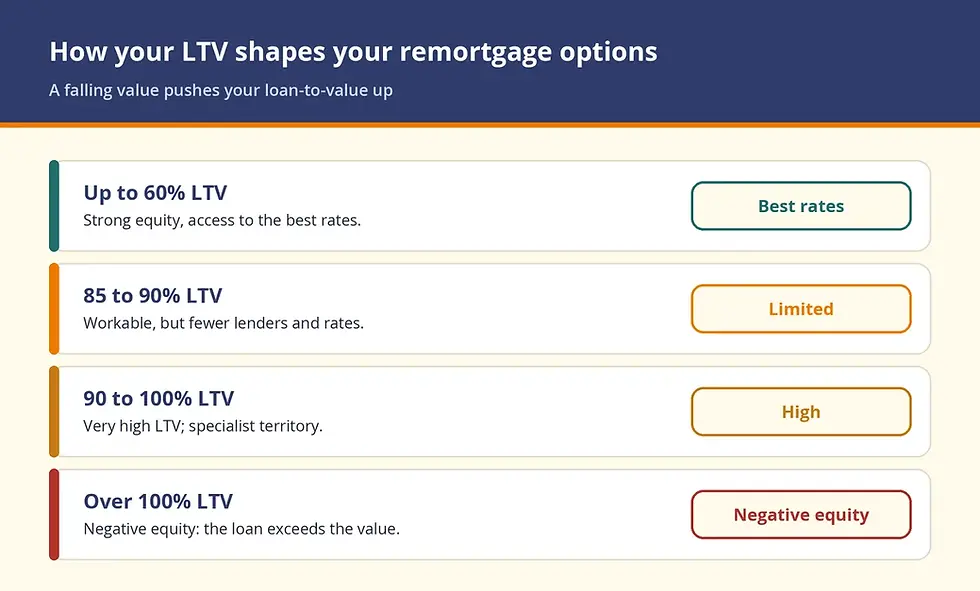
Understanding Equity and Loan-to-Value (LTV)
Your LTV is calculated as: Mortgage Balance ÷ Property Value × 100. The lower your LTV, the better rates you can access.
For example:
Up to 60% LTV: strong equity, access to the best rates
85 to 90% LTV: limited but available options
90 to 100% LTV: very high LTV, specialist options
Over 100% LTV: negative equity, the most restricted
How to work out your current LTV
Start with a realistic value, not the figure you hoped for. Look at what similar homes nearby have actually sold for recently, or ask an estate agent for an honest appraisal, then divide your outstanding mortgage by that value and multiply by 100. A £190,000 mortgage on a home now worth £200,000 is a 95 percent LTV. It pays to be conservative, because the lender's own surveyor will value the property and lend against the lower figure. Knowing your likely LTV before you apply tells you which lenders are realistic, and our full guide to remortgaging walks through the wider process. Getting that number right early is one of the most useful things you can do.
Can You Remortgage in Negative Equity?
Yes, but your choices are narrower. Most high-street lenders won’t remortgage if your home is in negative equity, as it increases risk. However, specialist lenders may consider it if:
Payments have always been made on time
The value drop is small (under 10%)
The borrower’s income and credit profile are strong
Will a value drop change your payments right now?
If you are part-way through a fixed or tracker deal, a fall in value does not change your monthly payment, and your lender will not ask you to make up the difference. The value really only matters at two moments: when your current deal ends and you want to switch, and if you want to borrow more. So if your fix has time to run, you often have breathing room to let the market settle or to chip away at the balance before you need to remortgage. The risk to plan around is slipping onto your lender's higher standard variable rate if you do nothing when the deal ends.
How Much Negative Equity Is “Too Much”?
Every lender sets internal thresholds. A small fall (for example, 5–8%) may be manageable. Larger drops (15% or more) often trigger stricter limits or short-term renewals rather than full remortgages. There is no single industry-wide figure, which is exactly why a broker who knows each lender's appetite is worth talking to before you assume you are stuck. Knowing roughly where you sit on that scale is the first step to a realistic plan.
What if you are in genuine negative equity?
True negative equity, where the mortgage is larger than the property is worth, narrows the options but does not freeze you in place. Staying put and keeping payments perfect is often the sensible first move, because the thing that matters most to a future lender is an unbroken payment record. A product transfer with your current lender usually remains available and avoids a fresh valuation. Overpaying where you can, even modestly, rebuilds equity faster than waiting alone. As the balance falls and values recover, your LTV improves and the wider market reopens. A broker can tell you the point at which it becomes worth re-testing the market. Until then, steady monthly payments quietly do the heavy lifting.
Lender Acceptance Spectrum
The lender acceptance spectrum can be summarised as:
Conservative lenders: Will not lend above 90% LTV
Mainstream lenders: May allow 90–95% LTV for strong credit profiles
Specialist intermediary lenders: May review cases up to 100% LTV if payments are stable and the property remains saleable
Policy Exceptions and Mitigating Factors
Lenders sometimes show flexibility when strong compensating factors exist, such as:
Long employment history
High disposable income
Low unsecured debt
Positive credit behaviour over several years
Product Transfer vs Full Remortgage
If you’re in negative equity, your current lender may still offer a product transfer, a new rate without a full remortgage. This avoids new underwriting or valuation costs and is often the most practical short-term solution until the property’s value recovers.
Related reading: Should You Product Transfer or Remortgage
In short, the two routes compare like this:
Product transfer | Full remortgage |
Stay with your current lender | Move to a new lender |
Usually no new valuation or legal work | New valuation and legal checks apply |
Light affordability check, if any | Full affordability and credit assessment |
Best when equity is tight or value has dropped | Best when you have equity and want a wider market |
Options if Your House Value Has Dropped
Stay with current lender via product transfer
Reduce balance with extra payments
Extend mortgage term to ease affordability
Seek a specialist remortgage (intermediary lenders)
Consider secured loan if you need additional funds
Wait and revalue after market recovery
Related reading: Does Remortgaging Always Extend Your Mortgage Term? UK Guide
Case Study: Remortgaging in a Down Market
A couple in Somerset bought a property for £260,000 in 2021 with a 10% deposit. By 2025, the home was valued at £240,000, leaving them at 96% LTV. Their initial lender declined a remortgage, but a broker secured a product transfer at a slightly higher rate, preserving payment stability. After one year of repayments and a mild value recovery, they successfully remortgaged to a lower-rate deal.
How Brokers Help in Falling-Value Cases
Brokers understand which lenders have flexible remortgage policies and can negotiate directly with underwriters.
They also:
Compare LTV thresholds across lenders
Help prepare accurate valuation evidence
Identify when to re-apply for better deals later
At Manor Mortgages, we’ve guided hundreds of clients through these scenarios, ensuring they don’t lose access to fair mortgage terms.
What Underwriters and Valuers Assess

Current property condition and saleability
Recent market comparables
Borrower payment history
Loan-to-value post-valuation
Employment and income stability
Market trends
House prices have been flat to slightly softer in many areas, so more homeowners find their LTV has crept up.
Lenders remain cautious, but are offering longer-term fixes for stability.
Equity-rich homeowners increasingly choose product transfers over full remortgages.
Common Mistakes to Avoid
Ignoring valuation issues until late in the process
Applying to multiple lenders and damaging credit score
Overestimating property value for affordability calculations
Assuming product transfers are automatically worse value as they often aren’t
Expert Tips for Improving Approval Chances
Order an early valuation to manage expectations
Reduce unsecured debts before applying
Keep mortgage payments consistent for at least 6–12 months
Avoid new credit commitments leading up to remortgage review
Use a broker for targeted lender matching
Related reading: What Happens If You Miss a Payment Before Remortgaging?
FAQs
Q: Can I switch lenders if my value has dropped?
Possibly, but most likely through a specialist lender.
Q: Is it worth remortgaging in negative equity?
Sometimes yes, if you can secure a better rate or avoid reverting to a higher SVR.
Q: Will my credit score affect the outcome?
Yes, strong credit can offset reduced equity.
Q: Should I wait for prices to recover?
If possible yes, but product transfers or partial repayments can help in the meantime.
Glossary of Key Terms
Negative Equity: When your mortgage exceeds property value.
Product Transfer: New deal with existing lender, without full remortgage.
Loan-to-Value (LTV): The ratio of mortgage amount to property value.
Reader’s Checklist: Questions to Ask
What’s my current property valuation?
What’s my estimated LTV?
Does my lender offer product transfers?
Could a specialist lender consider my case?
Should I reduce my balance before applying?
Conclusion & Next Steps
You can often remortgage even if your home’s value has dropped, but your strategy depends on equity level, income, and lender flexibility.
While mainstream banks may hesitate, intermediary lenders and broker-negotiated options can provide solutions. The key is not to panic, but to act early, get accurate valuations, and review your lender’s policies. Acting a few months before your deal ends gives you the most room to manoeuvre, whether that means overpaying, arranging a product transfer, or lining up a specialist remortgage. The earlier you start, the more of these routes stay open to you.
Updated 17 June 2026.
Written by Ben Stephenson, CeMAP-qualified mortgage broker at Manor Mortgages Direct.
Manor Mortgages Direct is FCA authorised (FRN 496907), established for nearly 30 years and rated 4.9★ on Google. Based in Bristol, we help clients across the UK remortgage in changing market conditions. Call 01275 399299.
Related Guides