
Is There a CCJ Amount Small Enough for Lenders to Ignore?
Find out how lenders actually treat a small CCJ, and why published value cut-offs help fewer borrowers than expected.
Quick Answer
Yes, some lenders publish a CCJ value threshold, typically between £200 and £500 in total, below which a satisfied judgment can be overlooked. But the median new consumer judgment in England and Wales is £602, so most borrowers sit above the line rather than under it.
The threshold is almost always an aggregate figure covering every judgment on your credit file, not an allowance for each one. It usually sits alongside a limit on how many judgments you can have. At several lenders it applies only once the judgment has been satisfied.
That means the amount is rarely the deciding variable. Whether the judgment has been paid, how many there are, and how long ago it was entered tend to matter more. A small unsatisfied judgment can be treated the same way as a very large one.
Reviewed by Ben Stephenson, FCA authorised (FRN 496907) · 25+ years' experience · 4.9★ on Google. Updated: 31 July 2026.
Who Is This Guide For
Best for buyers with a judgment of a few hundred pounds, remortgagors who assumed a low-value CCJ was harmless, and applicants with a disputed parking, telecoms or utility judgment, who all need to know whether the amount alone changes anything.
Key Points
Published lender thresholds run £200 to £500, not per judgment
Median new consumer judgment is £602, above every threshold
The commonest judgment value is £283, likely a parking charge
Table of Contents

Yes, a Threshold Exists, and It Sits Below the Median Judgment
Yes, there is an amount small enough for some lenders to look past. Several mainstream lenders publish a figure in their criteria, and the ones we could verify sat between £200 and £500 in total.
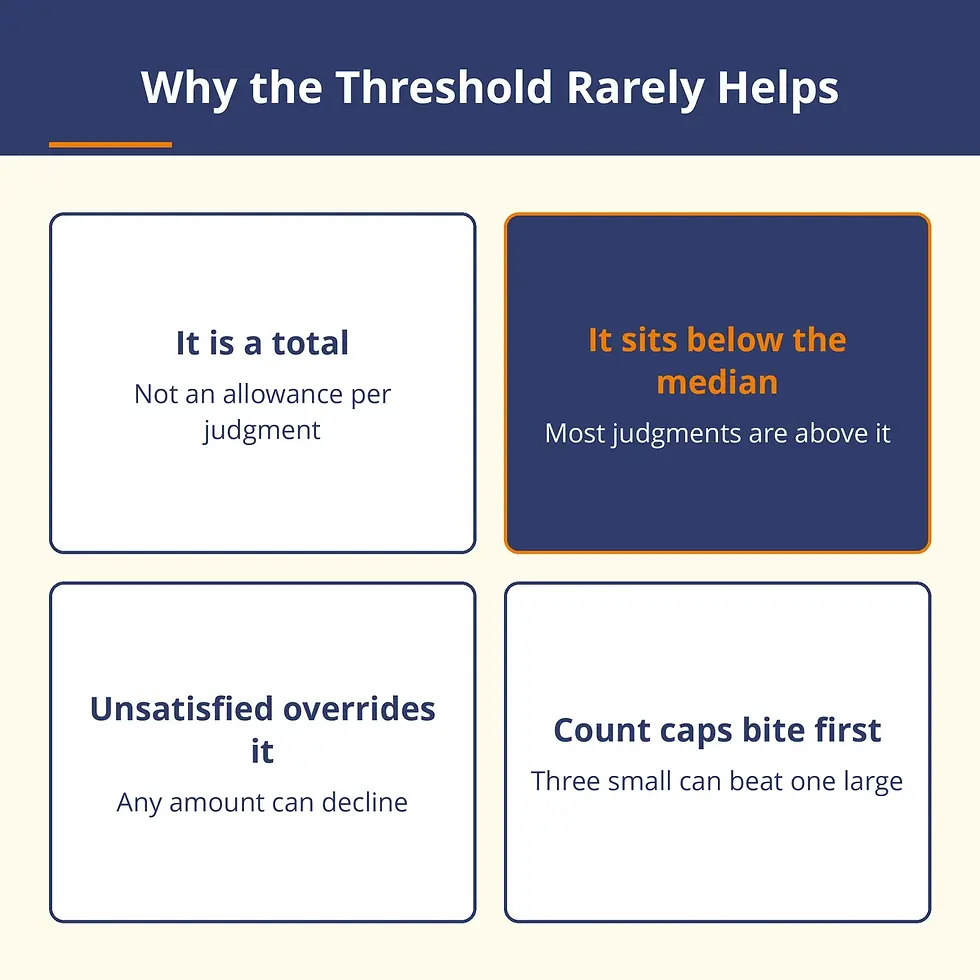
Here is the part that rarely gets said plainly. Registry Trust (2026) puts the median new consumer judgment in England and Wales at £602. Every published value threshold we identified sits below that number.
The market has not drawn its line at the middle of the market. It has drawn it underneath. A borrower with a judgment of £600, genuinely below the average and entirely typical, is above every mainstream value cut-off we found.
So the answer to the question in the title splits in two. A threshold exists, and most people's judgment is not under it. People hear that lenders ignore CCJs under a certain amount, assume they are inside it, and only discover otherwise when a decision in principle is declined.
Our bad credit mortgage pages cover the wider picture. This article stays on one question: the amount, and what the amount does and does not buy you.

What the Published Value Cut-Offs Actually Say
Lender criteria are published documents, and the value rules in them are specific. One mainstream lender declines where satisfied judgments total more than £200 and the most recent was entered within the past three years. Another sets the total at less than £500 across the credit file.
A third mainstream lender combines judgments and defaults into a single £500 total, permits no more than three of them inside three years, and requires each to have been satisfied at least three months before the application. A near-prime lender we reviewed sets £500 as well, but splits it: £500 satisfied on one product tier, £500 unsatisfied only if the borrower moves up to a higher tier.
Three things are consistent across all of them. The figure is a total, not a per-judgment allowance. It comes paired with a cap on the number of judgments. And it is almost always conditional on the judgment having been paid.
A fourth point matters more than the number itself. Several of these lenders decline any unsatisfied judgment outright, with no amount stated, so the value rule is unreachable until the judgment is settled.
None of this is fixed. Criteria change without notice, and the figures above were captured on 31 July 2026. Treat any published threshold as a snapshot rather than a standing promise.
How Small Is a Small CCJ? The Real Spread of Judgment Values
Most borrowers have no reference point for whether their own judgment is large or small. Registry Trust (2026) recorded 322,076 new consumer judgments in England and Wales in the second quarter of 2026, with a combined value of £565.9 million.
Of those, 45 per cent were for less than £500 and the median was £602. The single most frequent amount was £283, which appeared on 6,486 judgments in one quarter.
Divide the total value by the number of judgments and you get a mean of roughly £1,757, which is our own calculation rather than a published statistic. The mean is nearly three times the median, because a small number of very large judgments drags the average far above where most judgments sit.
That gap is why two contradictory statements are both true. The average CCJ is around £1,750, and most CCJs are a few hundred pounds. Borrowers anchor on the first figure and think theirs is tiny, while lenders set a threshold calibrated near the bottom of the second.
One correction is worth making explicitly, because it is repeated widely and we had it in our own notes. The quoted line is that around 43 per cent of judgments are under £500 and the median is about £500.
That 43 per cent comes from full-year 2025 reporting covering the UK and Ireland and both consumer and commercial judgments. The median of £500 was never a published median. Registry Trust's own quarterly figures for England and Wales consumer judgments are 45 per cent below £500, with a median of £602 in the second quarter of 2026 and £607 in the first.
Judgment value measure, new consumer judgments, England and Wales | Figure |
Most frequent single judgment amount | £283 |
Median judgment value | £602 |
Mean judgment value (our calculation) | £1,757 |
Share of judgments below £500 | 45 per cent |
Share of judgments above £3,000 | 12 per cent |
Share of total judgment value held by that top 12 per cent | 61 per cent |
Typical published lender value threshold | £200 to £500 |
Read the last two rows together and the shape becomes clear. Most judgments are small, but most judgment money is not. Thresholds are set against the first fact, risk appetite against the second.
Why the Figure Is a Total, Not an Allowance Per Judgment
This is the most common misreading of a published threshold, and it costs applications. Every value rule we located is expressed as a total across the credit file, not as a limit for each judgment.
The wording in one set of criteria is "satisfied CCJs totalling more than £200". Another says "total value of all CCJs on the credit report must be less than £500". A third permits "not more than three CCJs or defaults of less than a total of £500". In each case the arithmetic is done on the whole file, then compared to the number.
We did not find a per-judgment threshold at any lender. That does not prove none exists anywhere in the market, but it does mean you should not plan an application around the assumption that each judgment gets its own allowance.
One phrasing deserves particular attention. "Total value of all CCJs on the credit report" is not the same as "all CCJs in the last three years". On a literal reading it sweeps in every judgment still visible on the file, including one from four or five years ago that feels long dead to the borrower.
That older entry can quietly consume the allowance before the recent one is counted. Two £180 judgments do not each get measured against £200. They are added together and measured as £360.
Three £300 Judgments Versus One £900 Judgment
Here is a comparison that surprises almost everyone. On total value, three judgments of £300 look better than one of £1,500. On lender criteria, the single £1,500 judgment often has more homes available.
The reason is that the count cap bites before the value cap does. Take one mainstream lender that allows a £500 total but only one judgment inside three years. A single satisfied judgment of £450 can be acceptable. Three satisfied judgments of £150 each total £450, comfortably inside the same £500, and are declined on the count rule alone.
Change lender and the answer flips. Another mainstream lender permits up to three judgments or defaults, still subject to the same £500 combined total. The identical three-judgment case can work there. Same facts, opposite outcomes, decided by a rule that has nothing to do with the money.
There is an underwriting logic behind this, and one lender's published criteria states it openly: historic adverse credit should be linked to a single life event with an explanation the underwriter can accept. One judgment of £900 reads as an event, a dispute or an illness or a house move where post went to the old address.
Three judgments of £300 across eighteen months read as a pattern instead, a borrower who repeatedly does not open post or engage with a claim. Underwriters price patterns more harshly than events, even when the pattern adds up to less money.
Two applicants with the same total can therefore need completely different lenders, and the one with the smaller aggregate can be the harder case. Our specialist lender route exists largely for this kind of mismatch between arithmetic and criteria.
A Small CCJ You Have Already Satisfied Still Counts
Paying a small judgment helps, and it helps meaningfully. It does not make the judgment disappear, and that belief is an expensive one.
Registry Trust (2026) is direct about it: a satisfied judgment stays visible for six years and is marked as cleared, showing when it was paid. Satisfaction does not remove the entry and does not automatically lift a credit score. The published criteria bear this out, because satisfied judgments are still counted, still added to an aggregate, and still capped by number.
There is one narrow exception, and it turns on the calendar rather than the amount. Under the Register of Judgments, Orders and Fines Regulations 2005, where a judgment is satisfied within one calendar month of the judgment date, the entry is cancelled rather than endorsed. Pay after that month and it is simply marked satisfied and remains for the balance of six years.
Read that against the question in the title and it reframes the whole thing. No amount is small enough to be ignored by the register, yet any amount paid inside one calendar month comes off entirely. A £9,000 judgment settled in 28 days is cancelled, while a £150 judgment settled in 35 days sits on the file for six years.
The mirror image also holds, and it is the harshest rule here. At several lenders, an unsatisfied judgment is a decline with no amount stated. An unsatisfied £40 judgment fails the same test that fails an unsatisfied £40,000 judgment, so a small judgment is treated identically to a large one.
Borrowers in that position are not out of options, but they are usually in a different part of the market. Our guidance on an unsatisfied CCJ mortgage covers the tiers that can still work, and it is honest about the trade-off: rates and fees in the specialist tier are typically higher than mainstream pricing, sometimes materially so.
Where the judgment is genuinely owed and paying is affordable, settling it usually widens the options. Where the debt is disputed, settling it can undermine the dispute.
Parking Tickets, Broadband Bills and the £283 Judgment
Return to the most frequent judgment amount for a moment. Across the whole register, the single commonest consumer judgment value is £277, appearing on 65,505 entries. For new judgments it is £283. Registry Trust (2025) noted in its response to the government's parking consultation that the top twenty judgment values all fall between £185 and £298, and that this strongly suggests a large share relate to standardised penalty charges such as parking fines.
Put plainly: on the balance of the evidence, the commonest CCJ in England and Wales is a parking charge, often one that started at £60 to £130. Registry Trust cited a motorist originally charged £135 who ended up owing £258.36 once interest, listing fees, hearing fees and mileage were added.
So does the origin of the debt change how the judgment is treated? On the criteria we examined, essentially no. Not one of the four criteria sets we reviewed contained any carve-out or discount based on what the underlying debt was. They say "CCJ" and stop there.
There is a structural reason. The register holds the amount, date, court and status, but Registry Trust does not receive claimant details from the courts. A lender usually cannot tell whether your £283 was a car park, a mobile contract or a payday loan.
Here is the sharper point. Lenders do sometimes carve out non-credit debt, but they do it for defaults, not judgments. One lender's published criteria disregards up to £250 of combined telecoms and utility defaults, satisfied or not, across all its lending types.
That concession exists one step earlier in the chain, and once the same telecoms dispute becomes a court judgment it disappears. If your adverse stopped at the default stage, our mobile or utility default guidance is the more relevant read.
One distinction is worth getting right, because borrowers routinely confuse the two. A private parking charge notice, issued on private land by an operator, is a contractual claim. National Debtline (2026) confirms the notice itself does not appear on your credit file, but that if the operator obtains a county court judgment, it is usually recorded for six years. That is a full CCJ.
A council penalty charge notice is a different instrument, enforced through the Traffic Enforcement Centre rather than by an ordinary county court claim. National Debtline (2026) describes the council as registering the charge "as if it is" a county court judgment, and the registration regulations do not list those orders among registrable judgments. On that evidence it does not ordinarily create a CCJ on your credit file, though no source states that in terms, so treat it as a mechanism worth checking rather than a settled certainty.
"It was only a parking ticket" can therefore describe something invisible to lenders, or a judgment that fails a £200 aggregate threshold. The borrower rarely knows which, which is why we pull the register entry rather than take anyone's word for it.
The Pattern We See Most: A Few Hundred Pounds, Never Satisfied, Assumed Harmless
The single most common presentation we see on this axis is not a large judgment. It is a judgment somewhere between £200 and £400, two or three years old, still unsatisfied, from a dispute the borrower believed had gone away.
They have usually read that small judgments are ignored, and they are half right. The amount genuinely is inside several published thresholds. What they have missed is that those thresholds are switched off entirely while the judgment is unpaid, so the favourable number never comes into play.
The second is the aggregate surprise: two or three judgments, none of them large, that the borrower thinks of individually. Added together they clear £500 and the count cap at the same time, and neither problem is visible until someone does the arithmetic the way the criteria do.
The third is timing regret: a judgment settled six weeks after it was entered, missing the one calendar month cancellation window by a fortnight, leaving a six-year entry that could have been removed altogether.
An illustrative case study
An IT contractor in the South East came to us with a £240 judgment from a disputed broadband bill, entered two years earlier and never satisfied. They were buying at £385,000 with a 20 per cent deposit of £77,000, borrowing £308,000 at 80 per cent loan to value on contractor income equivalent to roughly £78,000 a year. Two mainstream lenders declined on the unsatisfied judgment alone, despite the amount sitting inside both of their published value thresholds.
The judgment was settled, evidence of the dispute was documented, and the case was placed in the near-prime tier, where affordability was tested at a stress rate materially above the pay rate on the product itself. This is an illustrative composite built from typical cases rather than a specific client, and the outcome is not a prediction of what any individual application may achieve.
Contractor income adds a second layer, and a strong income does not automatically neutralise a low score. Our page on a low credit score with high income covers that combination.
What to Check Before You Assume Your CCJ Is Too Small to Matter
Start with the register entry rather than your memory of it. Amounts escalate through fees and interest, so the judgment figure is frequently higher than the debt you remember.
Then answer four questions in order, because lenders apply them in roughly this sequence.
Is it satisfied, and if not, can it be settled before you apply?
How many judgments are visible on the file in total?
What is the combined value of all of them, not just the most recent?
How long ago was each one entered?
Only after those four does the amount become the deciding factor, and by then it is often no longer the binding constraint. "Is my CCJ small enough" is usually the fourth-most-important question, not the first.
There is no minimum value for registration, incidentally. The registration regulations require a return of every judgment entered, with no monetary floor in them, and Experian (2026) says the same. The 65,505 entries sitting at exactly £277 are the proof.
Finally, be realistic about cost. Moving to a lender whose criteria accommodate your judgment often means accepting a higher rate, a product fee, or both. That trade-off can still be worth making where the alternative is waiting six years, but it should be a decision made with the numbers in front of you rather than a surprise at offer stage.
FAQs
Is there a minimum CCJ amount that does not get registered?
No. The Register of Judgments, Orders and Fines Regulations 2005 require a return of every judgment entered, and no monetary floor appears anywhere in them. Registry Trust (2026) data shows tens of thousands of entries at values under £300, which would not exist if small judgments went unrecorded. The threshold you may have heard about is a lender criteria figure, not a registration rule.
Does a £200 CCJ affect a mortgage application as much as a £2,000 one?
Sometimes yes, and sometimes it is treated far more leniently, depending entirely on whether it has been satisfied. Where a lender's published criteria decline any unsatisfied judgment with no amount stated, a £200 unsatisfied judgment fails the same test as a £2,000 one. Where the judgment is satisfied and sits inside an aggregate threshold of £200 to £500, the smaller figure can genuinely help.
If I pay a small CCJ, does it come off my credit file?
Only if you pay it within one calendar month of the judgment date, in which case the entry is cancelled. Paid after that window, it is endorsed as satisfied and stays visible for six years from the judgment date. This rule turns on timing rather than value, so a large judgment paid quickly can be removed while a small one paid slowly is not.
Are two small CCJs better than one larger one?
Usually not, because most lenders cap the number of judgments as well as the total value, and the count cap tends to bite first. Two satisfied judgments of £100 each can be declined by a lender that would have accepted one satisfied judgment of £200. Underwriters also tend to read several judgments as a pattern rather than a single event.
Does it matter that my CCJ came from a parking ticket rather than a loan?
Not to the criteria we reviewed, which make no distinction based on what the underlying debt was. Registry Trust does not receive claimant details from the courts, so a lender generally cannot see the origin from the entry at all. If the origin is a genuine mitigation, you have to supply and evidence it yourself, which some lenders explicitly allow for a documented settled dispute.
Summary
A value cut-off does exist in published lender criteria, generally somewhere between £200 and £500 across the whole credit file. The difficulty is that this line sits below the typical judgment in England and Wales, so most borrowers fall outside it. Satisfaction status, the number of judgments and their age usually decide the case before the amount does. If you are unsure which side of the line you sit on, it is worth checking properly.
Updated: 31 July 2026
Written by Ben Stephenson, CeMAP-qualified Mortgage Broker.
Manor Mortgages Direct is FCA authorised, FRN 496907, has traded for 25 years, is highly positively reviewed, 4.9 rated on Google, and has helped thousands secure the right mortgage. Bristol-based mortgage brokers, assisting clients nationwide.
Sources
Registry Trust (2026) - https://www.registry-trust.org.uk/court-judgment-statistics/q2-2026-summary - accessed 31 July 2026
Registry Trust (2026) - https://www.registry-trust.org.uk/court-judgment-statistics/q1-2026-summary - accessed 31 July 2026
Registry Trust (2025) - https://www.registry-trust.org.uk/news-and-insights/parking-fines-and-ccjs-our-response-to-the-government-s-consultation - accessed 31 July 2026
Registry Trust (2025) - https://www.registry-trust.org.uk/news-and-insights/decoding-debt-unpacking-the-landscape-of-monetary-judgments - accessed 31 July 2026
Registry Trust (2026) - https://www.registry-trust.org.uk/court-judgments/ccj-guide - accessed 31 July 2026
legislation.gov.uk (2005) - https://www.legislation.gov.uk/uksi/2005/3595/regulation/8/made - accessed 31 July 2026
legislation.gov.uk (2005) - https://www.legislation.gov.uk/uksi/2005/3595/regulation/11/made - accessed 31 July 2026
National Debtline (2026) - https://nationaldebtline.org/get-information/guides/parking-charge-notices-ew/ - accessed 31 July 2026
National Debtline (2026) - https://nationaldebtline.org/get-information/guides/penalty-charge-notices-ew/ - accessed 31 July 2026
Experian (2026) - https://www.experian.co.uk/consumer/guides/ccjs.html - accessed 31 July 2026
The Intermediary (2026) - https://theintermediary.co.uk/2026/03/ccj-volumes-hit-highest-level-since-2019-research-reveals/ - accessed 31 July 2026
Related Guides