
Which Surveys Should First-Time Buyers Pay For, and Which Can Be Skipped?
Updated: Sep 4
Paying for the right survey can save thousands later.
We are FCA authorised (496907) • 25+ years’ experience • Highly Reviewed (4.9★) on Google
Key Points
Mortgage valuations are not full surveys
HomeBuyer Reports suit most modern properties
Building Surveys suit older or unusual homes
Skipping surveys may lead to costly repairs
Survey choice depends on property condition

Quick Answer
First-time buyers in the UK often need to decide between three main survey types, a mortgage valuation, a HomeBuyer Report, and a full Building Survey.
The key point is that a mortgage valuation is not designed to protect the buyer, it is carried out for the lender’s benefit and may not highlight structural issues.
For most standard properties built after 1930 and in reasonable condition, a HomeBuyer Report is often considered sufficient, providing a balanced level of detail without excessive cost.
However, for older properties, unusual constructions, or homes requiring renovation, a Building Survey may be more appropriate, offering a comprehensive inspection.
According to the Royal Institution of Chartered Surveyors, around 20% of homebuyers who skip surveys uncover issues after purchase, often costing thousands to fix. This highlights why choosing the right survey matters.
While it may be tempting to save money upfront, skipping a survey entirely can expose buyers to hidden defects such as damp, structural movement, or roof problems.
However, in limited situations, such as new-build homes with warranties, some buyers may opt for a lighter level of inspection.
Updated: 13 March 2026
Written by Ben Stephenson, CeMAP-qualified Mortgage Broker, and reviewed by Mortgage Experts.
Manor Mortgages Direct is FCA authorised, FRN 496907, has traded for nearly 30 years, is highly positively reviewed, 4.9 rated on Google, and has helped thousands secure the right mortgage. Bristol-based mortgage brokers, assisting clients nationwide.
Table of Contents
What is a property survey and why does it matter?
The three main types of surveys explained
What a mortgage valuation actually covers
Which surveys first-time buyers should pay for
When can you skip a survey?
What surveyors actually look for
Myth vs reality about surveys
Policy exceptions and property risk tolerance
Market trends in 2026
Expert tips and mistakes to avoid
Case study example
FAQs
Checklist for next steps
What Is a Property Survey and Why Does It Matter?
A property survey is an independent inspection of a property's condition, typically carried out by a RICS-qualified surveyor.
Its purpose is to identify:
Structural issues
Damp or timber problems
Roof and drainage concerns
Potential legal or boundary issues
According to RICS guidance, surveys are designed to inform buyers about risks before exchange, when it is still possible to renegotiate or withdraw.
Without a survey, buyers rely largely on visual impressions and estate agent details, which may not reveal hidden issues.
The Three Main Types of Surveys Explained
1. Mortgage Valuation
This is often the first confusion point.
A mortgage valuation:
Is arranged by the lender
Confirms the property value for lending purposes
Is not a detailed inspection
Some valuations are done remotely or very briefly.
Important: This report is for the lender, not the buyer.
2. HomeBuyer Report (Level 2 Survey)
This is the most common choice for first-time buyers.
It includes:
General condition rating (traffic light system)
Identification of urgent issues
Advice on repairs and maintenance
Suitable for:
Properties in reasonable condition
Standard construction homes
Homes built after 1930
It typically avoids intrusive inspection but still highlights key risks.
3. Building Survey (Level 3 Survey)
The most detailed and comprehensive option.
It includes:
In-depth structural analysis
Detailed defect reporting
Advice on repairs and potential costs
Suitable for:
Older properties (pre-1930)
Unusual construction types
Renovation projects
According to RICS, Building Surveys provide the highest level of detail available.
What a Mortgage Valuation Actually Covers
Many first-time buyers assume the valuation doubles as a survey.
In reality, it usually covers:
Basic property condition
Market value confirmation
Obvious major defects only
It may not:
Identify damp issues
Highlight structural movement
Detect hidden defects
This misunderstanding is one of the most common causes of post-purchase surprises.
Which Surveys Should First-Time Buyers Pay For?
Most Common Scenario
For a typical first-time buyer purchasing a standard UK home:
A HomeBuyer Report is often appropriate
It balances:
Cost efficiency
Practical insight
Risk awareness
Higher-Risk Properties
You may want to consider a Building Survey if the property:
Is over 80–100 years old
Shows visible signs of wear
Has been heavily altered or extended
Skipping a detailed survey in these cases may increase the risk of unexpected costs.
Lower-Risk Situations
Some buyers consider lighter inspection options where:
The property is a new build with warranty
It has recently been renovated professionally
The buyer has strong knowledge of property
Even in these cases, risks may still exist.
When Can You Skip a Survey?
While not generally recommended, some scenarios exist where buyers may choose to skip a survey.
Examples include:
Brand-new homes with NHBC or equivalent warranties
Cash buyers with renovation experience
Very low-value transactions
However, even new builds can have issues.
Industry reports have highlighted that snagging defects are common in new homes, which means inspections still provide value.
What Surveyors Actually Look For
Surveyors assess a wide range of factors beyond surface appearance.
Key areas include:
Structure
Cracks, subsidence indicators, movement
Damp and timber
Rising damp, condensation, rot
Roof condition
Missing tiles, structural integrity
Services (limited checks)
Visible plumbing and electrics
Legal risks
Boundaries, shared access issues
Their role is to highlight risks, not to provide guarantees.
Myth vs Reality About Property Surveys
Myth: Surveys are optional extras
Reality: They are one of the few opportunities to identify risks before commitment.
Myth: New builds do not need surveys
Reality: Even new homes can have defects, often identified through snagging inspections.
Myth: A valuation is enough
Reality: Valuations are not designed to protect buyers.
Policy Exceptions Insight
In some cases, lenders may proceed without requiring a full survey beyond the valuation.
This may occur where:
Loan-to-value ratios are low
Property types are standard
Risk appears minimal
However, this reflects the lender’s risk, not the buyer’s.
Some buyers working with brokers explore broader solutions through areas like a Specialist Mortgage, particularly where properties are unusual or survey findings raise concerns.
The Lender Acceptance Spectrum
Properties also sit on a risk spectrum, similar to borrowers.
Low-risk properties
Modern construction
Good condition
Minimal alterations
Higher-risk properties
Older homes
Structural concerns
Non-standard construction
Higher-risk properties often require more detailed surveys and sometimes specialist lenders.
Market Trends: What’s Changed in the Last 12 Months
Several trends have shaped survey decisions:
Increased repair costs
According to UK construction cost data, material and labour costs have risen significantly since 2022, increasing the financial risk of undiscovered defects.
Greater buyer caution
More buyers are opting for surveys after experiencing or hearing about unexpected repair costs.
Growth in renovation purchases
Rising property prices have led more buyers to consider properties needing work, increasing demand for Building Surveys.
Case Study Example
A first-time buyer purchased a Victorian terrace without a survey to save costs.
Scenario
Purchase price £285,000
No survey carried out
Mortgage valuation completed only
Shortly after completion, the buyer discovered:
Significant damp issues
Timber decay in floor joists
Roof repairs needed
Estimated repair cost exceeded £12,000.
In similar cases, a Building Survey may have identified these issues before purchase, allowing renegotiation or reconsideration.
Expert Tips and Common Mistakes to Avoid
Helpful tips
Match the survey to the property type
Budget for survey costs early
Review the report carefully, not just the summary
Ask surveyors follow-up questions
Common mistakes
Relying on the lender’s valuation
Choosing the cheapest option without considering risk
Ignoring survey recommendations
Small upfront savings can sometimes lead to larger long-term costs.
Comparing Different Borrower Types
Survey needs can vary depending on the buyer:
First-time buyers
Often benefit from more detailed surveys due to limited experience.
Investors
May rely more on experience but still use surveys for risk assessment.
Expats
Property purchases from abroad can involve additional risk, making surveys particularly valuable. Buyers in this situation sometimes explore options such as Expat Mortgages, where remote decision-making increases reliance on professional reports.
Why This Matters in the 2026 Market
In today’s market, margins are tighter.
Unexpected repair costs can affect:
affordability
renovation timelines
long-term financial planning
According to UK housing condition surveys, a significant proportion of homes, particularly older stock, require ongoing maintenance or repairs.
Understanding survey options helps buyers make more informed decisions.
Broker Insights: What We See Most Often
From a brokerage perspective, survey issues often arise when:
buyers rely solely on valuations
older properties are purchased without detailed checks
survey findings delay mortgage approvals
Survey results can sometimes impact lender decisions, particularly where structural issues are identified.
FAQs
Do I need a survey if I am getting a mortgage?
Yes, although not always required, surveys provide independent protection for the buyer.
Is a HomeBuyer Report enough?
For many standard properties, it is often sufficient. More complex homes may require a Building Survey.
Can I skip a survey on a new build?
Some buyers do, but issues can still arise. Snagging inspections are often recommended.
How much do surveys cost?
Typical costs range from £400 to £1,500+ depending on survey type and property size.
Will a bad survey affect my mortgage?
It can. Lenders may reassess the property or request repairs before proceeding.
Can I renegotiate after a survey?
Yes, survey findings are often used to renegotiate price or request repairs.
Checklist for Next Steps
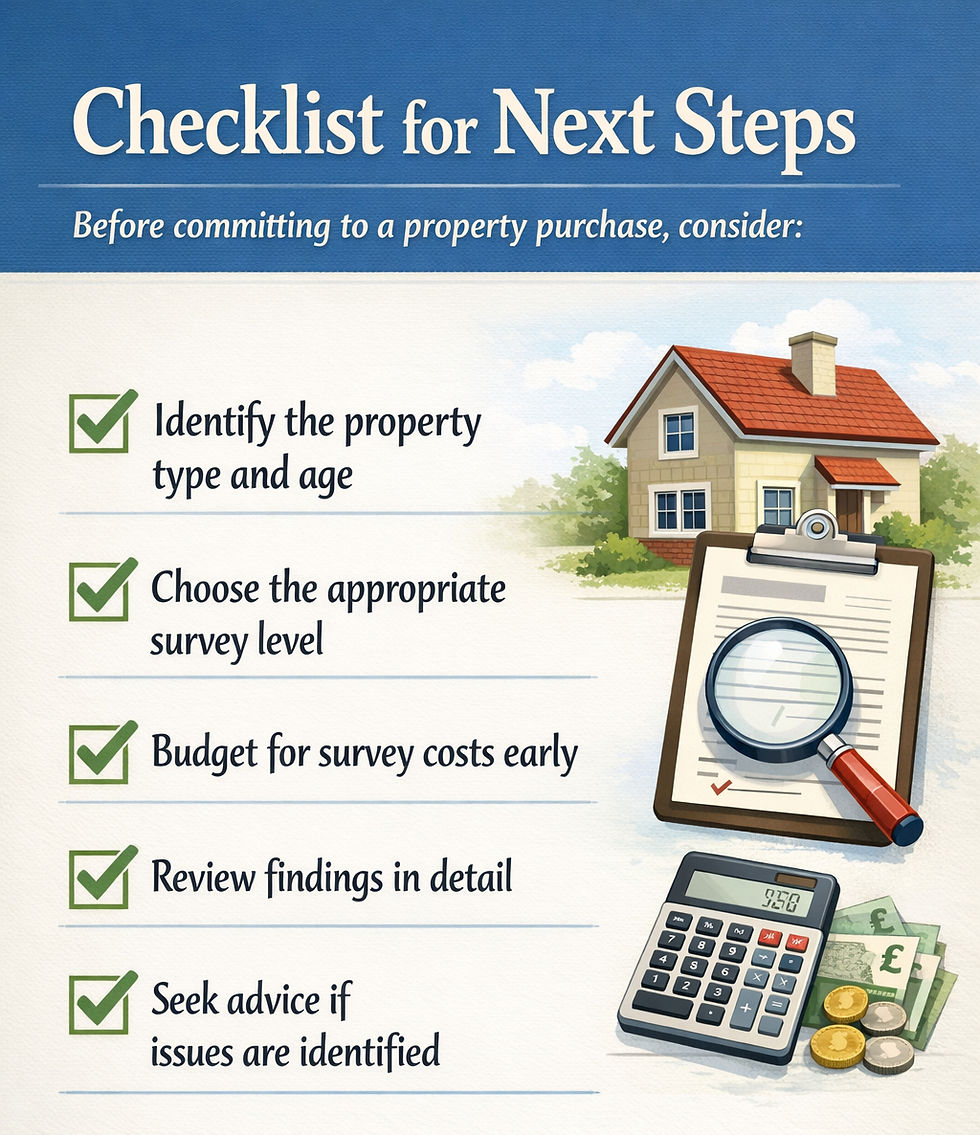
Making the right survey choice can help reduce risk and provide greater confidence in your purchase.
Final Thoughts
Choosing the right property survey is less about ticking a box and more about protecting yourself from avoidable financial risk.
While it may feel like an optional extra during an already expensive process, a well-chosen survey can highlight issues that are not visible during viewings and may influence your decision to proceed, renegotiate, or walk away.
For most first-time buyers, the key is to match the level of survey to the property, not simply choose the cheapest option.
A modest upfront investment in the right report may prevent far greater costs later. At the same time, not every property requires the most detailed survey, understanding the balance is where informed decisions are made.
If anything in a report feels unclear or concerning, it is worth asking questions early. Mortgage timelines, negotiations, and even lender decisions can be influenced by survey findings, so clarity matters.
Ultimately, buying your first home is one of the largest financial commitments you will make. Taking a careful, informed approach to surveys can help ensure there are fewer surprises after you get the keys.