
Which Lenders Accept a Default Registered One to Two Years Ago?
Find out why the same one to two year default lands at wildly different lender ceilings, and what genuinely moves it.
Quick Answer
Much of the specialist tier and several mainstream mutuals accept a default registered one to two years ago. Published criteria read on 31 July 2026 ran from a seventy percent loan to value ceiling at one lender to ninety five percent at another, on the identical single default.
The spread is the answer to the question. It is not produced by anything the borrower did, and within this band it is barely produced by the age of the default either. It is produced almost entirely by which lender's criteria are reading the file.
The boundaries that do move the answer sit at twelve, twenty four and thirty six months. Ageing from thirteen months to twenty three months changed nothing at any lender examined, so counting weeks inside the band is wasted effort. One further variable matters near a boundary: some lenders test the default at application, and at least one tests it at completion.
Reviewed by Ben Stephenson, FCA authorised (FRN 496907) · 25+ years' experience · 4.9★ on Google. Updated: 31 July 2026.
Who Is This Guide For
Best for buyers who defaulted during a job loss or illness a year or two back, self-employed applicants whose accounts have since recovered, and remortgagors coming off a fixed rate, who have been told a recent default rules them out.
Key Points
Published ceilings ran 70% to 95% on identical facts
Ageing from 13 to 23 months changes nothing
One lender tests at completion, others at application
Table of Contents
The Same One to Two Year Old Default, Six Different Lender Answers
Seventy Percent LTV at One Lender, Ninety Five at Another, on One Two Year Old File
Thirteen Months or Twenty Three Months: the Band Where Waiting Stops Paying
Is Your Default Twenty Months Old at Application, or at Completion?
Twenty Four Clean Months Since It Was Registered, and What They Earn
Two or Three Adverse Entries Inside the Same Two Year Window
The Lines on Your File That Decide a Twenty Month Old Default

The Same One to Two Year Old Default, Six Different Lender Answers
Take one borrower with a single default registered eighteen months ago. On 31 July 2026 we read published residential criteria against that one fact. The answers did not merely differ in price. They differed on whether the case was possible at all.
One near-prime published grid took it to ninety five percent loan to value. A large mutual also reached ninety five percent, but only where the default was satisfied and the combined value came under five hundred pounds. A deep specialist took it to ninety percent on a purchase, and disregarded the default completely if it was under five hundred pounds.
A second mutual declined it outright unless it was both satisfied and under five hundred pounds, with one such entry permitted in three years. A manual-underwriting mutual accepted it, but only by pushing the case onto a credit repair range capped at seventy percent. A mainstream scorecard bank published no answer at all, saying only that it considers defaults depending on the value and the date registered.
That is the whole post in one paragraph: an identical fact pattern, a published ceiling running from seventy percent to ninety five percent, and a flat decline among the answers.
Now the uncomfortable part. Very little of that spread is about you. Inside this band the largest single determinant of your answer is whose criteria read the file, not what you have done since.
That does not make preparation worthless, but it does mean you should choose the reading before you optimise the file.
Our overview of mortgages with bad credit is the wider map if you are at the start of this. Every threshold below is a snapshot of criteria published at 31 July 2026, and criteria change frequently.
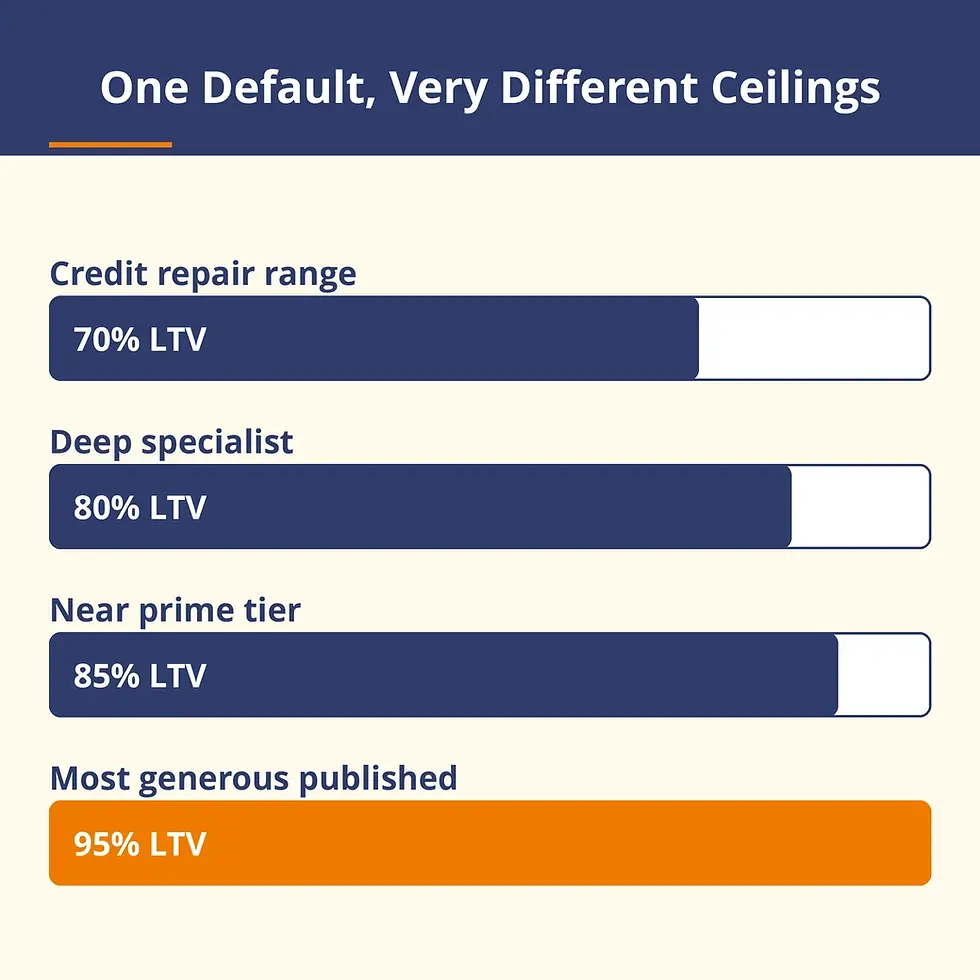
Seventy Percent LTV at One Lender, Ninety Five at Another, on One Two Year Old File
Two different mechanics produce that spread, and most online advice collapses them into one.
The first is a ceiling created by tier assignment. The default does not cap your borrowing directly; it pushes the case onto a product whose own maximum happens to be lower.
The clearest example sits at a manual-underwriting mutual whose standard lending requires thirty six clean months and whose two mid-tier ranges each require twenty four. A default anywhere in our band fails all three, so the case falls to the credit repair range, which stops at seventy percent.
That seventy percent is a property of the product, not a verdict on the default. At three other lenders the same default left the ceiling untouched, so reading it as proof that a default demands a thirty percent deposit is simply wrong. How these credit repair mortgage ranges are structured explains most of the low ceilings you see quoted.
The second mechanic is a ceiling that does not move. On one near-prime published grid, a single default in the twelve to twenty four month window drops the case out of the top two tiers onto the third, and that third tier still runs to ninety five percent. Nothing about the deposit changes; the default costs price instead.
How much price? On that lender's own published tables, current at 31 July 2026, the gap between its clean tier and the tier accepting a twelve to twenty four month old default came to roughly 0.4 to 0.5 percentage points, holding within that narrow band at four separate loan to value levels.
That is one lender on one day, not a market figure, and it is not a rate. It does show that the cost of this band can be far smaller than the multiple-point penalty implied online. The fifteen to twenty five percent deposit figure quoted elsewhere is not a general rule either.
Financial Reporter (2026) notes that as the severity or recency of adverse credit increases, lenders often tighten maximum loan to value thresholds, treating it as a risk control rather than only a pricing dial. Some pull the deposit lever, some the price lever, at least one neither. The near-prime tier is where that second behaviour lives.
Thirteen Months or Twenty Three Months: the Band Where Waiting Stops Paying
Readers in this band count weeks. The evidence says stop counting.
Across every set of criteria we read on 31 July 2026, not one lender distinguished a default registered thirteen months ago from one registered twenty three months ago. Both fell inside the same test everywhere, so both produced the same answer.
At lenders writing in whole years, both sit inside the last three years, so the same value cap and satisfaction requirement apply. At the lender writing in months, both are inside twenty four months and past the twelve month line, so both land on the same tier.
That is the counter-intuitive part. Criteria written in months are not more granular inside this band than criteria written in whole years, and both wordings treat thirteen and twenty three months as the same thing.
What months-based wording does is put the boundaries somewhere different. Months-based criteria break at twelve, twenty four and thirty six; whole-year criteria break at three years and again at six. The band is wide precisely because those boundaries land at scattered points across it.
The movement is all at the edges.
Twelve months. On one near-prime grid, defaults inside twelve months face a fifteen hundred pound value cap, and past twelve months the cap disappears. A fourteen thousand pound default at thirteen months is treated identically to a nine hundred pound one at twenty three months.
Twenty four months. At the manual-underwriting mutual, twenty three months means credit repair at seventy percent and twenty five months means a mid-tier range at eighty five percent. Fifteen loan to value points sit on one boundary.
Thirty six months. The whole-year mutuals loosen, and one specialist disregards defaults over three years old altogether.
Waiting from thirteen months to twenty three months bought nothing at any lender we examined. Waiting from twenty three to twenty five months could buy a great deal at one of them.
Almost no guide says this, and readers routinely delay applying on an assumption the criteria do not support. If you are going to wait, wait to a boundary.
Where the default sits when it is tested | What that position actually changes |
Under twelve months | Value caps bite hardest, one grid caps the default at £1,500, several mutuals are closed |
Thirteen to twenty three months | No lender examined distinguished one month from another inside this range |
Crossing twenty four months | One mutual's ceiling moves from 70% to 85%, one grid returns the case toward clean tiers |
Crossing thirty six months | Whole-year mutual thresholds relax, one specialist disregards the default entirely |
Any age, value under £500 | Disregarded outright at one specialist, an aggregate decline trigger at three mutuals |
Any age, still unsatisfied | An absolute bar at several lenders, and completely irrelevant at others |
Is Your Default Twenty Months Old at Application, or at Completion?
This is the most actionable finding in the post, and it is almost never mentioned.
Lenders publish the measurement point in directly opposite directions. One deep specialist states on its live broker page that criteria are based on the customer's credit profile at the date of completion, not application. One scored mutual states twice, for two separate rules, that a default must be satisfied at the time of application, and one near-prime grid excludes anything recorded in the three months before application. Most other lenders publish nothing on the point.
So the widely repeated claim that lenders count your default from the application date is only sometimes true. Where it is not, the weeks between application and completion are quietly working in your favour.
The consequence is concrete. A default that is twenty two or twenty three months old at application is typically past twenty four months by the time a purchase completes. At a completion-measured lender that can move the case up a tier, and on the laddered mutual's ladder it separates a seventy percent ceiling from an eighty five percent one. At an application-measured lender the same weeks are worth nothing.
One completion-measured lender has published a case in which its underwriter used this deliberately, holding completion back until a satisfied default reached the age its better product required. That is a lender describing the tactic in its own words.
The symmetry cuts both ways. New adverse credit between application and completion can move a case down a tier there as easily as ageing moves it up, so taking out car finance after your offer is a live re-underwriting risk.
One honest limit: we found no lender publishing that it measures at the offer date, so treat offer as a re-check point rather than the measurement date.
Case study: twenty month old default, fifteen percent deposit, Wales
A self-employed applicant in Wales came to us with two full years of accounts, average declared profits of £41,000, and one default of £2,380 registered twenty months earlier and satisfied nine months after registration. The purchase was £236,000 with a £35,400 deposit, so eighty five percent loan to value, which put any seventy percent credit repair route out of reach. It was placed with a lender assessing the credit profile at completion rather than application, so the default had passed twenty four months by the time the case completed.
Affordability was tested against a lender stress rate well above the pay rate, the pay rate being the interest actually charged and the stress rate the higher figure used only to test that payments stay affordable. These figures are an illustrative composite, not a real client.

What Satisfying an Eighteen Month Old Default Actually Buys
Satisfying the default is the advice every reader has already been given. The evidence says it does three completely different things depending on who is reading, and at one major lender it does nothing at all.
First, at several lenders it is a hard gate. One near-mainstream lender bars defaults of any value that are currently unsatisfied, whatever their age or size. Two mutuals require anything inside three years to be satisfied, and one scored mutual accepts an unsatisfied default only below fifty pounds with evidence of payment.
At those lenders, satisfying an eighteen month old default is the difference between having an application and not having one.
Second, at other lenders satisfaction is explicitly irrelevant. One manual-underwriting mutual disregards defaults over twenty four months whether satisfied or not, and over thirty six months on its standard lending.
Third, one near-prime published grid does not mention satisfaction anywhere in its default rows. Its tiers turn on count, age and value only, so at eighteen months satisfying the default appears to change neither tier nor price there.
That negative finding contradicts a claim you meet everywhere. Satisfying a default does not make you clean: it is an absolute gate at one group of lenders, a loan to value lever at a specialist, and inert at another.
The lever case is documented. At a deep specialist, one satisfied default within three years qualified for a product at eighty five percent loan to value against eighty percent on the tier below. Five loan to value points, bought with a settlement.
Now the trade-off, honestly. Money spent satisfying a default is money no longer in your deposit. Where the binding constraint is loan to value rather than a satisfaction gate, spending two thousand pounds on an entry your target lender does not test can push you into a worse band and cost more than it saves.
Financial Reporter (2026) puts this as an advisory judgement rather than a rule, noting that settling a debt before submission may in some situations significantly improve the range of products available. In some situations. Which one you are in depends on the lender, and that sequencing is what a specialist adviser is for.
Twenty Four Clean Months Since It Was Registered, and What They Earn
We have to be straight here, because industry rhetoric runs ahead of the published evidence.
We looked specifically for criteria that reward a documented clean period since a default. We did not find any. No lender examined published a clause saying that twenty four clean months since an entry earns a better tier, a higher ceiling or a lower price.
Anyone telling you that lenders formally credit good behaviour since a default is describing something we could not locate in published criteria on 31 July 2026.
What happens at twenty four clean months is mechanical. The default ages out of the zero-in-twenty-four-months test on the near-prime grid and out of a mutual's twenty four month range requirement. The benefit is real and can be large, but it comes from the age test, not your conduct.
A mechanical benefit at least arrives on a date you can calculate, whether your last two years were exemplary or merely uneventful.
What criteria do contain are floors rather than rewards: no missed payments in the last six months at one scored mutual, nothing recorded in the three months before application on one near-prime grid, no other defaults in six months on one mutual's mid-tier range. Those are minimum windows you must clear, not uplifts you earn by clearing them.
The one place an explicit conduct period appears as an acceptance condition is debt management plans, where one mutual requires satisfactory conduct for twelve or twenty four months depending on the range. So the industry can write conduct clauses. It has simply not written one for defaults.
Where clean conduct genuinely works for you is with manual underwriters, and there it is evidential rather than mechanical. One manual-underwriting mutual requires historic adverse credit to be linked to a single life event with an acceptable explanation, a published requirement rather than a courtesy. Financial Reporter (2026) frames the same point from the underwriting side, arguing that the aim is to demonstrate distance from the problem and evidence of stability since.
So write the explanation, evidence the event, keep the last six months spotless. Just do not expect a published discount for it. Eventually the entry drops off altogether, and defaults older than six years are a separate question with better answers.
Two or Three Adverse Entries Inside the Same Two Year Window
Two or three defaults inside one two year window are usually one event with several creditors. Grids do not know that. Underwriters can be told.
Three cap architectures showed up, and which one you face changes the arithmetic completely.
The first is a count cap with value uncapped past twelve months. On one near-prime grid, two defaults inside twenty four months hold the same tier at ninety five percent, whatever their size. A third breaks the cap and drops the case to the deepest tier, capped at eighty percent. The second default cost nothing; the third cost fifteen loan to value points.
The second is an aggregate value cap with no count cap. One mutual requires the combined total of defaults in the last three years to be under five hundred pounds, so three entries of a hundred and fifty pounds fail where one of four hundred and fifty passes.
The third is both together. One scored mutual permits three defaults in twenty four months, under a thousand pounds combined, all satisfied. Another allows one default or judgment in three years, under five hundred pounds and satisfied, the strictest we found.
De-minimis rules then change the count itself. Where a specialist disregards any default under five hundred pounds, or a mutual disregards up to two hundred and fifty pounds combined, small entries do not consume the count allowance at all. One lender disregards telecommunications defaults outright.
So two entries on your file can be two defaults, one, or none, depending purely on whose grid reads them. Counting your own defaults is not well defined until you know the lender.
The five hundred pound figure needs its own warning, because it appears in three opposite roles. At one specialist it is a de-minimis threshold below which defaults are ignored. At three mutuals it is an aggregate cap above which the case is declined.
At one scored lender it is a per-default cap inside a twelve month rule. Identical number, contradictory effects, and guides quoting it as a single market rule are misleading you.
Count caps count entries, not events, so a cluster from one redundancy hits the cap as hard as three unrelated failures. Manual underwriters are the exception, and the single-life-event requirement is how a cluster that breaks a grid can still be placed by a human.
One last point online guides omit: at least one specialist selects the product on the lowest credit tier of any applicant, so one partner's eighteen month old default can set the tier for both of you.
The Lines on Your File That Decide a Twenty Month Old Default
Strip away the narrative and a short list of data points decides which end of the seventy to ninety five spread your case lands on. These are the things actually read.
The registered date, to the day. Not the month you remember, and not the date you paid. The twelve, twenty four and thirty six month boundaries are tested against the date on the file.
Whether that lender tests at application or completion, which decides which boundary you are actually on.
Satisfaction status, and whether the default rows mention satisfaction at all. At some lenders it is the gate. On one near-prime grid it does not appear.
The value, and which of three roles five hundred pounds plays on that grid. De-minimis threshold, aggregate ceiling or per-default cap.
Whether any other adverse entry sits inside the same window, including small ones another lender would have disregarded.
Conduct in the last three to six months. Missed payments here breach explicit floors regardless of how old the default is.
A written explanation tying the default to a dated event, which is a published requirement at one manual-underwriting mutual.
Consistency of income across tax calculations, accounts and bank statements. Financial Reporter (2026) warns that discrepancies are likely to attract closer attention during underwriting.
The other applicant's tier, because on at least one specialist the lower of the two governs.
Most of that list is preparation rather than credit history, and none of it requires the default to be older than it already is.
Be realistic if the answer turns out to be the specialist tier. It typically means a higher rate than a high street lender would offer a clean file, often with a lender or product fee on top, and that is a real monthly cost. What it buys is criteria that accommodate the entry, and sometimes a human reading your explanation rather than a scorecard counting entries.
Read it as a waypoint rather than a destination. The twenty four and thirty six month boundaries are dates you can diarise, and a remortgage once the entry has aged past the tests currently binding you is the ordinary route back.
The mistake to avoid is treating the band itself as a waiting game. Between thirteen and twenty three months there is nothing to wait for, and the case is decided by placement rather than patience.
FAQs
Can a high street lender accept a default registered one to two years ago?
Some may, and the blanket claim that they all decline is overstated. Criteria published on 31 July 2026 showed one near-mainstream lender accepting satisfied defaults registered more than twelve months ago up to two thousand pounds in total, and two large mutuals accepting small satisfied defaults inside three years. The genuine difficulty is that the largest scorecard banks publish no numeric thresholds at all, so their answer is unpredictable rather than automatically negative.
Should I wait until my default is older before applying?
Only if you are waiting for a specific boundary. No lender we examined distinguished a default registered thirteen months ago from one registered twenty three months ago, so waiting inside that range buys nothing. The boundaries that do change outcomes sit at twelve, twenty four and thirty six months, and crossing twenty four months moved one lender's ceiling from seventy percent to eighty five percent.
Does paying off my default improve my chances?
It depends entirely on the lender, which is why blanket advice on this is unreliable. At several mutuals and one near-mainstream lender an unsatisfied default is an absolute bar, so settling it is the difference between applying and not applying. At one deep specialist it moved the loan to value ceiling by five points, while on one near-prime grid satisfaction is not mentioned in the default rows at all.
How much more does a default from one to two years ago cost?
Never assume a fixed figure, because it varies by lender and changes constantly. On one near-prime lender's own published tables current at 31 July 2026, the gap between its clean tier and the tier accepting a twelve to twenty four month old default was roughly 0.4 to 0.5 percentage points at comparable loan to value bands. That is one lender on one day rather than a market rate, and deeper specialist pricing typically sits further above it.
I have two defaults from the same bad year. Is that twice as serious?
Not necessarily, and on some grids the second one may cost nothing at all. One near-prime grid allowed two defaults inside twenty four months at its highest loan to value, with a third dropping the ceiling by fifteen points. Other lenders cap combined value instead of count, so several small entries can fail where one larger entry passes, and small defaults are disregarded entirely at some lenders.
Summary
A default from one to two years ago is accepted across a wide slice of the market, but on very different terms. Published ceilings on the same entry ran from seventy percent to ninety five percent loan to value, decided far more by which lender reads the file than by anything you have done since. Ageing inside the band changes little; the twenty four month boundary changes a lot. It is worth matching your file to the right reader first.
Updated: 31 July 2026
Written by Ben Stephenson, CeMAP-qualified Mortgage Broker.
Manor Mortgages Direct is FCA authorised, FRN 496907, has traded for 25 years, is highly positively reviewed, 4.9 rated on Google, and has helped thousands secure the right mortgage. Bristol-based mortgage brokers, assisting clients nationwide.
Sources
Financial Reporter (2026) - https://www.financialreporter.co.uk/academy/adverse-credit-in-2026-what-brokers-need-to-look-out-for.html - accessed 31 July 2026
Near-prime lender residential product guide and adverse tier tables, current at 31 July 2026 - published intermediary product guide - accessed 31 July 2026
Deep specialist lender broker product criteria (2026) - lender intermediary website - accessed 31 July 2026
Manual-underwriting building society credit repair and residential criteria (2026) - lender criteria page - accessed 31 July 2026
Building society intermediary lending criteria, four societies (2026) - lender criteria pages and guides - accessed 31 July 2026
Mainstream scorecard bank intermediary adverse credit criteria (2026) - lender criteria pages - accessed 31 July 2026
Related Guides