
Settled or Pre-Settled: Does Your Status Actually Change Your Mortgage Options?
Updated: Sep 1
Find out why UK address history and your credit footprint decide far more than the settled or pre-settled label ever will.
Quick Answer
Usually not much. Most mainstream lenders' published criteria treat settled and pre-settled status alike, filing both with indefinite leave to remain, so EU Settlement Scheme status rarely decides a UK mortgage on its own. What decides it is UK address history, credit footprint, income type and which lender you approach.
The legal difference is real. Under the Immigration Rules settled status is indefinite leave to remain, while pre-settled status is five years of limited leave. Since 2023 that leave has been extended automatically shortly before it expires, and since 2025 eligible holders have been converted to settled status without having to apply. The short clock the old advice worried about has largely gone.
A minority of lenders and individual underwriters do still treat the distinction as live, usually in the wording of their highest loan-to-value bands. That is a placement question rather than an eligibility one. The bigger practical hurdles are the length of your UK address history, the depth of your UK credit file and how your income is structured. All three respond well to a bit of sequencing before you apply.
Reviewed by Ben Stephenson, FCA authorised (FRN 496907) · 25+ years' experience · 4.9★ on Google. Updated: 6 August 2026.
Who Is This Guide For
Best for EU, EEA and Swiss citizens with pre-settled status, settled-status holders unsure whether the label still matters, and mixed-status couples buying together, who live and work in the UK, are paid in sterling, and want a residential mortgage.
Key Points
Most lenders treat both statuses as indefinite leave to remain
Pre-settled status is now auto-extended by five years
UK address history decides more than your status label
Table of Contents
The settled versus pre-settled label is not the thing lenders price
What settled and pre-settled status actually are under the Immigration Rules
Why pre-settled status no longer carries the expiry date people fear
Proving your status to a lender: the share code, and why the wrong one bounces
UK address history and a thin UK credit file: where the real gate sits
Partners and family members who hold EU Settlement Scheme status through someone else
Getting ready to apply: status record first, credit file second, lender choice third

The settled versus pre-settled label is not the thing lenders price
If you hold pre-settled status and have been putting off a mortgage application until it converts, this article will ask you to reconsider. The advice you have almost certainly read, get settled status first because lenders dislike a status with a clock on it, was written for a different set of facts.
The first half of it moved because pre-settled status no longer runs out. GOV.UK (2026) states that it is extended by five years shortly before it is due to expire, and that the holder is emailed when this happens.
The second half moved because most mainstream lenders never applied that clock to EU Settlement Scheme status. One large lender's published criteria state flatly that applicants with settled or pre-settled status will be treated as having indefinite leave to remain. Another files both statuses under normal lending terms, alongside UK and Irish nationals.
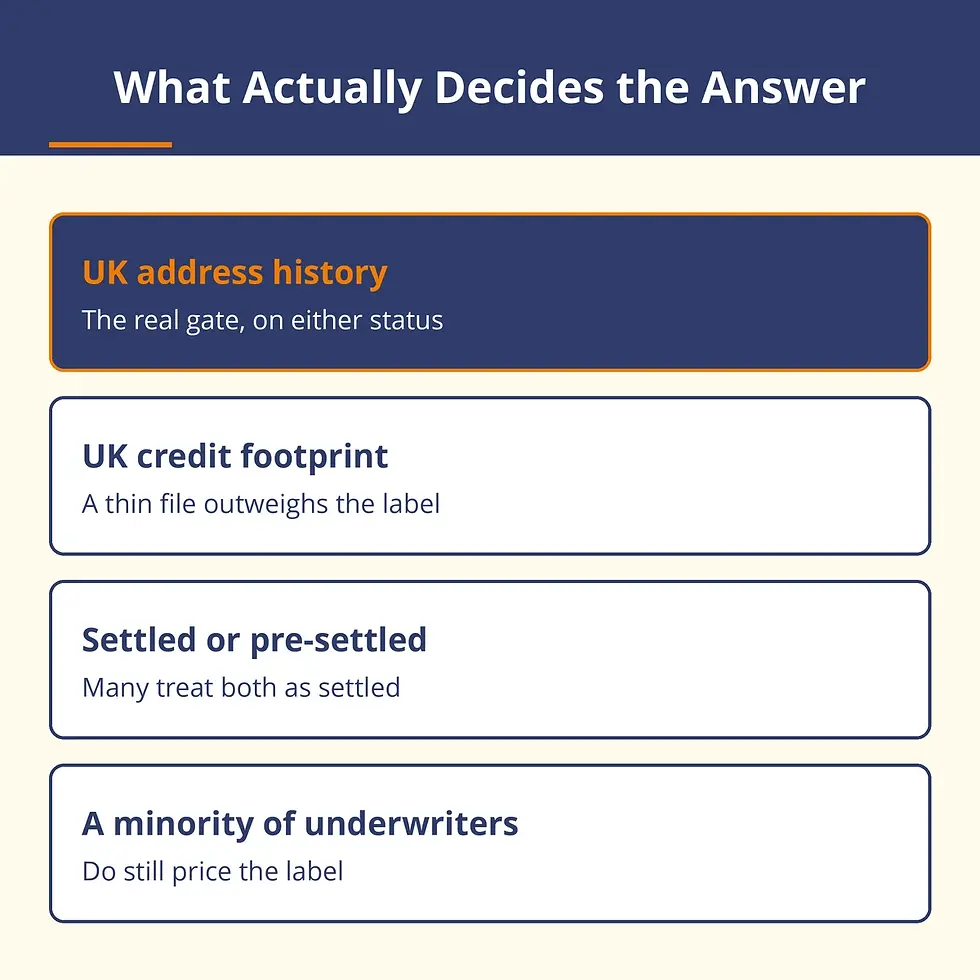
So the honest headline is the inverse of the usual one. For a mainstream residential mortgage, the settled versus pre-settled distinction is usually not what decides the outcome. What decides it is UK address history, UK credit footprint, income structure and lender choice, and those bite the same whichever status you hold.
None of that makes the label invisible. The legal difference is real, published criteria are not uniform, and a minority of lenders and underwriters still treat it as live. The label matters much less than it did, but it has not vanished.
This is not a niche problem. Home Office figures put the number holding pre-settled status at an estimated 1.3 million as at 31 March 2026, with the Home Office's own caveat that this may not reflect the current resident population. GOV.UK (2026).

What settled and pre-settled status actually are under the Immigration Rules
The definitions are worth getting exact, because lenders borrow their criteria wording straight from immigration law. Home Office caseworker guidance published in July 2026 defines settled status as indefinite leave to enter, for applications made outside the UK, or indefinite leave to remain. GOV.UK (2026).
Read that again if you hold it. Settled status is not similar to indefinite leave to remain, and it is not a lesser cousin of it. Under the Immigration Rules it is indefinite leave to remain, granted through a particular scheme.
The same guidance defines pre-settled status as five years of limited leave. That is the genuine legal difference and there is no point pretending otherwise. Whether it costs you anything at a lender is a separate question, and for most mainstream lending it usually does not.
Both statuses rest on residence in the UK by 31 December 2020, with five years of continuous residence needed for settled status. GOV.UK (2026). The deadline for most people was 30 June 2021, although late applications remain possible where there are reasonable grounds.
A related point catches people out. Someone who already holds indefinite leave to enter or remain does not need settled or pre-settled status to carry on living here, though applying and being granted settled status brings a longer absence allowance, five years in a row outside the UK rather than two. GOV.UK (2026).
There is a mortgage echo there: a reader whose status was granted years after the deadline may also have a shorter UK credit file, and that is what a lender notices.
Why pre-settled status no longer carries the expiry date people fear
The automation arrived in stages, and the current version is the one that matters. From September 2023 the Home Office began automatically extending pre-settled status before expiry, so nobody lost rights by failing to reapply. From late January 2025 it began automatically converting eligible holders to settled status. GOV.UK (2025).
From 9 April 2026 it changed shape again. Settled status is now granted automatically off a residence check looking for 30 months of tax and benefit payments in the last 60 months, and where that check cannot be satisfied, GOV.UK (2026) states that pre-settled status will continue to be extended by five years.
You do not have to wait: GOV.UK (2026) confirms you can apply for settled status as soon as you are eligible, free of charge. The guidance carries a caveat too, in that the Home Office may cancel an extension if it thinks the holder no longer meets the requirements.
Here is where the mortgage angle lives. The automation runs on HMRC and DWP data, so someone with a thin UK tax and benefits record may not be picked up by the automatic upgrade at all.
That is our observation rather than a published rule, but the reasoning is simple. The same thin data trail that stops an upgrade tends to thin a credit file, so treat a missed upgrade as a prompt to check your UK footprint rather than a verdict.
The risk has also inverted. From 9 April 2026 the Home Office began removing pre-settled status from people who have clearly ceased continuous residence, reviewing those absent longest first, with a right of appeal. GOV.UK (2026). If you have spent long stretches abroad, that is an immigration question first, and it belongs with an OISC-regulated adviser or a solicitor rather than a mortgage broker.
One last thing this settles. Where lenders publish a minimum amount of leave remaining, the rules we reviewed run from around six months to two and a half years, and several apply no minimum at all. Because pre-settled status is five years of leave and is then extended by another five, a holder is unlikely to be presenting a status with only months left on it.
Proving your status to a lender: the share code, and why the wrong one bounces
There is no card. Physical immigration documents have been replaced by eVisas, digital records of your identity and immigration status, accessed through a free UKVI account. GOV.UK (2026).
You prove your status through the View and Prove service, which generates a share code. The code lasts 90 days, can be used as often as you need before it expires, and the person checking needs it plus your date of birth. GOV.UK (2026).
Now the practical trap. View and Prove asks why you want to prove your status, and generates a different type of code depending on your answer. One building society's published criteria state that only share codes beginning with the letter S, issued within the last 90 days, are acceptable.
A code generated for a right to rent or employment check is a different code and is likely to bounce when the lender tries it. Choose the option for proving your status to another organisation, get the S code, and hand it over inside the 90 days.
What does the lender do with it? It enters the code and your date of birth into the Home Office checking service and reads your status live. Guidance for financial providers, updated in 2025, calls this real time information direct from Home Office systems. Home Office (2025).
That guidance is worth knowing about, because occasionally a front-line staff member asks for a card that no longer exists. A campaigning organisation for EU citizens reports hearing of cases where providers declined to accept share codes. That is consumer experience rather than a measured rate, so we will not quantify it.
Your conveyancer runs identity checks too, under money laundering rules rather than immigration ones, and the same code normally satisfies them. Treat the 90 days as a timing tip: a code generated at decision in principle stage may have expired by exchange, and a fresh one costs nothing.
What people expect the criteria to say | What the published criteria we reviewed actually say, August 2026 |
Pre-settled status is a lesser category | Several sets file settled and pre-settled together with indefinite leave to remain, on normal terms |
You need three years of UK address history | The range runs from no stated minimum, through twelve months, to two or three years at the strictest end |
Your leave must have years left to run | Some lenders apply no minimum remaining leave at all, and where a minimum exists it is usually written for visa holders |
Pre-settled status caps your loan to value | Caps we found were written against applicants with no permanent right to reside, a category settlement scheme holders sit outside |
A card or passport stamp proves your status | An eVisa share code beginning with S, generated within the last 90 days, plus your date of birth |
Criteria change without notice, and that table is a snapshot taken in August 2026. It describes the market's direction, not a promise about your application.
UK address history and a thin UK credit file: where the real gate sits
These requirements apply regardless of which status you hold, and they are the reason two people with identical labels can get very different answers.
Start with address history. Across the criteria we reviewed, the minimum UK residency requirement runs from no stated minimum at all, through twelve months, to two years, to three years at the strictest end. One large lender simply requires the credit search to cover all addresses over the last three years.
That range is the useful bit. It clusters around two to three years, so four years in the UK clears essentially everything, while fourteen months narrows the panel rather than closing it.
Then the credit file. Electoral roll registration is a core identity anchor on a UK credit report, and Experian (2026) is blunt about missing it: applications may take longer to process, and you could even be rejected.
Here is the twist almost nobody writes about. The automatic right of EU citizens to register to vote in English local elections was removed from 7 May 2024. Local Government Association (2024). Two groups keep it: nationals of the five treaty countries, Denmark, Poland, Spain, Portugal and Luxembourg, and those lawfully resident in the UK by 31 December 2020 who hold lawful immigration status.
Read that second limb closely, because it maps almost exactly onto the settlement scheme eligibility test. On that basis most settled and pre-settled holders should still be eligible to register, which is free and strengthens the file a lender reads. Confirm your position with your local authority.
Irish citizens are unaffected, as are Maltese and Cypriot citizens as Commonwealth nationals.
Beyond the electoral roll, a thin file behaves the same way here as for anybody who has not borrowed much in the UK. Our guide on how much credit history you need covers the mechanics, and the fixes for a thin credit file as a young buyer work here too: an address history that reconciles, a little well-managed sterling credit, and no unexplained gaps.
One published requirement shows how lenders think when the UK file is short: one high street lender asks applicants with under twelve months here for a credit report from their previous country of residence, plus three months of bank statements and payslips. The file need not be long, but it must be legible.
We will not put a number on how much UK credit activity makes a meaningful difference, because no reliable published figure exists.
When a lender prices your status instead of your file
An illustrative composite: the same file, two different answers
A nurse four years into a UK posting, holding pre-settled status, earned around £41,500 basic plus roughly £4,600 a year in unsocial hours enhancements, with a 10% deposit of about £23,500 towards a £235,000 flat. Her first application was declined by a lender whose higher loan to value bands were written around indefinite leave to remain, and the decline turned on the label rather than the file. Placed with a lender whose criteria treat settled and pre-settled status as indefinite leave to remain, the case was assessed on affordability in the ordinary way, at a stress rate well above the pay rate she would actually have been charged, and proceeded at 90% loan to value. This is an illustrative composite, not a real client or a prediction.
That composite reflects a real gap. One lender's published ladder is written around indefinite leave to remain: evidence of indefinite leave is required above 90% loan to value, and without it the ceiling drops, to 90% where one applicant has a substantial income and lower again where nobody does.
Whether that lender reads settled status as satisfying its indefinite leave test is not spelled out. Given the Home Office definition it logically should, but the criteria do not say so, and a live application is a poor place to test an inference.
That gap is the honest illustration of the problem. Some criteria say outright that settled or pre-settled equals indefinite leave to remain, and some leave it to be inferred. Resolving which is which before anything reaches a credit search is much of what a specialist broker is for.
It is also fair to say that published criteria and individual underwriting decisions are not always the same thing. A criteria page tells you what a lender will consider, not how an underwriter reads a particular file.
Here is the contrast that matters most. Holding settlement scheme status of either flavour is what keeps you out of the foreign national box. One high street lender's route for applicants who hold neither that status nor indefinite leave to remain caps lending at 85% loan to value, requires the deposit to come from the applicant's own savings, and imposes either a twelve month residence test or six-figure joint income thresholds.
The direction of travel has been loosening rather than tightening. Trade press reported in June 2026 that one large lender raised its cap for foreign nationals from 75% to 90%, leaving policy unchanged for settled, pre-settled and indefinite leave applicants above 75% loan to value, which suggests those groups were already better placed.
Some lenders' published criteria go to 95% loan to value for either status, and we found no published penalty applied to pre-settled status as such. That is a statement about criteria, not an offer: what pushes a real applicant to a bigger deposit is address history, credit depth, income type and the property.
Partners and family members who hold EU Settlement Scheme status through someone else
The scheme covers EU, other EEA and Swiss citizens and their family members, so plenty of households hold more than one status, sometimes of different kinds. Untangle that before you apply rather than during.
There is no household share code. Every applicant has their own status record and generates their own code, and a lender will normally want one from each of you. Build that into your timing, because the 90 day clock runs separately for each person.
Check what your partner actually holds. A non-EEA spouse may hold status as a family member under the scheme, or may instead hold a separate family visa, and lenders treat those very differently. A family visa typically carries a genuine time-remaining test; settlement scheme status generally does not.
Mixed-status couples are where the label can still bite. Several criteria sets unlock the highest loan to value band where one applicant is British or holds indefinite leave to remain. Where neither does, a joint application is read against the tighter of the two profiles.
Dependent children are not parties to a mortgage, so their status does not feature in the eligibility assessment. They appear as dependants in the affordability calculation, as they would for any borrower.
One last family point links back to the removal process. A household member who has spent long periods abroad is exposed twice over: their continuous residence may come under review, and their UK address history will look patchy.
If you later move abroad and want to keep or buy UK property, that is a different lending market entirely, covered in our guides to expat mortgages and to holding a residential mortgage while living abroad.
Getting ready to apply: status record first, credit file second, lender choice third
Sequence matters more than speed, because two of these steps take weeks to bear fruit and the third leaves a mark on your credit file if you get it wrong.
First, check your own status record
Log into your UKVI account and look at what is actually showing. Confirm which status you hold, whether it has been extended, and whether it has been converted without you noticing. The Home Office emails holders when an extension happens, but emails get missed.
If you are eligible for settled status and would rather hold it, you can apply as soon as you are eligible instead of waiting for the automation. On the evidence here, though, it is not something most people need to complete before starting a mortgage conversation.
Generate the S share code last, once you know roughly when the application will go in, so the 90 days covers the useful part of the process.
Second, work on the credit file
Register on the electoral roll if you are eligible. Pull your statutory reports from all three credit reference agencies and check that your address history reconciles across them, including any period at an address abroad.
Correct anything wrong, close accounts you no longer use, and give a recent house move time to filter through. This part rewards a few months of patience, and it usually has the largest effect on the answer.
If you have been here under a year, gather the home country evidence early: a credit report from your previous country of residence, recent payslips and several months of bank statements.
Third, choose the lender before anyone runs a search
This is the step people reverse, and it is the expensive one. Because criteria differ on how explicitly they treat settled and pre-settled status, and a declined application leaves a footprint, the lender choice should rest on criteria evidence rather than a rate table.
Be honest about the trade-off. If your file genuinely needs a specialist or manually underwritten lender, the rate and fees may be higher than a headline high street product, and that is a real cost. The specialist tier prices your circumstances properly, not cheaply.
FAQs
Do I need settled status before I apply for a mortgage?
Usually not. Several mainstream lenders' published criteria treat settled and pre-settled status identically, filing both alongside indefinite leave to remain, and pre-settled status is now extended automatically before it expires. A minority of lenders write their highest loan to value bands around indefinite leave to remain specifically, so the lender you approach matters more than the label you hold.
Is settled status the same as indefinite leave to remain?
Yes, under the Immigration Rules. Home Office caseworker guidance published in 2026 defines settled status as indefinite leave to enter or indefinite leave to remain granted through the EU Settlement Scheme. Pre-settled status is defined as five years of limited leave, which is a genuinely different legal category, even though most lenders do not price the difference.
What happens when my pre-settled status expires?
It is extended. GOV.UK (2026) states that pre-settled status is extended by five years shortly before it is due to expire, and that you will be emailed when this happens. After an extension it may be automatically converted to settled status, and the Home Office notes it may cancel an extension if it believes the holder no longer meets the requirements.
What proof of status does a mortgage lender want?
A share code from the View and Prove service, plus your date of birth. Physical immigration documents have been replaced by eVisas, so there is no card to hand over. Choose the option for proving your status to another organisation so you get the right code type, and note that a share code lasts 90 days from the date it is generated.
How much UK address history do lenders want to see?
It varies more than people expect. Across published criteria we reviewed in August 2026, requirements ran from no stated minimum, through twelve months, to two or three years at the strictest end, and one lender simply requires the credit search to cover all addresses over the last three years. Fewer than two years in the UK narrows the panel rather than closing it.
Can I get a 95% mortgage with pre-settled status?
Some lenders' published criteria do go up to 95% loan to value for applicants holding either settled or pre-settled status, and we found no published loan to value penalty applied to pre-settled status as such. That is a statement about criteria rather than an offer. What pushes a real applicant to a larger deposit is usually address history, credit file depth, income type or the property itself.
Summary
For most mainstream residential lending in 2026, whether you hold settled or pre-settled status is rarely the deciding factor. Many lenders file both with indefinite leave to remain, and pre-settled status now extends itself automatically. The things that genuinely move an application are your UK address history, the depth of your credit file, how you are paid and which lender sees the case. A short conversation with a broker who places these cases regularly can tell you where you stand.
Updated: 6 August 2026
Written by Ben Stephenson, CeMAP-qualified Mortgage Broker.
Manor Mortgages Direct is FCA authorised, FRN 496907, has traded for 25 years, is highly positively reviewed, 4.9 rated on Google, and has helped thousands secure the right mortgage. Bristol-based mortgage brokers, assisting clients nationwide.
Sources
GOV.UK / Home Office (2026) - EU Settlement Scheme caseworker guidance, version 32.0 - https://www.gov.uk/government/publications/eu-settlement-scheme-caseworker-guidance/eu-settlement-scheme-eu-other-eea-and-swiss-citizens-and-their-family-members-accessible - accessed 6 August 2026
GOV.UK (2026) - EU Settlement Scheme status automation update, 9 April 2026 - https://www.gov.uk/government/publications/eu-settlement-scheme-euss-status-automation-update-april-2026/eu-settlement-scheme-euss-status-automation-update - accessed 6 August 2026
GOV.UK (2025) - EU Settlement Scheme status automation - https://www.gov.uk/government/publications/eu-settlement-scheme-euss-status-automation/eu-settlement-scheme-euss-status-automation - accessed 6 August 2026
GOV.UK (2026) - Convert pre-settled status to settled status - https://www.gov.uk/settled-status-eu-citizens-families/convert-pre-settled-status-to-settled-status - accessed 6 August 2026
GOV.UK (2026) - What settled and pre-settled status means - https://www.gov.uk/settled-status-eu-citizens-families/what-settled-and-presettled-status-means - accessed 6 August 2026
GOV.UK (2026) - If you have indefinite leave to enter or remain - https://www.gov.uk/settled-status-eu-citizens-families/if-you-have-indefinite-leave-to-enter-remain - accessed 6 August 2026
GOV.UK (2026) - View and prove your immigration status - https://www.gov.uk/view-prove-immigration-status - accessed 6 August 2026
GOV.UK (2026) - Online immigration status (eVisa) - https://www.gov.uk/guidance/online-immigration-status-evisa - accessed 6 August 2026
Home Office (2025) - Residence documents: information for financial providers - https://www.gov.uk/government/publications/biometric-residence-documents-information-for-financial-providers/residence-documents-information-for-financial-providers - accessed 6 August 2026
GOV.UK (2026) - Immigration system statistics, year ending March 2026 - https://www.gov.uk/government/statistics/immigration-system-statistics-year-ending-march-2026/how-many-indefinite-leave-to-remain-settlement-and-euss-settled-status-and-citizenship-grants-have-been-issued-in-the-uk - accessed 6 August 2026
Experian (2026) - The electoral roll and your credit score - https://www.experian.co.uk/consumer/guides/electoral-roll.html - accessed 6 August 2026
Local Government Association (2024) - Changes to EU voting and candidacy rights - https://www.local.gov.uk/about/our-meetings-and-leadership/political-composition/local-government-elections/changes-eu - accessed 6 August 2026
the3million (2024) - FAQ: provider asking for proof of immigration status or a share code - https://the3million.org.uk/faq/bank-sharecode - accessed 6 August 2026
Lewis Silkin (2026) - EU Settlement Scheme: automating grants of settled status and removing pre-settled status - https://www.lewissilkin.com/en/insights/2026/05/07/eu-settlement-scheme-new-processes-for-automating-grants-of-settled-status-and-r-102ms2z - accessed 6 August 2026
Related Guides