
Which Lenders Treat an Expat's Former Home as a Consumer Buy-to-Let?
Updated: Sep 1
Find out why prior occupation, not moving abroad, is what pushes your old home inside the consumer perimeter.
Quick Answer
If you lived in the property before letting it, and you own no other rental property or buy-to-let mortgage, refinancing it usually makes it a consumer buy-to-let. That narrows you to lenders and brokers registered for consumer buy-to-let, and among those, the ones that accept non-resident borrowers.
The test is set by the Mortgage Credit Directive Order 2015 and it says nothing at all about where you live. It asks what you bought the property for, whether you or a close relative have occupied it, and whether you hold other let property. Your address abroad is irrelevant to the classification. It is highly relevant to which lender can then take the case.
That combination is what makes placement the whole exercise. Registration for consumer buy-to-let is a minority position among lenders, and appetite for non-resident borrowers is another minority position, so you are working in the overlap of two small groups. There is no published list of that overlap, and criteria change without notice, so it has to be checked case by case.

Reviewed by Ben Stephenson, FCA authorised (FRN 496907) · 25+ years' experience · 4.9★ on Google. Updated: 6 August 2026.
Who Is This Guide For
Best for UK nationals posted overseas, accidental landlords letting a former home, and beneficiaries of an inherited property who need to refinance a house they or their family once lived in from abroad, often while an existing consent to let is running out of road.
Key Points
Lived there first? It is likely consumer buy-to-let
Lender and broker both need CBTL registration
The PRA's 125% stress rule does not apply
Table of Contents
Consumer Buy-to-Let Is the Leftover Category, Not a Special One
The Three Limbs of Article 4(4), and Where a Posted-Abroad Owner Fails Them
Inherited Homes, and What Happens When a Relative Lives There
Two Registrations, One Small Overlap: Why Your Lender List Shrinks Twice
Consent to Let or a Proper Buy-to-Let Remortgage: When the First Stops Working
Stress-Testing an Accidental Landlord's Loan When the PRA Standards Do Not Apply
Letting Without Telling the Lender: What Actually Tends to Happen
What Changed on 1 May 2026: Assured Periodic Tenancies and Criteria That Lag
Your Old Front Door Key Matters More Than Your New Address
Most people in this position start with the wrong question. They ask which lenders accept borrowers living in Dubai, Singapore or Sydney. That question matters, but it is the second one.
The first question is regulatory, and it is answered by history rather than geography. If you bought the house to live in, and you did live in it, your loan sits in a different box from your neighbour's investment flat.
That box is consumer buy-to-let. Nothing in the governing legislation turns on where the borrower lives. The Mortgage Credit Directive Order 2015 asks what the property was bought for and who has occupied it since, and nothing at all about the borrower's current address.
The consequence is practical. A consumer buy-to-let can only be arranged and written by firms registered for that business. So your pool is the overlap between firms holding that registration and firms comfortable lending to someone with a foreign address.
Both groups are minorities, and the overlap is not published as a browsable list. That makes this a placement problem, not a rate comparison. Our expat mortgages page covers the wider landscape; this article stays with the accidental landlord.

Consumer Buy-to-Let Is the Leftover Category, Not a Special One
Almost every article on this subject describes consumer buy-to-let as a narrow carve-out that a few unusual borrowers fall into. That framing is backwards, and turning it round makes the rest obvious.
Article 4(1) of the Mortgage Credit Directive Order 2015 defines a consumer buy-to-let contract as a buy-to-let mortgage contract "which is not entered into by the borrower wholly or predominantly for the purposes of a business carried on, or intended to be carried on, by the borrower".
Read that slowly: it is a negative test. A let is consumer buy-to-let unless it is business. Consumer is the residual category, the default, the thing left over once the business cases have been taken out.
So the useful question is never "do I qualify as a consumer buy-to-let?" It is "is there anything here that makes this a business?" If the answer is no, you are already inside the consumer perimeter, whether or not anyone told you.
Your fact pattern | Where it usually lands |
You bought it to live in, lived in it, now let it, own no other rentals | Consumer buy-to-let under Part 3 of the Order |
You bought it as an investment and never occupied it | Business buy-to-let, outside the consumer regime |
You own another let property or hold another buy-to-let mortgage | Deemed business, even though you lived there |
A parent, child or sibling occupies it as their home | Not a buy-to-let contract at all, a regulated mortgage |
You have consent to let on your residential mortgage | Still the residential contract it always was |
The contract was entered into before 21 March 2016 | Outside the consumer buy-to-let regime entirely |
Treat that as a starting map, not a decision: one changed fact moves the case to a different row.
The Three Limbs of Article 4(4), and Where a Posted-Abroad Owner Fails Them
Article 4(4) of the same Order does the real work. It sets out when a borrower is regarded as acting for business purposes, and so sits outside the consumer regime. Nearly identical wording appears at article 61A(5) of the Regulated Activities Order 2001.
The first route to business status has three limbs, and all three must be true together:
you previously bought the property, or you are borrowing in order to buy it
at the time you bought it you intended it to be let, and never occupied by you or a related person
since you bought it, neither you nor a related person has occupied it as a home
The classic accidental landlord fails the second limb and the third. You bought it to live in, and you then lived in it. The limbs are conjunctive, so one failure is enough, and this fact pattern produces two.
Under article 4(4)(b) there is a second route, and it catches more expats than expected. If you own other let land, or hold any other buy-to-let mortgage, you are deemed to be acting for business anyway. One other rental flat, and the same house on the same facts becomes an ordinary unregulated buy-to-let.
"Related person" is defined, and the FCA Handbook (2026) sets it out at PERG 4.4.19G: a spouse or civil partner, a partner in a relationship with the characteristics of marriage, and a parent, brother, sister, child, grandparent or grandchild. Nieces, nephews, cousins and in-laws are not on that list.
Article 4(2) lets a borrower sign a declaration that the loan is for business purposes, raising a presumption to that effect. Article 4(3) removes that presumption where the lender knows or has reasonable cause to suspect otherwise, and a file showing you lived there is exactly that. A signature cannot reclassify the case.
Inherited Homes, and What Happens When a Relative Lives There
Inheritance is the other common route into this category, and it usually lands in the same place. You did not buy the property intending to let it, because you did not buy it at all, so the first route to business status cannot be satisfied.
One building society's published criteria list inherited property alongside letting a former home as a trigger for consumer buy-to-let treatment. That is a lender's summary rather than a statutory statement, but it points the same way as the Order.
The second route still applies. If you already hold another buy-to-let mortgage, or own something else that is let, the inherited house may be deemed business even though you never chose to become a landlord.
Now the variation that surprises people most. If a parent, child, sibling or other related person occupies the property as their home, it is not a buy-to-let mortgage contract at all. Article 4(1) requires that the land cannot at any time be occupied by the borrower or a related person, and family occupation defeats that condition outright.
What you have instead is a regulated mortgage contract with full conduct of business protection. The FCA Handbook (2026) confirms at PERG 4.4.6AG that a loan may be a regulated mortgage contract where the property is to be occupied by the borrower's relatives as their home.
Lenders label this family or regulated buy-to-let, and the two products are not interchangeable. Some specialist ranges exclude family tenants altogether, so a nominal rent from a sibling can quietly rule out a product that looked available. Our note on living in your buy-to-let covers the occupation side of the same boundary.
Two Registrations, One Small Overlap: Why Your Lender List Shrinks Twice
Consumer buy-to-let is not simply regulated buy-to-let with a friendlier name. It sits outside the ordinary regulated activities regime altogether, under Part 3 of the Mortgage Credit Directive Order 2015, and firms are registered for it rather than authorised.
The FCA Handbook (2026) is blunt about the reach of that requirement. At PERG 4.10B.23G, a firm holding ordinary mortgage permissions is subject to a requirement that it does not carry on any activity constituting consumer buy-to-let business unless it is registered for it.
So the gap runs both ways. Your lender needs the registration to write the loan, and your broker needs it to arrange or advise on it. A firm with full mortgage permissions and no consumer buy-to-let registration is barred from your case, however keen it may be to help.
Both registrations can be verified on the Financial Services Register, FCA (2026). We are deliberately not putting a number on the overlap: the figures circulating online descend from a pre-launch estimate, FCA (2015), that consumer buy-to-let might be around eleven per cent of buy-to-let lending. Eleven years on, that is history rather than data.
A related trap is worth naming. Several of the most visible lenders in searches for expat buy-to-let are licensed offshore rather than inside the UK perimeter, so they are not writing Part 3 contracts, and those protections do not follow.
An illustrative composite, not a real client. A couple posted to Singapore had lived in their Bristol house for six years before the move, and let it rather than sell. It was valued at around £420,000 with £198,000 outstanding, roughly 47% loan to value, and achievable rent of about £1,650 a month.
Because they had lived there and owned no other rental property, it was a consumer buy-to-let, which removed most of the lenders their own search had found. One specialist grid tested the rent at a stress rate of 5.5%, a testing assumption rather than the pay rate charged, and the rent cleared the required cover comfortably.
Consent to Let or a Proper Buy-to-Let Remortgage: When the First Stops Working
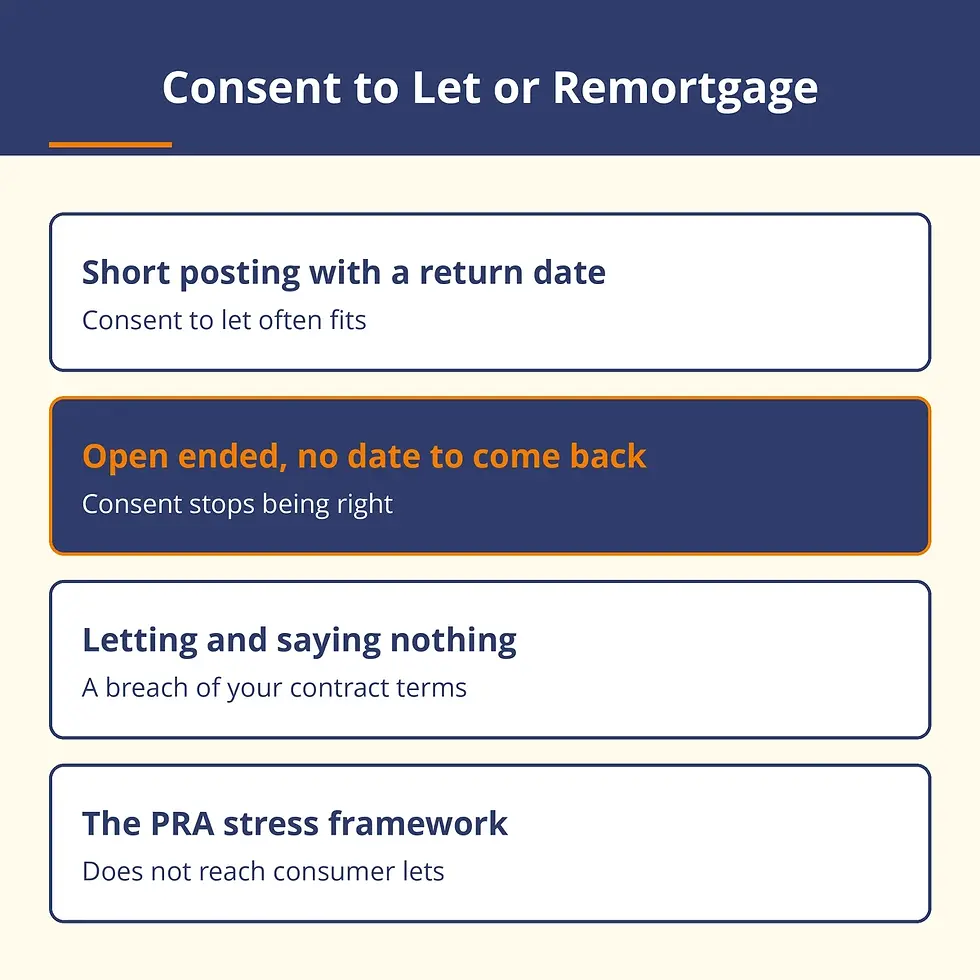
Consent to let is permission from your existing lender to rent out the home you already have a residential mortgage on. The PRA (2026) describes it as a residential mortgage contract where the borrower is an owner-occupier and applies to let the property on a temporary basis. The word doing the work is temporary.
Here is the correction most worth having. Getting consent to let does not convert your mortgage into a buy-to-let. The FCA Handbook (2026) at PERG 4.4.3G confirms that a contract meeting the regulated mortgage contract conditions at the outset remains one for the rest of its term. You keep the detailed arrears and forbearance rules, which are far thicker than the single forbearance paragraph in the consumer buy-to-let rulebook.
You may also have read that consent runs for twelve months. We could not verify that as a general rule. One major lender's 2026 letting terms keep consent in place until the borrower confirms the letting has stopped; another prices it as a fee up front plus a yearly fee. Check your own consent letter.
The real constraint is not a calendar date. One lender's published letting terms bar a product switch, additional borrowing, borrower changes and any contract variation for as long as the letting continues. Add a rate loading, half a percentage point and variable on fixed and tracker deals in those same terms, and the arithmetic eventually breaks.
There is a second sting. Some specialist remortgage tiers are closed to consent-to-let cases by design: one expat grid states that a remortgage must be a true buy-to-let remortgage, and that consent to lets are not eligible for its cheapest like-for-like treatment.
So the trigger to convert is clear enough. Move when you no longer intend to return, or when your fixed rate is close enough to ending that the product freeze would strand you. Our guide to the consent to let and buy-to-let switch works through the mechanics.
One honest caveat about waiting. Your classification does not change with time, but your residency profile hardens: longer abroad, foreign currency income, no recent UK address history. Published criteria impose country lists, service address requirements and currency conditions, so delay tends to cost options.
Stress-Testing an Accidental Landlord's Loan When the PRA Standards Do Not Apply
Here is the claim repeated most often and understood least. The 125% at 5.5%, or pay rate plus two points, convention is widely described as a regulatory requirement for all buy-to-let. It is not a requirement for yours.
SS13/16, the PRA's underwriting standards for buy-to-let, states at paragraph 1.1 that it is relevant to lending not already subject to FCA regulation, and that it does not apply to consumer buy-to-let contracts, PRA (2026). Consent to let is out of scope too. Even for lending in scope, the same statement calls 125% "the current industry standard" rather than a rule.
What does apply is Schedule 2 to the Mortgage Credit Directive Order 2015. Paragraphs 10 and 12 require a thorough creditworthiness assessment that cannot lean predominantly on the property's value, and that must consider local rents and demand, future rate rises, voids, arrears and letting costs. Notice what is absent: any number.
Most lenders run familiar arithmetic anyway, because it is the same credit risk on the same operational rails. The criteria we reviewed sit between 125% and 150% cover depending on tax band, commonly stressed at the higher of 5.5% or the product rate plus two points, with lower cover on five-year fixes and like-for-like remortgages.
Two things follow that you can act on. Nothing stops a registered lender setting a more accommodating threshold, because the threshold is theirs to set. And if someone tells you 5.5% is a regulatory requirement on your case, that is loose language rather than law.
Being an expat does not change the stress rate by rule either. What non-residence does is decide which grid you are measured against, and those grids often carry lower maximum loan to value, minimum income floors, haircuts applied to foreign currency income, and top-slicing restricted to sterling earnings.
One lending fact is worth knowing, and it says nothing about your own tax position. The supervisory statement expects lenders to build a tax assumption into their rental calculations, and permits them to assume every borrower is a higher rate taxpayer, which is one reason a quote comes back tight. Your own tax position falls outside our permissions, so HMRC or a qualified adviser is the right destination. Our specialist lending page explains how manual underwriting handles cases the calculators reject.
Letting Without Telling the Lender: What Actually Tends to Happen
This corner of the internet is unusually shouty, and wrong in both directions at once. Letting quietly is not a victimless technicality, and not automatically a criminal matter.
Start with the accurate framing. A residential mortgage is advanced on the basis that you occupy the property, so letting it without permission breaches the mortgage conditions, and the remedies for that breach are contractual. One high street lender puts it to its own customers plainly: renting your home without permission may break your mortgage rules.
The breaches tend to arrive in a stack. Cover written for an owner-occupied home may be restricted once the property is let, which then puts you in breach of the separate condition to keep suitable insurance in place. Where the property is leasehold, a freeholder consent requirement for underletting may bite as well.
The most damaging consequence is usually not a penalty. It is the lock-out. Under one lender's published letting terms, while a letting is in place you cannot switch products, borrow more, change borrowers or vary the contract, and consent cannot be applied for while the account is in arrears.
Now the careful part. A criminal dimension only arises where there is dishonesty, for example representing an intention to occupy in order to obtain a residential mortgage while actually intending to let it. That is a fact-specific question for a solicitor, not a mortgage broker, and we are not going to tell you undisclosed letting is routinely prosecuted as fraud, because we found no sound evidence for that.
The practical answer is nearly always the boring one. Tell the lender, take the consent if there is a real prospect you return, and plan the move to a proper buy-to-let contract if there is not. Our page on UK buy-to-let mortgages for expats sets out what that involves.
What Changed on 1 May 2026: Assured Periodic Tenancies and Criteria That Lag
The specific thing that has moved under accidental landlords is the tenancy itself. In England, the assured shorthold tenancy is no longer the tenancy you grant. GOV.UK (2026) guidance refers to tenancies becoming assured periodic tenancies from 1 May 2026 under the Renters' Rights Act 2025.
That is already visible in lender paperwork. One major lender's April 2026 letting form now requires lettings in England to be assured tenancies under the Housing Act 1988 as amended by the Renters' Rights Act 2025, rather than assured shortholds.
It is not visible everywhere yet. Several lender criteria pages we reviewed still specify an assured shorthold tenancy of six to twelve months, which is out of date for England. Surface that mismatch before submission. Wales, Scotland and Northern Ireland run separate regimes.
Two things have not changed. The consumer buy-to-let regime is fully in force today: the Mortgage Credit Directive Order 2015 is named in Schedule 1 to the Financial Services and Markets Act 2023 as assimilated law within the revocation framework, so it sits on the statute book for eventual replacement, but it has not been revoked.
Nor is the current mortgage rule review addressing it. We searched the FCA's 2026 consultation on supporting first-time buyers and underserved consumers and found no reference to buy-to-let anywhere in it, FCA (2026).
If you want to move, the useful preparation is short. Your country of residence, the currency you are paid in, whether anyone on the related person list has occupied the property, how many other let properties you hold, and the date your rate ends. Those facts decide most of it.
FAQs
Does moving abroad turn my mortgage into a buy-to-let?
No. Nothing in the Mortgage Credit Directive Order 2015 turns on where the borrower lives, and moving overseas does not change the contract you already hold. What changes the position is letting the property and then taking out a new contract written as a buy-to-let. Your residence affects which lenders can consider you, not which regime applies.
I already have consent to let. Is that a consumer buy-to-let?
No. The FCA Handbook (2026) at PERG 4.4.3G confirms that a contract which was a regulated mortgage contract at the outset remains one throughout its term. Consent to let is a permission sitting on top of your existing residential mortgage, so you keep the fuller conduct protections. You only enter consumer buy-to-let territory when you take out a new contract written as a buy-to-let.
My sister lives in the property and pays me a small rent. What is that?
Occupation by a related person means the contract cannot be a buy-to-let mortgage contract at all, because article 4(1) requires that the borrower and related persons cannot occupy the property. It is a regulated mortgage contract instead, sometimes labelled family or regulated buy-to-let. Charging rent does not change that, though some specialist ranges exclude family tenants entirely, so the product set is different again.
Can I sign a business purpose declaration and avoid all this?
Not where the lender knows the history. Article 4(2) allows a declaration that raises a presumption of business purpose, but article 4(3) removes that presumption if the lender, or anyone acting for it, knows or has reasonable cause to suspect the loan is not wholly or predominantly for business. A file showing you lived there is precisely that kind of knowledge.
I own one other rental flat. Does that change my category?
It may well do. Article 4(4)(b) deems a borrower to be acting for business purposes where they own other let land, or hold any other buy-to-let mortgage. On that basis the same former home, on the same facts, can be an ordinary unregulated buy-to-let rather than a consumer one, which changes the protections and the lender pool alike.
Does the 125% at 5.5% stress test apply to my case?
Not as a regulatory requirement. The PRA (2026) states in SS13/16 that its buy-to-let underwriting standards do not apply to consumer buy-to-let contracts, and it describes 125% as an industry standard rather than a rule even for lending in scope. Most lenders apply similar arithmetic anyway as their own policy, so expect the maths, but do not accept it as law.
Does every broker need a special permission for this?
Yes, and it is a real constraint rather than a formality. The FCA Handbook (2026) at PERG 4.10B.23G places a requirement on firms with ordinary mortgage permissions not to carry on consumer buy-to-let business unless registered for it. Both your broker and your lender need that registration, and both can be checked on the Financial Services Register.
Summary
Having lived in the house before letting it is what pushes the refinance into the consumer category, and holding another let property or buy-to-let mortgage is what pushes it back out. Your address abroad does not decide the classification, but it does shrink the list of firms able to act. Both your lender and your broker need the registration. Talk it through before you apply, and the placement gets far simpler.
Updated: 6 August 2026
Written by Ben Stephenson, CeMAP-qualified Mortgage Broker.
Manor Mortgages Direct is FCA authorised, FRN 496907, has traded for 25 years, is highly positively reviewed, 4.9 rated on Google, and has helped thousands secure the right mortgage. Bristol-based mortgage brokers, assisting clients nationwide.
Sources
The Mortgage Credit Directive Order 2015 (SI 2015/910), article 4 (2015) - https://www.legislation.gov.uk/uksi/2015/910/article/4 - accessed 6 August 2026
The Mortgage Credit Directive Order 2015 (SI 2015/910), Schedule 2 (2015) - https://www.legislation.gov.uk/uksi/2015/910/schedule/2 - accessed 6 August 2026
The Mortgage Credit Directive Order 2015 (SI 2015/910), Part 3 (2015) - https://www.legislation.gov.uk/uksi/2015/910/part/3 - accessed 6 August 2026
FSMA 2000 (Regulated Activities) Order 2001 (SI 2001/544), article 61A (2001) - https://www.legislation.gov.uk/uksi/2001/544/article/61A - accessed 6 August 2026
Financial Services and Markets Act 2023, Schedule 1 (2023) - https://www.legislation.gov.uk/ukpga/2023/29/schedule/1 - accessed 6 August 2026
FCA Handbook, PERG 4.4 What is a regulated mortgage contract? (2026) - https://www.handbook.fca.org.uk/handbook/PERG/4/4.html - accessed 6 August 2026
FCA Handbook, PERG 4.10B Regulation of buy to let lending (2026) - https://www.handbook.fca.org.uk/handbook/PERG/4/10B.html - accessed 6 August 2026
FCA Handbook, DISP 2.3 To which activities does the Compulsory Jurisdiction apply? (2026) - https://www.handbook.fca.org.uk/handbook/DISP/2/3.html - accessed 6 August 2026
FCA, CP15/3 Buy-to-let mortgages: implementing the Mortgage Credit Directive Order 2015 (2015) - https://www.fca.org.uk/publications/consultation-papers/cp15-3-buy-let-mortgages-implementing-mortgage-credit-directive - accessed 6 August 2026
FCA, CP26/18 Mortgage Rule Review: supporting first-time buyers and underserved consumers (2026) - https://www.fca.org.uk/publication/consultation/cp26-18.pdf - accessed 6 August 2026
FCA, Financial Services Register (2026) - https://register.fca.org.uk - accessed 6 August 2026
Prudential Regulation Authority, SS13/16 Underwriting standards for buy-to-let mortgage contracts, January 2026 update (2026) - https://www.bankofengland.co.uk/prudential-regulation/publication/2016/underwriting-standards-for-buy-to-let-mortgage-contracts-ss - accessed 6 August 2026
GOV.UK, The Renters' Rights Act Information Sheet 2026 (2026) - https://www.gov.uk/government/publications/the-renters-rights-act-information-sheet-2026 - accessed 6 August 2026
GOV.UK, Assured tenancy forms for privately rented properties from 1 May 2026 (2026) - https://www.gov.uk/guidance/assured-tenancy-forms-for-privately-rented-properties-from-1-may-2026 - accessed 6 August 2026
Related Guides