
Do Lenders Question Large or Unexplained Deposits in Your Account?
See what makes a lender question a large deposit, how to evidence it, and what to avoid before you apply.
Quick Answer
Yes, lenders do question large or unexplained deposits, but a big credit on your statements rarely stops a mortgage on its own. Underwriters want to see where the money came from. Show a clear, legitimate source and most applications proceed normally.
The rule of thumb in 2026 is simple. Any credit that sits outside your usual pattern can prompt a question, especially close to application. A payslip or a documented gift is easy to evidence; cash and cryptocurrency are much harder.
Problems come from unexplained money, not from large money. Keep gifts, sale proceeds and transfers well documented, ideally settled in your account for a few months, and a large deposit becomes a non-issue.
Reviewed by Ben Stephenson, FCA authorised (FRN 496907) · 25+ years' experience · 4.9★ on Google. Updated: 14 July 2026.
Who Is This Guide For
Best for buyers and homeowners who have recently received a gift, sold an asset, or moved a large sum between accounts, and want to know how a lender will treat it. Useful for first-time buyers, movers and remortgagers preparing their bank statements.
Key Points
Large deposits rarely block a mortgage on their own.
Lenders want a clear, legitimate source for the money.
Unexplained cash is the real problem, not size.
Table of Contents

What happens when a large deposit lands on your statements?
When you apply for a mortgage, a lender usually asks for your last two to three months of bank statements. An underwriter reads them line by line, and any credit that breaks your normal pattern stands out at once. A steady salary with a sudden five-figure payment beside it invites one obvious question: where did that come from?
This is not suspicion for its own sake. Since the Financial Conduct Authority (FCA) Consumer Duty took effect in 2023, lenders have to lend responsibly and understand a borrower's real financial position. A deposit that cannot be explained leaves a gap in that picture.
There is also an anti-money-laundering layer. Under HM Treasury's Money Laundering Regulations 2017, the firms handling your purchase have to satisfy themselves that your funds come from a legitimate source. Your conveyancer, and in many cases the lender, will want evidence rather than a verbal explanation.
The reassuring part is that this is a documentation exercise, not a character test. A wider panel of lenders will accept almost any genuine source of money once it is properly evidenced. The work is in the paperwork, and it is work you can do before you ever submit an application.
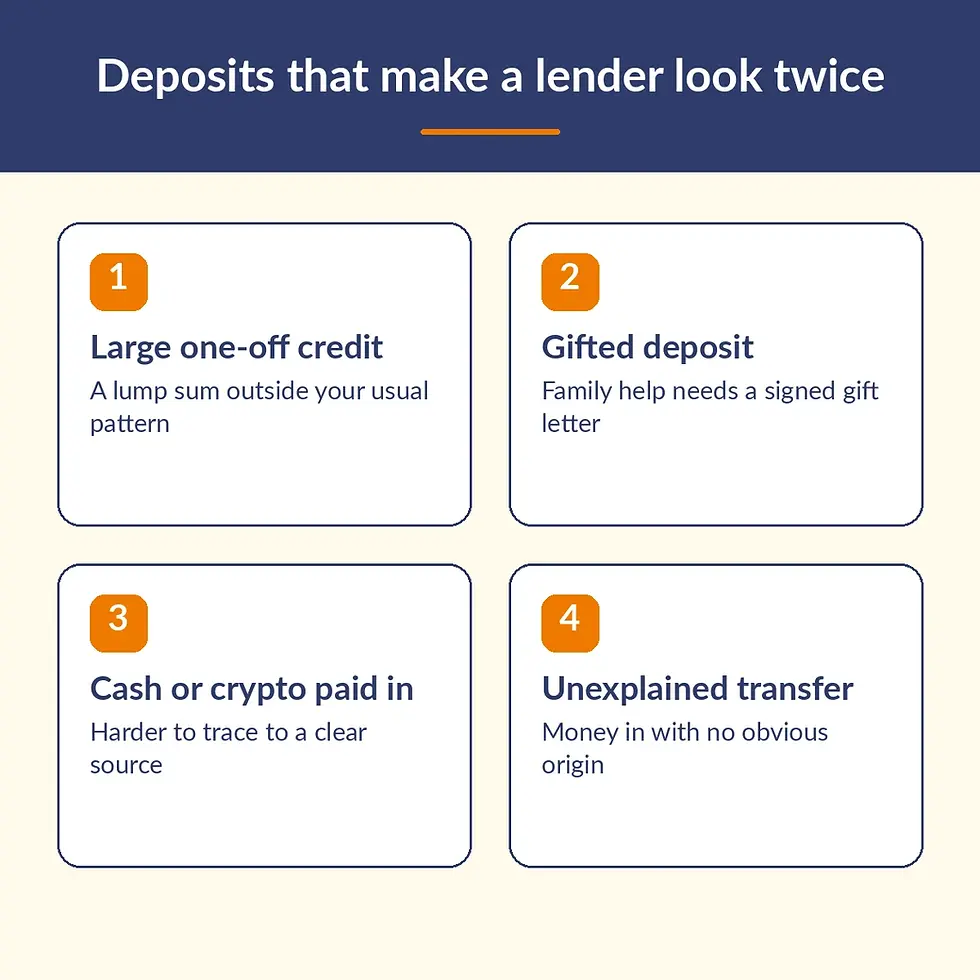
What counts as a large or unexplained deposit?
There is no single legal threshold. As a working guide, any credit that is large relative to your normal income and sits outside your usual pattern is worth explaining. For many applicants that means anything from a few thousand pounds upwards, though a small credit into a modest account can draw a query while a larger one into a high earner's account may not.
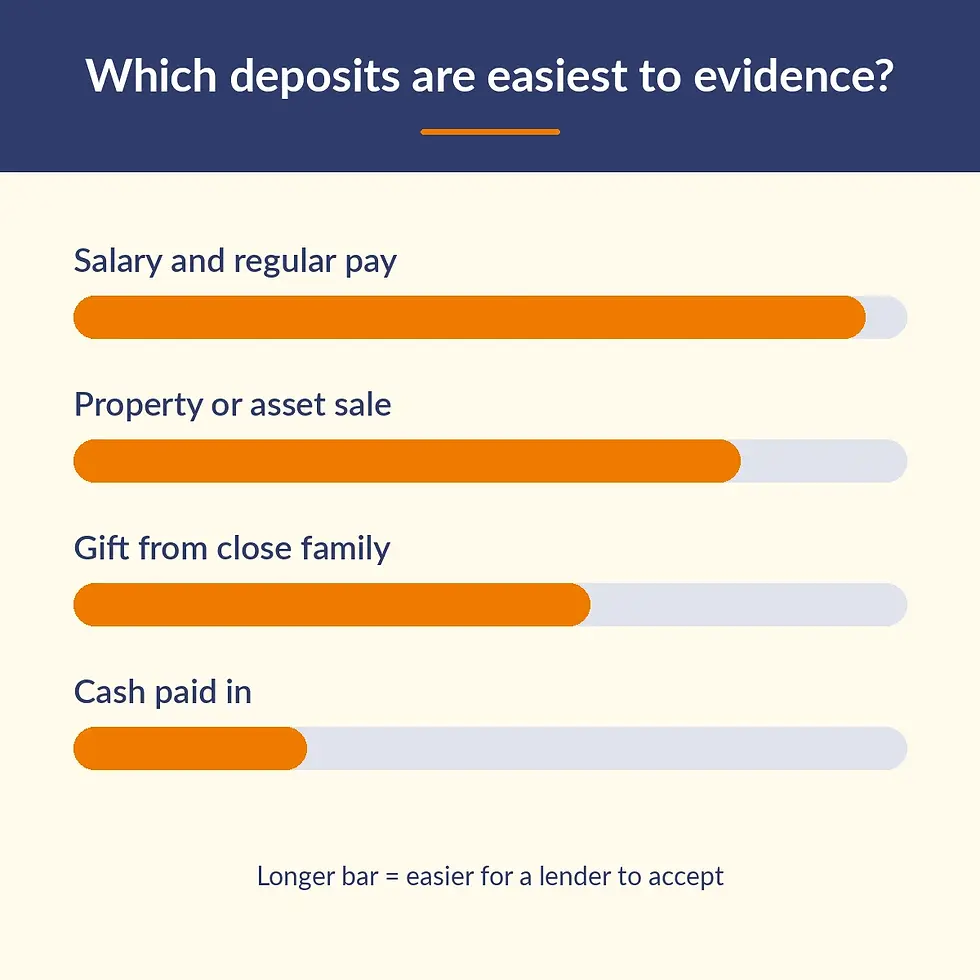
Context is everything. Lenders look at patterns over three to six months, so a one-off credit matters more than a regular, predictable one. Your own salary, a documented pension, or a recurring transfer you can explain are rarely an issue.
The credits that attract the most attention are the ones that are hard to trace. Cash paid in at a branch, cryptocurrency proceeds, gambling winnings, or a transfer from an account the lender cannot see all sit at the tricky end of the spectrum. Our guide on how lenders check gambling on your statements shows how pattern, not a single entry, drives the decision.
Deposit type | How a lender is likely to view it |
Salary or regular pay | Expected; no explanation needed |
Documented gift from family | Fine, with a signed gift letter |
Property or asset sale | Fine, with a completion or sale statement |
One-off transfer between your accounts | Fine, if both accounts are shown |
Cash paid in | Harder; needs a clear paper trail |
Gambling or crypto proceeds | Case by case; expect close questions |
None of these is an automatic decline. The table simply shows how much evidence each is likely to need. The harder a source is to trace, the earlier you should start gathering proof.
How to prove where your money came from
The principle underwriters use is simple: a clean, traceable trail from the origin of the money to your account. The stronger and more recent your evidence, the fewer questions you will face.
Salary, bonus or commission. A payslip matched to the credit on your statement is usually enough, though bonus and overtime are read more cautiously than basic pay.
Sale of a property, car or other asset. A completion statement, invoice or bill of sale ties the money to a clear event and date.
A gift from family. A signed gift letter plus the donor's own bank statements shows the funds are genuinely theirs to give.
Savings built up over time. Several months of statements showing the balance accumulating is the cleanest evidence of all.
Money moved between your own accounts. Show both sides. If a lender can see the debit leaving one account and the credit arriving in another, an internal transfer is a non-event.
Cash is the exception. Because it breaks the paper trail, many lenders will not accept undocumented cash towards a deposit at all. If you have been saving in cash, paying it in steadily and early, well before you apply, gives it time to read as established savings rather than a last-minute inflow. This sits alongside everyday habits like how you use an overdraft in your statement history.
Gifted deposits: the paperwork lenders ask for
Family gifts are one of the most common sources of a large deposit, and lenders are entirely comfortable with them, provided the gift is genuinely a gift. UK Finance, whose Mortgage Lenders' Handbook sets the instructions solicitors follow, makes the key point clear: the money must not be a loan, and the giver keeps no stake in the property.
That confirmation comes in a gift letter. It is a short signed declaration, and most lenders want the same core facts in it. The donor also has to prove the money is theirs, usually with a few months of their own bank statements, and pass the same identity checks you do.
A gift letter should state | A gift letter should avoid |
The donor's name and relationship to you | Any hint the money is a loan |
The exact amount being gifted | Any expectation of repayment |
That the gift is non-repayable | Any claim on or interest in the property |
That the donor keeps no stake in the home | Vague wording an underwriter must chase |
If your gift comes from abroad, expect extra checks on how it was earned and moved; our guide to an overseas gifted deposit walks through that source-of-funds trail. A large gift can also have tax implications for the person giving it, which is a question for a qualified UK tax adviser rather than a mortgage matter.
Case study: a large gift, evidenced cleanly
Here is an illustrative example of how this plays out. A first-time buyer we will call Sarah was buying a 300,000 pound flat with a 15% deposit of 45,000 pounds. Of that, 30,000 pounds was a gift from her parents and 15,000 pounds was her own savings.
The credit that would have worried an underwriter was the 30,000 pounds landing in one lump. Because Sarah planned ahead, the money arrived three months before she applied, her parents signed a gift letter and supplied three months of their own statements, and her 15,000 pounds showed a steady savings pattern going back over a year.
With every pound traced to a clear source, the application ran without a single extra query. The figures here are illustrative only and not a quote, but the lesson is real: the same gift, paid in the week before applying with no paperwork, would very likely have triggered delays. Preparation, not the size of the deposit, decided the outcome. Buyers weighing up their position may also find our notes on improving affordability as a first-time buyer useful.
What an underwriter is really looking for
It helps to see a large deposit through the underwriter's eyes. They are not trying to catch you out; they are answering three quiet questions for their own file and for the regulator.
First, is the money real and yours to use? Second, does it come from a legitimate source, as the Money Laundering Regulations 2017 require them to confirm? Third, does it change the affordability picture, for example if a gift is really a loan with monthly repayments hiding in the background?
Answer those three and an underwriter has what they need. This is why a documented gift or a clear sale is straightforward, while an unexplained transfer stalls: it leaves at least one of the three questions open. The Prudential Regulation Authority (PRA), part of the Bank of England, sets the lending standards behind this, and the FCA's responsible-lending rules reinforce them.
The practical takeaway is to do the underwriter's job for them. Arrive with the source of every large credit already evidenced, and you turn a potential sticking point into a formality. If your situation is unusual, a broker can tell you in advance which lenders will be most comfortable with your particular source of funds.
FAQs
How large is a large deposit to a lender?
There is no fixed figure. A deposit is worth explaining when it is large relative to your income and sits outside your usual pattern. For many applicants that starts at a few thousand pounds, but context matters more than any single number.
Will one unexplained deposit get my mortgage declined?
Rarely on its own. In most cases the lender simply asks for evidence of the source. It only becomes a real problem if the money cannot be explained, or if it points to an undisclosed debt or repayment.
How long should money be in my account before I apply?
There is no legal minimum, but many lenders like to see funds settled for around three months, often called seasoning. Earlier is better, and you should keep the evidence of the source regardless of timing.
Do I need a gift letter for money from my parents?
Almost always, yes. Lenders want a signed letter confirming the money is a non-repayable gift with no stake in the property, along with the donor's identification and a few months of their bank statements.
Can I use cash savings towards my deposit?
Often it is difficult. Undocumented cash breaks the paper trail, so pay it in steadily and early so it reads as established savings. Even then, some lenders will not accept cash deposits, so check before you rely on them.
Does moving money between my own accounts look bad?
No, as long as you can show both sides. When the debit leaving one account and the credit arriving in another are both visible, an internal transfer is a non-event for an underwriter.
Summary
In 2026, a large or unexplained deposit will rarely stop a mortgage by itself. Lenders question big credits because responsible-lending and anti-money-laundering rules require them to know where your money came from, not because size alone is a problem. Evidence every source, keep gifts and sale proceeds well documented and ideally settled for a few months, and a large deposit becomes a formality rather than a hurdle.
Updated: 14 July 2026
Written by Ben Stephenson, CeMAP-qualified Mortgage Broker.
Manor Mortgages Direct is FCA authorised, FRN 496907, with 25 years trading, is highly positively reviewed, 4.9 rated on Google, and has helped thousands secure the right mortgage. Bristol-based mortgage brokers, assisting clients nationwide.
Sources
Financial Conduct Authority - Consumer Duty (2023). fca.org.uk
The Money Laundering, Terrorist Financing and Transfer of Funds Regulations 2017. legislation.gov.uk/uksi/2017/692
UK Finance - Mortgage Lenders' Handbook. ukfinance.org.uk
FCA Handbook - MCOB 11.6 Responsible lending. handbook.fca.org.uk
Related Guides