
Raising Money on Your Mortgage Explained
Updated: Aug 28
If you already own a home, the equity built up in it is one of the most flexible sources of finance available to you. Whether you want to renovate, clear more expensive borrowing, help a family member onto the ladder, or cover a large one-off cost, the money is often already there in your property. The question is rarely whether you can access it, but which of the three main routes is the right one for your circumstances.
This guide explains each of those routes in plain English, compares them side by side, and links you straight through to a detailed walk-through of whichever one fits your situation. As a specialist mortgage broker, we arrange capital raising every week, including the cases the high street turns down, so if your circumstances are not textbook there is almost always a route worth exploring.

What does raising money on your mortgage mean?
Raising money on your mortgage, sometimes called capital raising or releasing equity from your home, simply means borrowing more against a property you already own and releasing that money as cash. The new borrowing is secured against your home, which is why the rates are usually far lower than unsecured options like personal loans or credit cards. It also means the lender has a claim over your property if the borrowing is not repaid, so it is a decision to take deliberately rather than lightly.
The amount you can raise is driven by two things: how much equity you hold (the gap between your property's value and your outstanding mortgage), and whether you can comfortably afford the larger total borrowing. Beyond that, the right structure depends on your existing mortgage deal, your reason for borrowing, and how quickly you need the funds. That is where the three routes below differ.
The three ways to raise money on your mortgage
1. Further advance: borrowing more from your current lender
A further advance is extra borrowing taken from the lender you already have, on top of your existing mortgage. It normally sits in its own sub-account with its own interest rate and term, while your main mortgage carries on untouched. Because your lender already holds your details and knows the property, a further advance can be one of the quicker routes, and the rate is often competitive because it is still first-charge lending.
The trade-off is choice. You are limited to your current lender's rates, criteria and maximum loan-to-value, so if they decline the extra borrowing or price it poorly, you cannot shop around without switching route. Further advances tend to suit borrowers whose lender is already competitive and who want the simplest possible arrangement.
Read the detailed comparison: further advance vs remortgage.
2. Second charge mortgage: a separate loan behind your main mortgage
A second charge is a completely separate loan from a different lender, secured against your home but sitting behind your existing first mortgage in priority. Your original mortgage stays exactly as it is, which is the whole point: it lets you raise money without disturbing a rate you want to keep, and without triggering the early repayment charge that remortgaging mid-deal often would.
Second charges also come into their own when your circumstances have changed since you took the first mortgage, for example if you are now self-employed, have had a credit blip, or need the money faster than a full remortgage allows. Rates are typically higher than a first-charge mortgage, so the saving from protecting your main deal needs to outweigh that. A broker can run both numbers to show which wins.
Learn more about this route:
3. Remortgage with additional borrowing
Remortgaging means moving your whole mortgage to a new deal, and borrowing more at the same time. When your current deal is ending or you are sitting on a standard variable rate, this is frequently the cheapest route overall, because you reset the entire balance plus the new money onto one fresh rate rather than running two separate borrowings.
The watch-outs are early repayment charges and term length. If you are still inside a fixed period, leaving early can trigger a charge that wipes out the saving, which is exactly when a further advance or second charge tends to win instead. And because the extra borrowing is usually spread over the full mortgage term, it is worth structuring it carefully so you are not paying interest on a short-term need for 25 years.
Related reading: how remortgaging works, does remortgaging extend your term?, and early repayment charges explained.
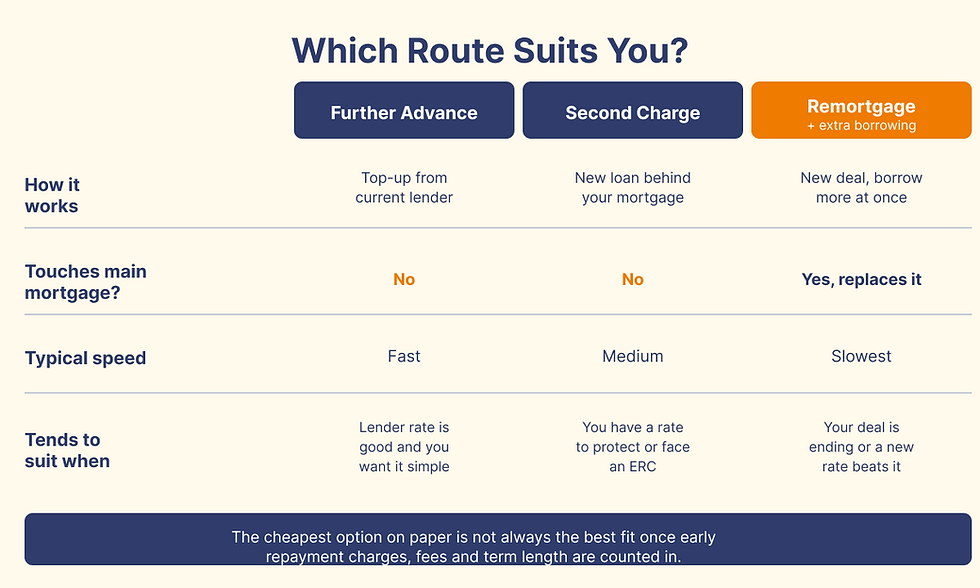
Which route is right for you?
Every case is different, but the comparison usually comes down to whether you want to keep your existing mortgage intact, how quickly you need the funds, and where the cheapest total cost lands once fees and charges are counted. As a rule of thumb:
Further advance: extra borrowing from your current lender that leaves your main mortgage untouched. Best when your lender's offer is competitive and you want the simplest, quickest route.
Second charge: a separate loan behind your first mortgage. Best when you have a good rate to protect, face an early repayment charge, or your circumstances have changed since the original mortgage.
Remortgage with extra borrowing: replaces your mortgage with a new deal plus the extra money. Best when your current deal is ending, or a fresh rate beats what you are on now.
The cheapest option on paper is not always the best fit once early repayment charges, arrangement fees, and how long you will actually hold the borrowing are taken into account. Comparing all three properly is exactly the job a broker does for you, and it is rarely obvious from the outside which one wins.
What people raise money on their mortgage for
Lenders will want to know the purpose of the borrowing, and some accept certain purposes more readily than others. These are the most common reasons our clients raise capital, each with a detailed guide:
Home improvements. Extending, renovating or adding value is one of the purposes lenders view most favourably. See remortgaging to fund home improvements.
Consolidating other borrowing. Bringing higher-cost debts into one secured payment. Start with debt consolidation, then the detail: how much equity you need, how many debts you can roll in, the maximum LTV lenders allow, whether it hurts your credit score, clearing credit cards, and doing it on an interest-only mortgage.
Helping family. For example repaying a family loan that funded a deposit. See remortgaging to repay a family loan.
Covering a tax bill. Raising money against the property to settle a bill. See mortgages and tax bills. We are not tax advisers; for how a bill should be dealt with, speak to a qualified tax professional.
Separation or divorce. Buying out a partner or releasing equity on a transfer of equity. See mortgages and divorce.
How much can you raise?
How much you can release depends mainly on your loan-to-value, which is the size of the total new borrowing measured against your property's value. Lenders cap the LTV they will lend to for capital raising, and that ceiling is often lower when the money is for consolidating debt than for home improvements, because they treat the purposes differently. As a broad guide, more equity gives you more room, and the most competitive rates usually sit at lower LTV bands.
The second test is affordability. The lender assesses your income and outgoings against the new total borrowing, not just the extra slice, so raising money has to fit your monthly budget as well as the property's value. Because both the LTV ceiling and the affordability calculation vary so much by lender and by purpose, the only reliable answer to how much you can raise comes from running your specific numbers, which we are happy to do.
What the process looks like
Whichever route you choose, the shape of the process is similar. We start by understanding why you need the money and how much, then check your equity and affordability against lenders who accept that purpose. From there we compare the realistic options, including the cost of any early repayment charge if a remortgage is on the table, and recommend the route that costs least over the time you will actually hold the borrowing. Once you choose, the lender values the property and issues an offer, and the funds are released on completion.
A further advance with your existing lender is usually the quickest because much of the groundwork is already done. A second charge typically completes faster than a full remortgage, while a remortgage takes longest because it is a complete new application with a new lender. Timescales vary by lender and by how straightforward the case is.
The risks and what to weigh up
Raising money against your home is a useful and often very cost-effective tool, but the borrowing is secured on your property, so it pays to go in clear-eyed:
Consolidating debt can cost more overall. Moving shorter-term, unsecured debts such as cards and loans onto your mortgage can reduce your monthly payments, but spreading them over the full mortgage term can mean paying considerably more interest in total. You are also converting previously unsecured debt into debt secured against your home. Think carefully before securing other debts against your home. Your home may be repossessed if you do not keep up repayments.
Early repayment charges. If you are still inside a fixed or discounted period, remortgaging to raise money can trigger an early repayment charge. This is often the single biggest reason a further advance or second charge turns out cheaper than a remortgage.
Term length. Extending the term lowers the monthly cost but increases the total interest paid. Where it makes sense, a broker can structure the extra borrowing over a shorter sub-account so a short-term need is not stretched across decades.
None of this is a reason to avoid raising money on your mortgage. It is a reason to get the structure right, which is the part we handle for you.
Frequently asked questions
Is a further advance cheaper than a second charge?
Often, because a further advance is first-charge borrowing from your existing lender at first-charge-style rates. But not always. If your current lender's further-advance rate is high, or they decline the borrowing, a second charge from a specialist lender can work out better. It is always worth comparing both before deciding.
Can I raise money to consolidate debt with bad credit?
Frequently, yes. High-street lenders are cautious about debt consolidation, particularly where credit is impaired, but specialist lenders take a broader view, especially where there is enough equity in the property. The right route and lender depend on your credit profile and your loan-to-value.
Will raising money on my mortgage affect my credit score?
Taking on new secured borrowing is recorded on your file, and consolidating debts changes your credit profile, so there can be a short-term effect. Provided the new payments are maintained, any impact is usually temporary.
Do I have to use my current lender?
No. You can take a further advance with your current lender, a second charge from a different lender, or remortgage to a brand new lender entirely. Each suits different situations, and you are never obliged to stay with your existing lender to raise money.
How much equity do I need to raise money?
There is no single figure, because it depends on the lender's maximum loan-to-value for your chosen purpose and on affordability. As a general rule, the more equity you hold, the more you can raise and the better the rates available. We can tell you exactly what is possible once we know your property value, outstanding balance and income.
How quickly can I get the money?
A further advance with your existing lender can be quick. A second charge is typically faster than a full remortgage. A remortgage takes longest because it is a complete new application. If speed matters, mention it at the outset and we will factor it into the recommendation.
More guides on raising money