
Returning Expat Mortgage: How to Get UK Approval Before You Move Back
Updated: Sep 1
Find out how to line up a UK mortgage before you move back from abroad, what lenders check, and how to avoid the delays that catch returning expats out.
Quick Answer
Yes, you can usually line up a UK mortgage before you move back, but approval before you return really means getting an Agreement in Principle and preparing your case, a full offer needs a specific property and valuation. The winning approach is preparation: a clean address and credit trail, well-evidenced overseas income, and a clear source of deposit, all ready before you fly.
Reviewed by Ben Stephenson, FCA authorised (FRN 496907) · 25+ years’ experience · 4.9★ on Google. Updated: 17 June 2026.
Who Is This Guide For
Best for UK nationals living abroad who plan to return in the next few months and want a mortgage lined up, especially anyone paid in a foreign currency, with a thin UK credit file, or a deposit held overseas.
Key Points
Get an Agreement in Principle before you fly
Overseas income is assessed cautiously and needs evidence
A thin UK credit file causes most delays
Table of Contents

What does “UK approval before you move back” actually mean?
In short, the two stages compare like this:
Agreement in Principle | Full mortgage offer |
A conditional indication of how much you may borrow | Formal approval after full underwriting |
Great for house-hunting and making offers | Needs a specific property and valuation |
Can be run from overseas before you fly | Usually comes after your offer is accepted |
Most returning expats use “approval” to mean one of three things:
Agreement in Principle (AIP)
This is a conditional indication of how much you may be able to borrow, based on the information provided and the checks run at that stage. It is useful for house‑hunting and making offers, but it is not the same as a mortgage offer.
Full mortgage offer
This usually requires a specific property, valuation, and full underwriting. MoneyHelper notes you can make an offer based on an AIP, but to legally proceed you need a full offer, and that a full offer is usually valid for around six months (and can be withdrawn if circumstances change).
Completion readiness
This is the unglamorous part that makes the difference for returning expats, having documents, deposit funds, and legal checks lined up so the case does not stall.
Broker reality check: returning expat cases rarely fail because of one dramatic issue. They stall because of small, preventable gaps, like a bank statement that does not match your declared address history, or an overseas payslip format that is missing an employer identifier.
Can you get an Agreement in Principle while still overseas?
Often, yes, but expect extra friction compared to applying while resident in the UK. Our guide on a UK residential mortgage while living abroad covers the wider route. Here is what typically helps:
Here is what typically helps:
A stable return plan: intended return date, UK employment start date (if applicable), and where you will live initially.
A clean, consistent identity trail: matching names, addresses, and dates across documents.
An affordability profile that stands up to stress testing: UK mortgage providers must consider the impact of future interest rate rises when assessing affordability (the FCA’s stress-test rule).
Realistic borrowing assumptions: as context, the Bank of England reported that in 2025 Q1, 45.8% of gross mortgage advances had LTVs above 75%, while only 6.7% were above 90%. That shows higher‑LTV lending exists, but it is not the bulk of the market.
Why this matters for you: if your file is harder to evidence (overseas income, limited UK credit footprint, complex deposit), the most flexible options may not be the ones you fit. The solution is not optimism. It is documentation and structure.
A practical 8-step plan to get mortgage-ready before you return
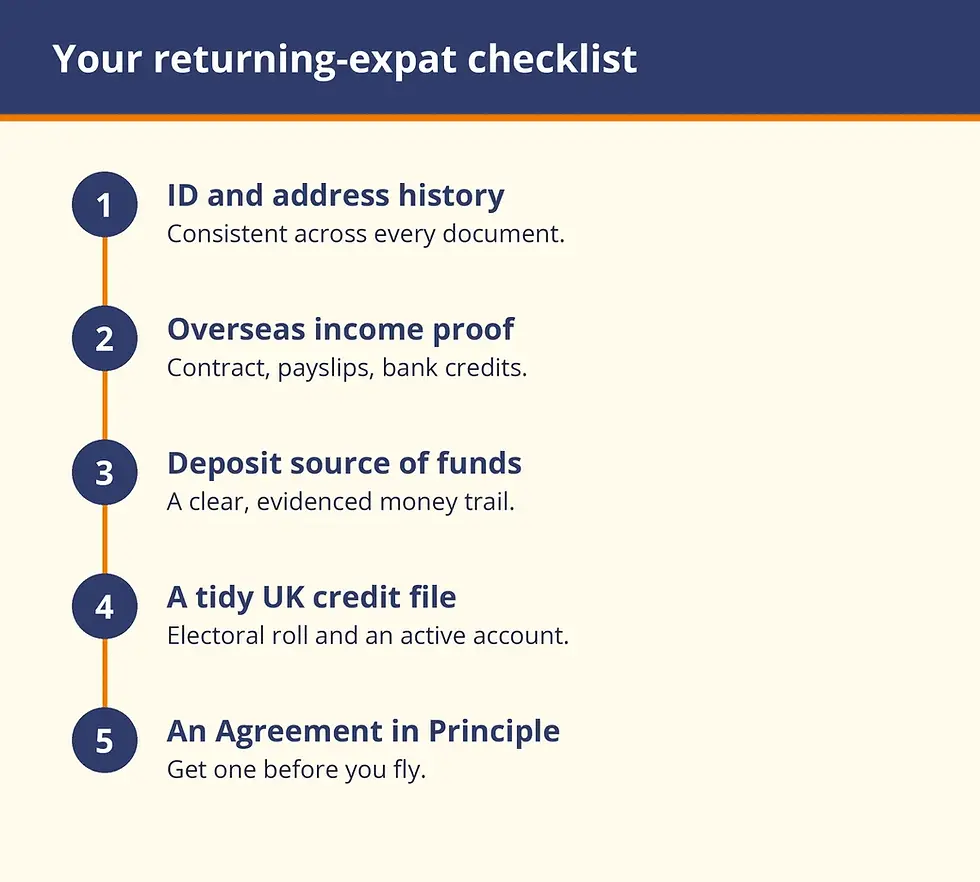
Use this as a working checklist. Many returning expats can do steps 1–6 before they book a flight.
1) Build a “single source of truth” for your application
Create one document (notes app is fine) that lists:
Full name (exactly as per passport)
Current overseas address and dates
Last UK address and dates
Any other addresses in the last 3 years
Employment history, including contract type and pay structure
All credit commitments (UK and overseas)
If anything is inconsistent, fix it before you apply. Inconsistencies do not always decline a case, but they almost always create delays.
2) Check your UK credit file early
If you have been overseas, your UK credit file can look “thin”, even if you are excellent with money.
Actions that often help:
Re‑register on the electoral roll when you have a UK address. MoneyHelper notes being registered helps firms verify your identity and can support your credit profile.
Keep UK accounts active where possible (even small, regular usage).
Avoid multiple credit applications close together.
Experian also notes that if identity cannot be confirmed via the electoral roll, you may be asked for additional proof of address, which can slow the process.
3) Decide what “returning” means for your mortgage purpose
Be clear whether the property will be:
Your main residence immediately, or
Purchased now but occupied later, or
Temporarily rented out
Important: mismatching the mortgage purpose to the real plan can create serious problems later. If you are not sure, get advice before you apply.
4) Prepare overseas income evidence in the format underwriting teams actually use
Aim to provide:
Employment contract (or assignment letter)
Recent payslips
Bank statements showing salary credits
Tax documentation relevant to your country (or accountant letter for self-employed)
If documents are not in English, budget for certified translations. Waiting until you have an offer accepted is a common mistake, and it can cost you the purchase if timelines slip.
5) Stress-test your own budget before anyone else does
Providers must consider future interest rate rises under FCA rules, so you should too. As a reference point for today’s environment, the Bank of England’s current Bank Rate is 3.75% (as at the 18 December 2025 decision).
Practical self‑test:
Add a buffer to your expected mortgage payment.
Add realistic UK living costs (council tax, utilities, commuting, childcare).
Assume at least one “moving surprise” expense, because it almost always happens.
6) Lock down deposit strategy and prove the source
Returners often have deposits coming from:
Overseas savings
Sale proceeds from an overseas property
A bonus, commission, or relocation allowance
Family gift
Repatriated investments
Your job is to make the story easy to evidence. Under anti‑money laundering requirements, conveyancers and financial firms must carry out customer due diligence and source of funds checks, so expect questions and plan for them.
7) Plan your timeline around the “slow steps”
The steps that commonly create delays:
Gifted deposit letters and donor bank statements
Proof of overseas address
Translations and certifications
Large international transfers
Property valuation issues
If you are serving notice on an overseas tenancy, do not assume the dates will align. Missing one break clause detail can force you into an expensive overlap, or pressure you into rushing a purchase.
8) Use the AIP as a planning tool, not a trophy
An AIP is valuable because it helps you:
Set a realistic property budget
Make offers with confidence
Identify documentation gaps early
But it is still conditional. The cleanest approach is to treat your AIP as the start of underwriting, not the end.
How overseas income is usually assessed

UK mortgage affordability is not a simple salary multiple exercise. Providers are expected to assess whether the mortgage is affordable both now and in the future, including the effect of future rate rises (FCA stress-test expectations). For the wider picture on lending from abroad, see our guide to expat mortgages.
For returning expats, the usual focus areas are:
What type of income is it?
Basic salary: typically the easiest to evidence.
Bonus, commission, allowances: often assessed more cautiously, especially if variable.
Contracting income: commonly requires clear contract terms, continuity, and sometimes a longer track record.
Self-employed overseas: usually evidence-led, tax documents and accounts matter.
What currency are you paid in?
If your income is not in GBP, underwriting often needs:
A consistent conversion method
An exchange-rate buffer (to account for volatility)
Evidence that the income is stable and ongoing
This is not “penalising expats”. It is a risk control. If your GBP-equivalent income drops after completion due to FX swings, affordability tightens quickly.
Where does your income hit your bank account?
Salary credits visible on bank statements are often a core piece of evidence. If your salary is split across accounts, or paid partly in cash, clarify it upfront.
How does debt and ongoing spending affect affordability?
Affordability assessments look at committed outgoings, not just income. Even if your overseas living costs will drop when you move back, you may need to evidence what will replace them in the UK (rent, childcare, commuting).
Data point for context: the Bank of England reported that in 2025 Q1, 45.2% of gross advances were to borrowers classed as “high loan-to-income” under its reporting definitions (single income LTI 4+, joint income LTI 3+). That does not mean high borrowing is “easy”. It means affordability is actively assessed, and higher LTIs exist within that framework.
Deposit, source of funds, and why transfers cause delays
Returning expats often underestimate how long it can take to make deposit money “usable” in a UK purchase.
Expect source of funds checks, and treat them as normal
The Money Laundering Regulations require due diligence, and the Law Society highlights how these requirements shape the checks solicitors must do.
Practical ways to reduce delays:
Keep deposit money in an account that can produce clear statements.
Avoid last-minute lump sums that cannot be explained.
If your deposit is gifted, prepare the gift letter and donor evidence early.
If funds are coming from overseas, keep transfer confirmations and account trails.
Common “returning expat” red flags (fixable)
A large transfer with no paper trail
Savings built across multiple countries without consolidated evidence
Name mismatches (marriage, middle names, different alphabets)
Business funds used as personal deposit without clear extraction evidence
Professional insight: the fastest cases are not always the richest. They are the clearest.
UK credit file and address history, how to rebuild fast
A returning expat can have strong finances and still look risky on paper if the UK footprint is thin.
Why the electoral roll matters
MoneyHelper specifically notes that registering to vote helps organisations verify your identity, which can support your credit profile.
Experian also notes that if your details cannot be confirmed via the electoral roll, you may be asked for other proof of address, which can delay applications.
Practical “credit footprint” actions that often help
Re-establish a stable UK correspondence address as early as possible.
Keep one UK current account active and tidy.
Avoid repeated credit applications in the run-up to a mortgage.
Make sure you are not financially linked to someone else unexpectedly (old joint accounts can do this).
Avoidable mistake: using different address formats across documents, for example “Flat 2” vs “Apartment 2”. Underwriting systems can treat these as different addresses.
Stamp duty: budget for it, and take tax advice
Stamp duty can materially change the cash you need to complete, so it is worth checking early.
Returning expats can face a higher stamp duty bill than they expect. A higher rate can apply if you are not yet UK-resident depending on how long you have been out of the UK, and owning a home abroad can mean a purchase is treated as an additional property, which carries higher rates. The exact rules, rates, residency tests and any refund routes are a tax matter for a qualified tax adviser rather than a mortgage broker. For the mortgage, the practical point is simple: get a stamp duty figure early and budget for it, so it does not eat into your deposit or open a funding gap after your offer is accepted.
Case study: returning expat, UK approval before landing
Scenario: A couple returning to the UK within 4 months. One applicant paid in a foreign currency, the other transitioning to a UK job offer.
Initial risks:
UK credit file was thin due to years overseas.
Deposit was held in an overseas account with mixed incoming funds.
Return date was close to intended completion.
What we changed:
Built a single, consistent address history pack and re-established a UK correspondence trail.
Produced a structured overseas income pack, contract, payslips, tax evidence, and bank credits, with clear GBP conversion notes.
Mapped deposit source of funds with statements and transfer trail, reducing back-and-forth queries.
Set expectations that “approval” would start with an AIP, then proceed to full offer once a property was agreed.
Outcome: The clients obtained an Agreement in Principle before travelling, then moved to a full application once the property offer was accepted. The key benefit was not speed alone, it was fewer surprises at underwriting stage.
FAQs
1) What is the difference between an AIP and a mortgage offer?
An Agreement in Principle is an early indication based on initial checks. A mortgage offer is the formal approval after full underwriting and property checks. MoneyHelper notes you can offer with an AIP, but you need a full offer to proceed, and offers are typically time-limited and can be withdrawn if circumstances change.
2) How far in advance should I start a returning expat mortgage application?
Often 3–6 months before you want to complete is sensible, especially if you need translations, have variable income, or your deposit is overseas. The biggest time-savers come from preparing documents early, not rushing later.
3) Will being paid in a foreign currency reduce what I can borrow?
It may, depending on the stability of income, currency, and how affordability is stress tested. UK affordability assessments must consider future interest rate rises, so providers may apply buffers to protect against shocks.
4) I have not used UK credit for years, what can I do?
Start by rebuilding identity and address verification. MoneyHelper recommends registering to vote as it helps verify identity, and Experian notes lack of electoral roll confirmation can slow checks. Then keep UK banking active and avoid repeated new credit applications.
5) Why do solicitors ask so many questions about my deposit?
Because anti-money laundering rules require customer due diligence and checks on source of funds. Expect to evidence where money came from and how it moved, especially for overseas transfers.
6) Could I face extra Stamp Duty if I buy before I am back in the UK?
Potentially. A higher rate of stamp duty can apply to non-UK residents, and owning a home abroad can affect the rate too. The detail is a tax matter for a qualified tax adviser, but the practical step is to budget for it before you commit so it does not create a funding gap.
7) Does the UK market context matter for my application?
It can affect affordability assumptions and valuations. For example, the UK House Price Index summary for October 2025 reported an average UK house price of £270,000, and noted mortgage approvals for house purchases at 65,000 in October 2025 (down 600 on the month).
Next steps
If you want to secure a returning expat mortgage agreement in principle before moving back, the most effective next step is a structured review of:
Your overseas income evidence
Your UK credit and address footprint
Your deposit source of funds trail
Your return timeline and intended completion date
A broker can help you package this so it matches how underwriting teams assess cases, and so you avoid preventable delays.
Updated 17 June 2026.
Written by Ben Stephenson, CeMAP-qualified mortgage broker at Manor Mortgages Direct.
Manor Mortgages Direct is FCA authorised (FRN 496907), established for nearly 30 years and rated 4.9★ on Google. Based in Bristol, we help returning expats and overseas clients line up UK mortgages. Call 01275 399299.
Related Guides