
How UK Expats in Spain Get a UK Mortgage in 2026
Updated: Sep 1
See how a British expat living in Spain can get a UK mortgage, which lenders accept euro income, the deposit you will need, and how the routes differ.
Quick Answer
Yes. A British expat living in Spain can usually get a UK mortgage, whether to buy a UK home, fund a buy-to-let, or remortgage a property they already own. Most high-street banks step back from non-residents, so these cases run through specialist lenders reached by a broker. They accept euro income, though many apply a discount to it, look for a live UK credit footprint, and usually want a deposit of around 25 percent or more.
Reviewed by Ben Stephenson, FCA authorised (FRN 496907) · 25+ years' experience · 4.9★ on Google. Updated: 19 June 2026.
Who This Guide Is For
Best for British expats living in Spain, whether employed, self-employed or retired, who want a UK mortgage to buy a home in the UK, add a buy-to-let, or remortgage a UK property while their income and bank accounts are based in euros.
Key Points
Euro income is accepted, usually with a discount applied
Specialist lenders, reached through a broker, do this lending
A 25 percent deposit and UK credit history are the usual asks
Table of Contents

A UK mortgage from Spain is very doable
The picture many expats have, that living in Spain shuts the door on UK borrowing, is out of date. A British expat on the Costa del Sol or in Madrid can get a UK mortgage in much the same way as a UK resident, just through a narrower set of lenders. The property is in the UK, the loan is in sterling, and the lender's real question is simply whether your income and history stack up from abroad.
What changes is who you apply to and how the case is packaged. Mainstream banks built their systems around a UK address and a UK payslip, so an overseas applicant often trips an automatic decline. Specialist expat lenders, by contrast, are set up for exactly this: a foreign address, an overseas employer and income in euros. Line those up clearly and a Spain-based application stops looking unusual and starts looking like routine expat business.
Part of the draw is that a UK property keeps a foot on the ladder back home, whether as a place to return to, a base for visits, or a let that earns while you are away. Lenders understand that motivation well, which is one reason a dedicated expat market exists at all.
Why the high street usually says no
Most high-street lenders simply do not lend to non-residents. It is not that your case is weak; it is that their criteria require a UK address, UK-based income and a credit file they can score automatically. An application from Spain falls outside that template, so the computer says no before a human ever reads it. That single rule, rather than anything about you, is what turns people away.
Specialist lenders take the opposite approach and underwrite these cases by hand. They are comfortable with a Spanish address, will assess euro income, and know how to read an expat's UK ties. Because most of them work only through intermediaries, a broker who places expat mortgages regularly is the practical route in. The graphic below sums up the four things they check first.

How lenders treat your euro income
Earning in euros is normal for these lenders, but most do not count every euro at face value. They convert your income to sterling and then apply a discount, often called a haircut, to allow for exchange-rate movements. The size of that discount is the single biggest variable between lenders, and it directly sets how much you can borrow, so matching your profile to a generous one matters.
As a rough guide, a cautious lender might use only around three quarters of your euro income, a typical one most of it, and a generous one the full amount. The table shows how that spread feeds through to your borrowing. A broker's job is partly to steer your file toward the lenders whose currency stance leaves you with the most room.
Lender stance | Euro income counted | Effect on borrowing |
Cautious | Around 75 to 80 percent | Lower maximum loan |
Typical | Around 85 to 90 percent | Moderate |
Generous | Up to 100 percent | Full income used |
If you are applying jointly, lenders will usually take both incomes, which softens the effect of any single currency haircut. Where one of you is paid in sterling, perhaps from a remote UK role, that strengthens the case further, because part of the income carries no exchange-rate discount at all.
Beyond the headline percentage, lenders want the income to look stable and verifiable: an employment contract, recent payslips, and bank statements showing the salary landing. Self-employed expats are catered for too, usually on the strength of accounts and tax returns, though the lender pool is a little smaller and the packaging matters more.
Deposit, credit and paperwork
Expect to put down more than a UK resident would. A deposit of around 25 percent is the common starting point for a residential purchase from abroad, and a buy-to-let or a weaker-tie case can push that towards 30 to 40 percent. The larger deposit does two jobs: it offsets the lender's extra caution, and it widens the pool of lenders willing to look at the case at all.
A live UK credit footprint is the other big lever. Lenders like to see that you still appear on the UK system, through a UK bank account, a credit card, or an existing mortgage, because it lets them score your reliability. If you have been abroad for years with no UK credit activity, it is worth rebuilding a small footprint before you apply. Our guide to how lenders assess overseas income goes deeper on the evidence side.
One more point on credit: lenders read your UK file, not a Spanish one, so a strong record in Spain does not carry across. That is why keeping even a single active UK account or card matters more than it looks. If you are still some way from applying, it is one of the easiest things to put right in advance.
On paperwork, keep it simple and complete: proof of ID and your Spanish address, evidence of income in euros, bank statements, and a clear account of your deposit and its source. Anti-money-laundering checks are stricter on overseas cases, so showing where the deposit came from, cleanly and early, is what keeps the timeline moving.
Rates, fees and how long it takes
Rates on an expat mortgage sit a little above the sharpest UK-resident deals, reflecting the smaller lender pool and the hand underwriting these cases need. The gap is often narrower than people fear, and it shrinks as your deposit grows, so it is worth weighing a slightly higher rate against the value of an approval now rather than no approval at all.
Budget for the extra costs that come with an overseas case. Some lenders charge a higher arrangement fee, and a few add an assessment or telegraphic-transfer fee, on top of the usual valuation and legal bills. You will also need a UK solicitor who is happy to act for a non-resident. None of this is unusual, but knowing the costs up front keeps the deal predictable.
On timing, a well-packaged Spain-based application moves at close to normal speed, often four to eight weeks to a mortgage offer, although the extra identity and source-of-funds checks on an overseas file can add a little. Getting your documents ready early, and choosing a lender used to expat cases, is what keeps the process moving.
Your three routes: buy, let, remortgage
Almost every Spain-based enquiry is one of three things, and the route shapes the lender list and the terms. Knowing which one you are on from the start saves time and wasted applications.
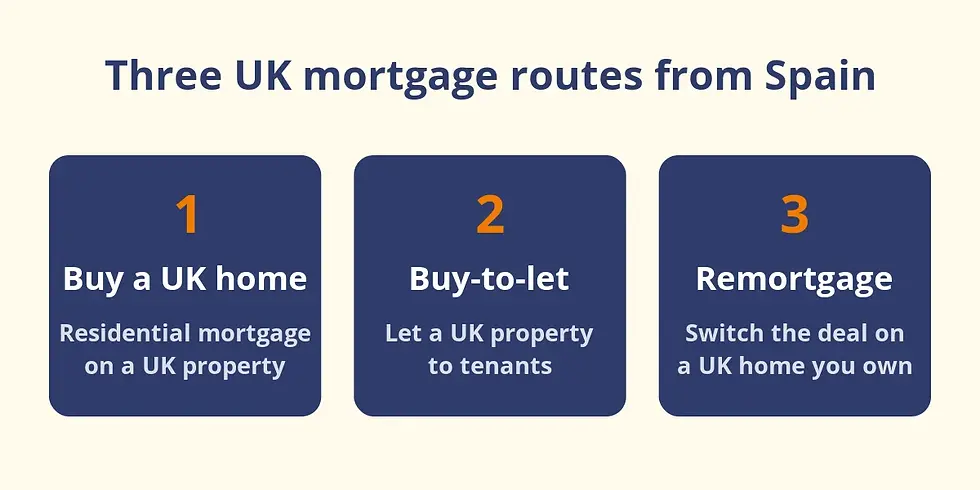
Buying a UK home to live in later, or to keep for visits and a future return, is a residential expat mortgage. Buying to rent out is a buy-to-let for expats, where the rent does much of the heavy lifting and the lender leans less on your salary. And if you already own a UK property, you can usually remortgage it from Spain, to move off a high standard rate or to release equity, on the same specialist panel.
The returning expat is a common and welcome case. If you are planning to move back to the UK, lining up the mortgage before you land, rather than after, often gives you more options, because some lenders prefer to see the existing overseas income rather than a brand-new UK job on probation.
Planning a move back to the UK
If Spain is a chapter rather than a permanent home, it often pays to arrange the UK mortgage while you are still abroad. Some lenders would rather underwrite the established overseas income you have now than a brand-new UK salary that is still inside a probation period once you land. Lining the mortgage up first can mean more lenders, and a smoother purchase, than waiting until after you have moved.
The practical sequence is to get an agreement in principle before you hand in notice in Spain, keep your UK credit active in the run-up, and hold the deposit somewhere clean and easy to evidence. Done in that order, a return can complete almost as soon as you are back, rather than stalling for months while you rebuild a UK financial footprint from scratch.
It also helps to know that buying before you return does not lock you in for good. Once you are back with a settled job and a UK address, you can usually remortgage onto a mainstream resident deal at the next opportunity, often at a sharper rate. The expat mortgage is the bridge that gets you into the property; it does not have to be the one you keep for the long term.
Case study: a Malaga couple buying back home
A British couple living near Malaga, both employed locally and paid in euros, wanted to buy a 360,000 pound house in Bristol to return to within two years. Two UK banks declined them outright on the non-resident rule, before anyone looked at the numbers. They had a 30 percent deposit saved and a clean UK credit card they had kept active throughout.
We placed the case with a specialist lender comfortable with euro income, which counted about 90 percent of their salaries and accepted the Spanish contracts and payslips. With the deposit and a tidy paper trail on its source, the mortgage was agreed at a competitive rate for an expat case. The point was not that the couple were a difficult case; it was that the first two lenders were simply the wrong ones.
Mistakes that slow a Spain-to-UK application
Most expat delays come from a handful of avoidable missteps. Spotting them before you apply keeps the case clean and the timeline short.
Applying to high-street banks first, and collecting declines and hard searches before reaching a specialist
Letting your UK credit go dark, with no active account or card the lender can score
Underestimating the deposit, and budgeting for 10 to 15 percent rather than 25 percent or more
Vague deposit source, which stalls the anti-money-laundering checks on an overseas file
Leaving currency to chance, instead of matching your euro income to a lender with a gentle haircut
None of these is fatal on its own, but together they can shrink the lender list and stretch the process by weeks. Raising them with a broker before you offer means the right lender is matched to your profile from the outset, rather than the case unravelling once an underwriter starts asking questions.
FAQs
Can a British expat in Spain get a UK mortgage?
Yes, in most cases. A specialist lender reached through a broker will lend to a British expat living in Spain for a UK home, a buy-to-let, or a remortgage, provided the income, deposit and UK credit picture stack up.
Will lenders accept my euro income?
Usually yes. Lenders convert euro income to sterling and most apply a discount, often counting around 75 to 100 percent of it depending on their stance. The lender you choose has a big effect on how much you can borrow.
How big a deposit do I need from Spain?
Plan for around 25 percent for a residential purchase, and 30 to 40 percent for a buy-to-let or a weaker-tie case. A larger deposit widens the lender pool and improves the rate.
Do I need a UK credit history?
It helps a lot. A live UK footprint, such as a bank account, credit card or existing mortgage, lets lenders score you. If yours has gone quiet, rebuild a little before applying.
Can I remortgage my UK home while living in Spain?
Yes. You can usually remortgage a UK property from Spain through the same specialist panel, to move off a high standard rate or release equity, subject to the equity and income checks.
Is it worth using a broker?
On an expat case, very much so. Most expat lenders work only through brokers, and a broker matches your euro income, deposit and ties to a lender likely to say yes, rather than risking declines.
Summary
A British expat in Spain can get a UK mortgage to buy, let or remortgage, but the route runs through specialist lenders rather than the high street. They accept euro income, usually with a discount, want a live UK credit footprint, and look for a deposit of around 25 percent or more. Match your profile to the right lender, keep the deposit trail clean, and a Spain-based case is a routine one.
Updated: 19 June 2026
Written by Ben Stephenson, CeMAP-qualified Mortgage Broker.
Manor Mortgages Direct is FCA authorised, FRN 496907, has traded for 25 years, is highly positively reviewed, 4.9 rated on Google, and has helped thousands secure the right mortgage. Bristol-based mortgage brokers, assisting clients nationwide.
Sources
GOV.UK, Living in Spain (guidance for UK nationals), https://www.gov.uk/guidance/living-in-spain, accessed 19 June 2026
Bank of England, Bank Rate and monetary policy, https://www.bankofengland.co.uk/monetary-policy/the-interest-rate-bank-rate, accessed 19 June 2026
Hero photo: Nerja, Spain, by kallerna, CC BY-SA 4.0, via Wikimedia Commons
Related Guides