
The Expat and Visa Study: How Many UK Lenders Will Consider You If You Are Not a UK-Resident UK National
See how published criteria split by residence, visa and currency, and find out where the hard stops sit.
Quick Answer
Of the 21 residential lenders whose published criteria Manor Mortgages Direct tracks, 19 will consider a non-EU foreign national living in the UK, while only 6 will consider an expatriate living outside it and 12 publish a refusal, checked September 2026. Residence, not nationality, is the dividing line.
The pattern holds across the rest of the data. Twelve of the 21 will consider a British national working overseas or offshore and 4 publish a refusal. On foreign currency mortgage lending, 7 will consider and 14 publish a refusal, so the currency the income arrives in matters more than the passport does.
"Will consider" means the published criteria do not exclude the case. It is not an offer, and every application is assessed individually against income, property and credit. The counts describe the 21 lenders tracked, not the whole mortgage market. Lenders are anonymised throughout and no lender is named.
Reviewed by Ben Stephenson, FCA-authorised mortgage adviser (FRN 496907) · 25+ years' experience · 4.9★ on Google. Updated: 9 September 2026.
Key Points
19 of 21 will consider a non-EU national living here
6 of 21 will consider an expatriate, 12 will not
7 of 21 will consider foreign currency mortgage lending
Table of Contents
The passport is rarely the problem, the currency of the income often is
Settled and pre-settled status sit near the top of the range
Visa categories split the tracked lenders close to the middle
Once you are an expatriate, refusals cluster in the detail questions
Four questions where almost no tracked lender publishes a yes

Residence decides far more than nationality does
Of the 21 residential lenders whose published criteria Manor Mortgages Direct tracks, 19 will consider a non-EU foreign national living in the UK, while only 6 will consider an expatriate and 12 publish a refusal, checked September 2026.
That pair of figures is the finding most likely to surprise a reader. The assumption that turns up in most enquiries is that a foreign passport is the obstacle and a British one is the solution. The published criteria point the other way round. Where the applicant lives, and where the income lands, does far more work in the criteria than the nationality printed on the document.
On the non-EU foreign national question, 20 of the 21 publish a position at all. Nineteen will consider the case and none publish a refusal. The one remaining lender that says something records a figure or a rule rather than a yes or a no, typically a residency length or a documentation requirement. A single lender has no published position, so it is excluded from that question rather than counted as a refusal.
The expatriate question runs in the opposite direction. Eighteen of the 21 publish a position, 6 will consider and 12 publish a refusal, with 3 silent and therefore excluded. Anyone who has been told that expat mortgages are a specialist area will find that the tracker supports the description more firmly than it supports most other labels in the data.
It is worth being precise about what the expatriate row measures. It records whether a lender's published criteria address an applicant whose main residence is outside the UK, as a category, before any of the detail questions are reached. A refusal at that first gate closes every question that follows it, which is why the detail rows later in this study carry such small consider counts.
The general residency question shows the same thing from another angle. Twenty of the 21 publish something on residency, but only 5 of those are recorded as a plain will consider. Fifteen publish a figure or a rule instead, most often a minimum period of UK residence or a requirement to hold a UK bank account or a UK credit footprint. That is a structural point rather than a refusal, and it is why counting only yes and no answers understates how much conditionality sits in this part of the market.

The passport is rarely the problem, the currency of the income often is
Of the 21 residential lenders whose published criteria Manor Mortgages Direct tracks, 12 will consider a British national working overseas or offshore while only 7 will consider foreign currency mortgage lending, and 14 publish a refusal on the currency question, checked September 2026.
Set those two rows side by side and the shape of the market becomes easier to read. Being British and abroad is not, on its own, the thing that closes doors. Sixteen of the 21 publish a position on the British national working overseas question, 12 will consider and only 4 publish a refusal, with 5 silent. That is one of the more permissive rows in the whole study.
The currency rows are the ones that tighten. On foreign currency mortgage lending, all 21 publish a position, which is unusual in this data set and suggests it is a question lenders feel obliged to answer. Seven will consider and 14 publish a refusal. Nothing is left silent.
The adjacent question, applicants paid in a foreign currency, is slightly softer but points the same way. Again all 21 publish a position, 8 will consider and 13 publish a refusal. The small gap between the two rows is worth noting: a handful of lenders draw a distinction between lending in a foreign currency and simply assessing income that happens to arrive in one.
A third row narrows the picture further. On employed income involving multiple employments or payment in more than one foreign currency, 18 lenders were tracked and all 18 published a position, splitting evenly at 8 will consider and 8 publish a refusal, with 2 recording a figure or rule only. Complexity in the income, rather than distance from the UK, is doing the work there.
Where a lender does engage with currency, it usually engages through a list. On acceptable currencies, 18 of the 21 publish a position, but only 3 are recorded as a plain will consider and 7 publish a refusal. Eight publish a figure or a rule, which in practice means a named list of currencies they will work with. Readers looking at a specific corridor may find a country-facing page such as the Ireland expat mortgage material more useful than a headline count.
One further row belongs here. On the non-UK taxpayer question, 15 of the 21 publish a position, 5 will consider and 9 publish a refusal, with 1 recording a figure or rule and 6 silent. Tax residence is treated as a separate question from currency, and the counts are not interchangeable.
Settled and pre-settled status sit near the top of the range
Of the 21 residential lenders whose published criteria Manor Mortgages Direct tracks, 10 of the 19 that publish a position will consider EU settled status and 11 of the 17 that publish a position will consider pre-settled status, with only 1 publishing a refusal in each case, checked September 2026.
This is the quietest good news in the study, and it is regularly misreported. Both settlement scheme rows have zero silence: every lender tracked published a position. On settled status, 19 were tracked, 10 will consider, 1 publishes a refusal and 8 record a figure or a rule. On pre-settled status, 17 were tracked, 11 will consider, 1 publishes a refusal and 5 record a figure or a rule.
The large figure or rule counts matter more than the will consider counts here. A lender that publishes a rule is not refusing. It is stating a condition, most often a minimum time already spent in the UK, a required length of remaining permission, or a deposit level that applies to applicants without indefinite leave. Readers in this position should treat those rows as conditional acceptance rather than as a knock back, and the EU citizen mortgage material covers what those conditions usually look like.
The wider UK resident EU national row behaves the same way. All 21 publish a position, none publish a refusal, 8 are recorded as will consider and 13 record a figure or a rule. A zero in the refusal column across 21 lenders is a strong result and stands in sharp contrast to the expatriate row discussed earlier.
Taken together, these three rows suggest that the practical question for an EU national in the UK is not whether a lender will look at the case but which conditions apply and how many of them the applicant already satisfies. That is a very different conversation from the one an expatriate is having.
Visa categories split the tracked lenders close to the middle
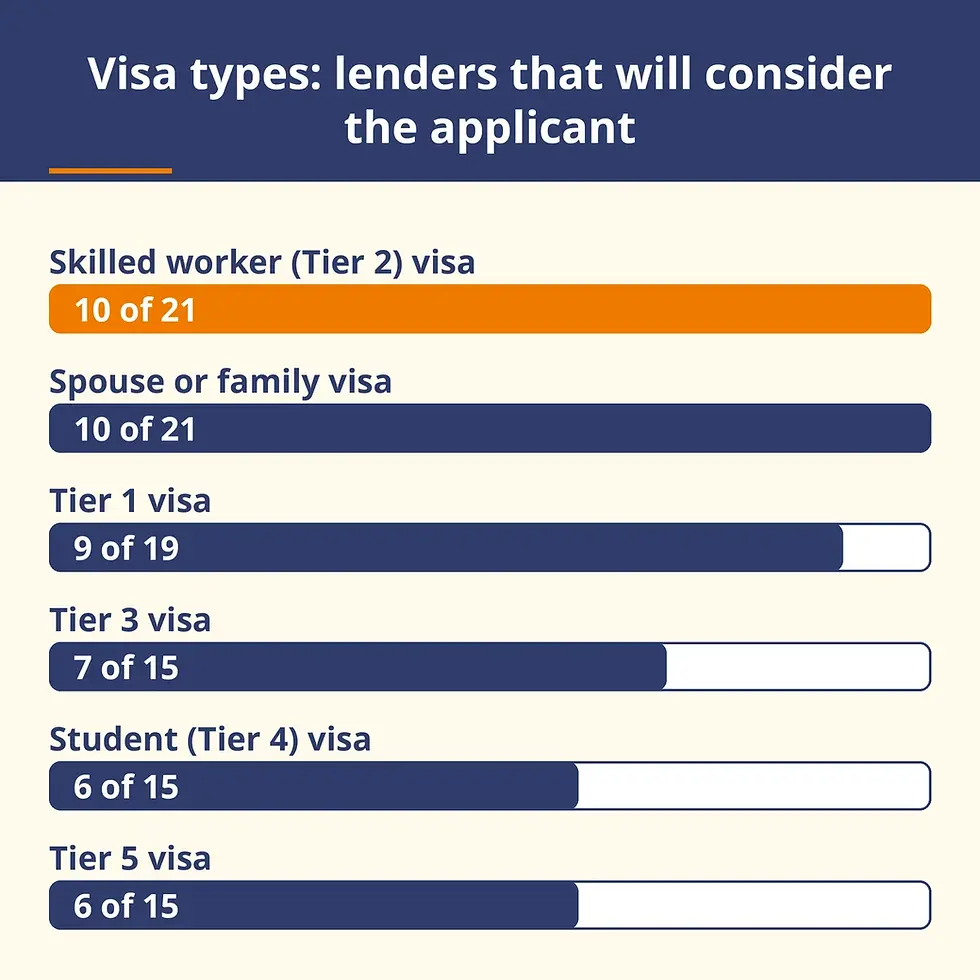
Of the 21 residential lenders whose published criteria Manor Mortgages Direct tracks, 10 will consider a skilled worker or Tier 2 visa holder and 8 publish a refusal, checked September 2026.
Visa rows are the most evenly divided part of the study. No category reaches the near unanimity of the non-EU foreign national row, and none collapses to the near total refusal of the hard stop questions later on. In almost every visa category the tracked lenders sit somewhere between a slim majority and an even split.
Not every visa question was put to all 21 lenders, because not every published criteria guide addresses every category. Where a smaller number were tracked, the denominator is shown in the table below and should be quoted with the figure.
Visa or status | Will consider, publish a refusal, of lenders tracked |
Skilled worker or Tier 2 | 10 consider, 8 refuse, of 21 asked |
Tier 1 | 9 consider, 8 refuse, of 19 asked |
Tier 3 | 7 consider, 7 refuse, of 15 asked |
Tier 4 student | 6 consider, 8 refuse, of 15 asked |
Tier 5 | 6 consider, 7 refuse, of 15 asked |
Spousal or family visa | 10 consider, 7 refuse, of 21 asked |
Time remaining on visa | 5 consider, 9 refuse, of 21 asked |
The spousal or family visa row is the one most often assumed to be harder than it is. Nineteen of the 21 publish a position, 10 will consider, 7 publish a refusal and 2 record a figure or a rule, with 2 silent. It sits level with the skilled worker row rather than below it.
The student and youth mobility categories are the tightest. On Tier 4, 15 lenders were tracked, 14 published a position, 6 will consider and 8 publish a refusal. On Tier 5, 15 were tracked, 13 published, 6 will consider and 7 publish a refusal. Both are close, and neither is a wall.
The most practically important row is the last one in the table. On time remaining on a visa, 15 of the 21 publish a position, only 5 are recorded as will consider, 9 publish a refusal and 1 records a figure or rule, with 6 silent. Applicants tend to focus on the visa type, but the published criteria are at least as concerned with how long the permission has left to run.
Once you are an expatriate, refusals cluster in the detail questions
Of the 21 residential lenders whose published criteria Manor Mortgages Direct tracks, only 2 will consider an expatriate first-time buyer and 11 publish a refusal, checked September 2026.
The detail rows behave as a consequence of the headline expatriate row rather than as independent questions. If 12 lenders publish a refusal at the category gate, the questions behind that gate cannot show higher consider counts. What the detail rows add is a sense of which sub-cases attract an explicit refusal even from lenders that engage with expatriates at all.
Expatriate sub-question | Will consider, publish a refusal, of 21 asked |
First-time buyer | 2 consider, 11 refuse |
Self-employed | 3 consider, 12 refuse |
New build flats or apartments | 1 consider, 12 refuse |
New build houses | 3 consider, 11 refuse |
Adverse credit | 2 consider, 11 refuse |
Consumer buy to let | 2 consider, 11 refuse |
Retired on application | 2 consider, 11 refuse |
Remortgage for debt consolidation | 3 consider, 13 refuse |
Country restrictions | 4 consider, 12 refuse |
Employed by a multinational company | 4 consider, 11 refuse |
Two rows in that table are stricter than the rest. Expatriate new build flats and apartments draws just 1 will consider against 12 refusals, with 2 figure or rule answers and 6 silent. Expatriate remortgage for debt consolidation draws 3 against 13, the highest refusal count of any expatriate detail row.
Maximum loan to value was asked of 19 rather than 21, because two guides do not address it. Of those 19, 15 publish a position, 2 will consider and 12 publish a refusal, with 1 figure or rule and 4 silent. The small number of lenders that do engage tend to publish a ceiling rather than a simple yes.
The income floor rows are gentler than the rest, which is telling. On minimum income for a single applicant and for a joint application, the figures are identical: 17 of the 21 publish a position, 3 will consider, 10 publish a refusal and 4 publish a figure or a rule. Those four are the lenders stating an actual threshold, and a reader with a substantial overseas salary should read those rows as the ones worth pursuing.
Two further rows sit slightly apart. On company directors based overseas, only 12 of the 21 publish a position at all, 5 will consider and 7 publish a refusal, leaving 9 silent, the largest silence in the study. On day one return to the UK, 13 publish a position, 4 will consider and 8 publish a refusal, with 8 silent. Both are cases where the absence of published wording is the main finding.
Deposit questions sit next to these rows in practice, and readers assembling funds from outside the UK will find the overseas gifted deposit material addresses a question this study does not count.
Four questions where almost no tracked lender publishes a yes
Of the 21 residential lenders whose published criteria Manor Mortgages Direct tracks, none will consider an applicant with diplomatic immunity and 18 of the 19 asked publish a refusal, checked September 2026.
Four rows in the data set stand out because the consider column is zero or close to it. These are the questions where a reader can reasonably take the published answer at face value and plan around it rather than shop for an exception.
Diplomatic immunity is the clearest. Nineteen lenders were tracked, 18 published a position and all 18 of those publish a refusal, with 1 silent. Not a single tracked lender publishes a will consider.
The sale of foreign property or assets as an interest only repayment vehicle is nearly as firm. All 21 were tracked, 19 published a position, none will consider, 17 publish a refusal and 2 record a figure or a rule. The two rule answers are the only chink, and they are conditions rather than acceptances.
Offshore mortgages produce zero will consider answers as well. Of the 21 asked, 15 published a position, 14 publish a refusal and 1 records a figure or rule, leaving 6 silent. The silence there is larger than on the other hard stops, which is consistent with a question many mainstream guides simply do not raise.
The BVI company structure row completes the group. Twenty-one were tracked, 17 published a position, 1 will consider, 14 publish a refusal and 2 record a figure or a rule. One lender in 21 is a thin margin, and it should not be read as a route so much as an exception that carries its own conditions. Structures of this kind normally sit outside mainstream residential criteria altogether, closer to the specialist end of the market.
Method, limitations and what the study does not say
The tracker is Manor Mortgages Direct's own record of published lender criteria, maintained for day to day broker use and covering residential first charge lending. This study draws on 46 questions relating to expatriates, foreign nationals, visas and foreign currency, put to the 21 residential lenders whose published criteria the firm tracks. Most questions were tracked of 21 or 19 lenders, and every count in this page carries its own denominator.
What was read was published criteria only: lender criteria guides, criteria pages and published policy documents. No enquiry was made to a lender, no case was submitted, and no unpublished or desk level guidance was used. The data was captured on 1 and 2 September 2026 and every figure on this page is described as checked September 2026.
"Will consider" means the published criteria do not exclude the case. It is not an offer, not a decision in principle, and not a promise of any kind. Every application is assessed individually on income, property, credit history and affordability, and a lender that will consider a case may still decline it.
Silence is treated as silence. Where a lender's published criteria do not address a question, it is recorded as no published position and excluded from that question's denominator. It is never counted as a refusal. Eleven high street brands were read page by page and 10 specialists and building societies were read from their full criteria guides, so a no published position on the high street usually means the page does not raise the question rather than that the lender has no view.
The counts describe the 21 lenders tracked and not the whole mortgage market. Lenders are anonymised throughout and no lender is named anywhere on this page.
This study carries three limitations specific to its subject. First, the counts are by status and by question, never by country of residence, because only a handful of lenders publish country lists at all. No country level claim can be drawn from this data. Second, a will consider for an expatriate is normally subject to minimum income, acceptable currency and country conditions that vary by lender, so the count marks the start of a conversation rather than the end of one. Third, the figure or rule only column carries real weight in several rows, and reading only the yes and no columns will understate how much conditional acceptance exists.
Finding | Figure and denominator |
Non-EU foreign national living in the UK | 19 will consider, 0 refuse, of 21 tracked |
Expatriate as a category | 6 will consider, 12 refuse, of 21 tracked |
British national working overseas or offshore | 12 will consider, 4 refuse, of 21 tracked |
Foreign currency mortgage lending | 7 will consider, 14 refuse, of 21 tracked |
Applicants paid in a foreign currency | 8 will consider, 13 refuse, of 21 tracked |
EU settled status | 10 will consider, 1 refuses, of 19 asked |
EU pre-settled status | 11 will consider, 1 refuses, of 17 asked |
Skilled worker or Tier 2 visa | 10 will consider, 8 refuse, of 21 tracked |
Time remaining on visa | 5 will consider, 9 refuse, of 21 tracked |
Expatriate first-time buyer | 2 will consider, 11 refuse, of 21 tracked |
Diplomatic immunity | 0 will consider, 18 refuse, of 19 asked |
Offshore mortgage | 0 will consider, 14 refuse, of 21 tracked |
Reading your own position off the data
A reader can place themselves in this data with two questions. The first is whether they live in the UK, because that single fact moves them between a row where 19 of 21 will consider the case and a row where 6 do. The second is the currency their income arrives in, because 14 of 21 publish a refusal on foreign currency mortgage lending regardless of nationality.
A foreign national living and paid in the UK is in the widest part of the data, whatever the passport says. A visa holder is in the evenly split middle, and the length of permission remaining is likely to matter more than the category, given that only 5 of 21 publish a will consider on time remaining.
An expatriate is in the narrowest part, and narrower still if the case also involves a first purchase, self-employment, a new build flat or adverse credit, each of which draws 1 to 3 will consider answers against 11 or 12 refusals. Anyone whose case touches diplomatic immunity, an offshore structure or foreign asset sale as a repayment vehicle is looking at rows where no tracked lender publishes a yes.
None of that is a prediction about any individual application. It is a count of what 21 lenders had published on 1 and 2 September 2026, and published criteria change.
To cite this study: Manor Mortgages Direct, "The Expat and Visa Study: How Many UK Lenders Will Consider You If You Are Not a UK-Resident UK National", September 2026, manormortgagesdirect.com/expat-visa-lender-count. Figures may be quoted with that attribution; lenders are anonymised and counts describe the lenders tracked.
FAQs
How many lenders will consider a foreign national living in the UK?
Of the 21 residential lenders whose published criteria Manor Mortgages Direct tracks, 19 will consider a non-EU foreign national living in the UK and none publish a refusal, checked September 2026. One lender records a figure or a rule instead of a yes or no, and one has no published position. "Will consider" means the criteria do not exclude the case, not that an application would be accepted.
Is it harder to get a mortgage as a British expatriate than as a foreign national in the UK?
On the published criteria, yes. Six of the 21 lenders tracked will consider an expatriate and 12 publish a refusal, against 19 who will consider a non-EU foreign national resident in the UK. Residence rather than nationality is what separates the two rows, checked September 2026.
Do lenders accept income paid in a foreign currency?
Some do. All 21 tracked lenders publish a position on foreign currency mortgage lending, with 7 who will consider and 14 who publish a refusal. On the narrower question of applicants paid in a foreign currency, 8 will consider and 13 publish a refusal, checked September 2026.
What do the tracked lenders publish about skilled worker and other visas?
Ten of the 21 will consider a skilled worker or Tier 2 visa holder and 8 publish a refusal. Tier 1 runs 9 to 8 of the 19 asked, spousal or family visa runs 10 to 7 of 21, and Tier 4 runs 6 to 8 of the 15 asked. Denominators differ because not every criteria guide addresses every category.
Does the amount of time left on a visa matter?
It appears to matter more than the visa type. Of the 21 lenders tracked, only 5 will consider the time remaining on a visa question, 9 publish a refusal, 1 records a figure or a rule and 6 have no published position, checked September 2026. Applicants close to a renewal should expect that question to be asked early.
Are there questions where no tracked lender publishes a yes?
Three. No tracked lender will consider an applicant with diplomatic immunity, with 18 of the 19 asked publishing a refusal. None will consider the sale of foreign property or assets as an interest only repayment vehicle, where 17 of 21 publish a refusal, and none will consider an offshore mortgage, where 14 publish a refusal, checked September 2026.
Summary
The published criteria of 21 tracked residential lenders divide by where an applicant lives rather than by nationality. Nineteen will look at a non-EU national resident in the UK, while only six engage with expatriates and twelve rule them out. Currency of income narrows the field further, visa categories split the tracked lenders close to evenly, and a small group of questions draws no positive published answer at all.
Reviewed by Ben Stephenson, FCA-authorised mortgage adviser, CeMAP-qualified.
Manor Mortgages Direct is FCA authorised, FRN 496907, has traded for 25 years, is highly positively reviewed, 4.9 rated on Google, and has helped thousands secure the right mortgage. Bristol-based mortgage brokers, assisting clients nationwide.
Sources
Manor Mortgages Direct (2026), criteria tracker, 46 expatriate, foreign national, visa and foreign currency questions across 21 residential first charge lenders, checked September 2026 - https://www.manormortgagesdirect.com/expat-visa-lender-count - accessed 9 September 2026
GOV.UK (2026), EU Settlement Scheme: settled and pre-settled status - https://www.gov.uk/settled-status-eu-citizens-families - accessed 9 September 2026
GOV.UK (2026), Check if you need a UK visa - https://www.gov.uk/check-uk-visa - accessed 9 September 2026
Related Guides