
Can You Get a Mortgage While You Are on an HMRC Time to Pay Arrangement?
Find out how lenders discover an arrangement that never reaches your credit file, and what that means for borrowing capacity.
Quick Answer
Yes, a mortgage is realistically achievable while you are on an HMRC Time to Pay arrangement. The arrangement is not recorded on your credit file, so it is not scored as adverse credit. Lenders still see it in your income evidence, and they typically treat the outstanding balance as a commitment.
The distinction that matters is where the case fails. A Time to Pay arrangement rarely fails an application at the credit-scoring stage, because there is nothing there to score. It tends to surface instead at the evidence stage, inside the standard self-employed document pack, and then at manual underwriting.
That timing catches people out. A decision in principle can pass comfortably and the difficulty can appear later, once an underwriter reads the tax year overviews and the bank statements. Presenting the arrangement deliberately, with the paperwork built around it, is a materially stronger position than having it discovered.
Reviewed by Ben Stephenson, FCA authorised (FRN 496907) · 25+ years' experience · 4.9★ on Google. Updated: 27 July 2026.
Who Is This Guide For
Best for sole traders, limited company directors, and day-rate contractors who are part-way through an HMRC payment arrangement, hold an otherwise clean credit file, and need to understand how a lender treats the outstanding balance before an application is submitted.
Key Points
Not on your credit file, but visible in evidence
Over 913,000 customers held arrangements (HMRC, 2025)
Discretionary at manual underwrite, so DIPs mislead
Table of Contents

Nothing Shows Up on Your Credit File. That Is Exactly Why People Get Caught Out
Almost every conversation we have on this subject starts the same way. Someone has checked their credit report, found no trace of the arrangement, and concluded that the lender has no way of knowing. The first half of that is correct. The second half is where applications come apart.
A payment arrangement with HMRC is not an entry on a UK credit file. There is no account, no payment-status marker and no arrangement flag, because the liability is not a credit agreement in the first place. As things stand in 2026, that position is settled and you can rely on it.
What does not follow is invisibility. Lenders do not learn about your finances from a credit search alone. For a self-employed applicant, the credit search is a small part of the assessment, and the much larger part is a documentary pack that you supply yourself.
There are four reliable routes by which the arrangement reaches an underwriter, and every one of them sits inside paperwork you are already required to hand over.
The tax year overview shows the tax charged against the tax paid. The accountant's reference speaks to the financial position of the business. The bank statements carry the monthly payment to HMRC, and the wider self-assessment evidence set ties the three together.
So the useful question is not whether the lender finds out. It is what a lender does with the information once it arrives, and how much of that is decided by rules rather than by opinion.

What a Credit File Actually Contains, and Why a Tax Arrangement Is Not In It
The Information Commissioner's Office (2026) sets out what credit reference agencies hold. Most of it relates to how you have maintained credit accounts and service or utility accounts. Alongside that sit your address history, electoral roll information, and public records such as county court judgments and insolvency data.
Read that list against a tax payment arrangement and the answer falls out. It is not a credit account, and it is not a service or utility account. It is not an electoral roll entry, and unless a court has been involved it is not a public record either.
It belongs to none of those categories, which is why nothing appears.
This matters because the myth runs in both directions. Some applicants assume the arrangement is recorded and quietly rule themselves out of a mortgage they could obtain. Others assume that because nothing is recorded, nothing needs to be said. Both are working from the same misunderstanding of what a credit file is for.
HMRC Reads Credit Data, It Does Not Write To It
Here is the cleanest way to hold the whole point in your head. The ICO (2026) confirms that government bodies may access credit data, including to recover unpaid taxes and similar debts. The flow is inbound.
HMRC is a consumer of credit reference data, not a contributor of it. It can look at a credit file. A payment arrangement does not write to one. Once you see the asymmetry, the confusion clears, and so does the temptation to treat a clean credit report as proof that nothing needs disclosing.
There are indirect routes onto the file, and they are worth naming plainly. If a debt is pursued through the county court and a judgment follows, that judgment is a public record and appears in the normal way. If cash-flow pressure caused missed payments on cards, loans or utility accounts, those arrears are reported as usual. If borrowing on consumer credit was involved, that borrowing shows as ordinary credit with its own balance and conduct history.
At that point the case changes character entirely. An applicant with a county court judgment is assessed under a lender's adverse-credit matrix, which is a different and considerably harder conversation. If that describes you, our guide to mortgages with adverse credit is the better starting point.
The Four Routes an Underwriter Uses To Find It Anyway
Take the four routes in turn, because the differences between them matter.
The tax year overview is the primary one and does the most damage when it is not anticipated. It shows the tax charged for the year and the amount paid against it, side by side. Lenders require it precisely because it corroborates the tax calculation, so a part-paid position is visible on the face of a document you supplied voluntarily.
The accountant's reference is the second. Where a lender accepts a certificate or letter from your accountant, that accountant is making a professional declaration about net profit, sustainability of income and the financial position of the business. No accountant signs a position they know to be misleading, which is why this route is better treated as an opportunity than a threat.
Bank statements are the third and the most consistently underestimated. Lenders commonly request three to six months of personal statements, and business statements too for directors and many sole traders. A recurring monthly debit to HMRC that does not match a routine payment pattern reads clearly to an underwriter working line by line, as do returned direct debits and payment timings clustered around deadlines. Our note on what underwriters look for in bank statements covers how closely these are read.
The fourth is the self-assessment evidence set as a whole. Tax calculations establish the size of the liability, finalised accounts show the position of the business, and for a limited company the accounts disclose amounts owed to HMRC within creditors. Directors in particular tend to overlook that last one.
Where it surfaces | What the underwriter actually sees |
Tax year overview | Tax charged for the year against tax paid, so a part-paid balance is visible on the document |
Accountant's reference | A professional statement on net profit, income sustainability and the position of the business |
Personal bank statements | A recurring monthly debit to HMRC outside the normal payment pattern |
Business bank statements | Payment timings around deadlines, returned direct debits, unarranged overdraft use |
Company accounts | Amounts owed to HMRC sitting within creditors, split by when they fall due |
Application questions | Direct questions on liabilities and commitments, which must be answered accurately |
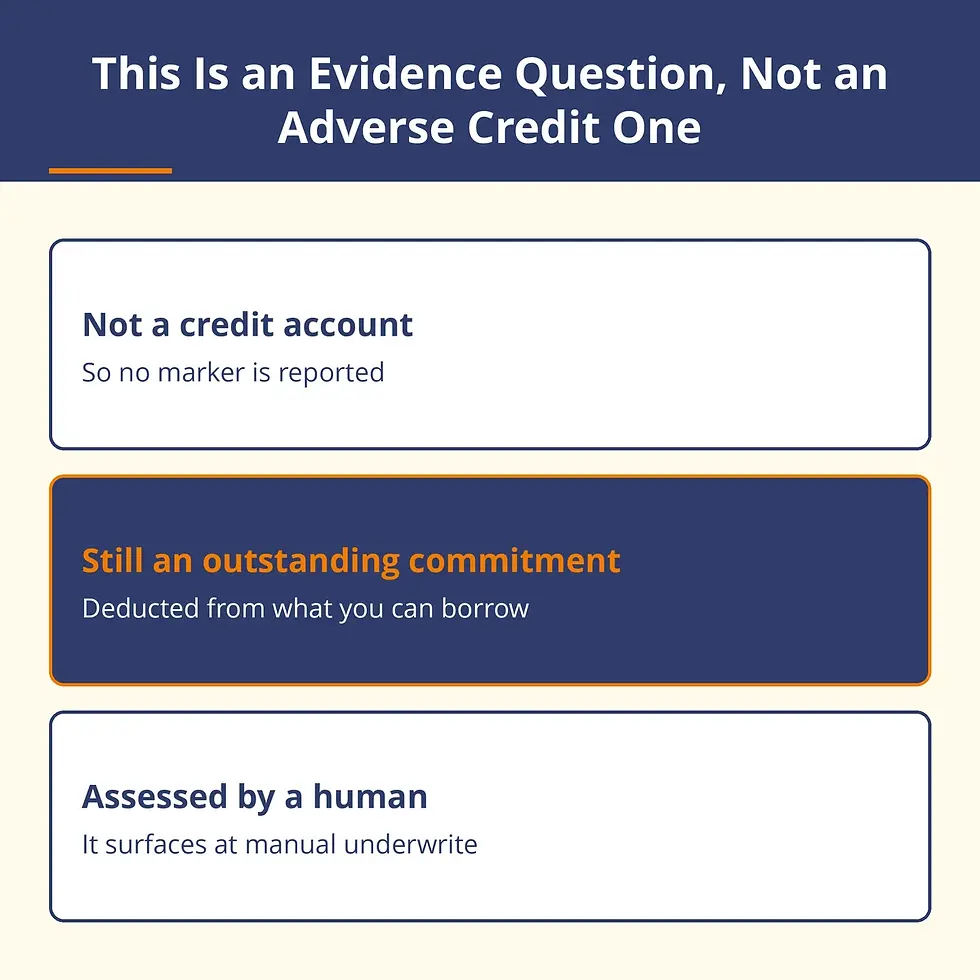
This Is an Evidence Problem, Not an Adverse Credit Problem
If you take one idea from this article, take this one. The reframe changes how you prepare, which lenders you approach, and what you should expect at each stage.
An adverse credit problem is a scoring problem. Something is recorded, a scorecard reads it, and the decision arrives early and automatically. You find out at the decision in principle, before much has been spent.
An evidence problem behaves differently. At the stricter end of the market, criteria can require the tax year overview to demonstrate that the liability has been paid in full, and can require an overdue liability to be entered as a commitment. We would not quote any lender's wording here, because published criteria vary on this point and the documents we reviewed could not all be re-verified as current. The behaviour is real even where the exact wording is not confirmable.
Where such a rule applies, the tax year overview is not treated as a referral trigger. It is treated as non-compliant income evidence. That is a harder obstacle than adverse credit, because it goes to whether your income can be evidenced at all, rather than to how risky you look.
Two consequences follow. First, a favourable decision in principle is not a reliable signal on these cases, because the documents that reveal the arrangement are not read until full application. Second, the case can fall late, after a valuation fee and an application fee have already been paid.
Second-guessing that at the outset is the whole value of preparation. If you want the wider picture on why these cases fall over, our breakdown of why self-employed mortgage applications are declined covers the recurring patterns.
Why a Strong Trading Year Can Penalise You Twice
This is the part almost nobody sees coming, and it has nothing to do with adverse credit.
Many arrangements arise after a good year. The liability is large precisely because profits were high, and the business had not held back enough against a bill that grew faster than expected. On any common-sense reading, a strong year is good news for a mortgage application.
Now put that through the most common mainstream income rule. A large part of the market assesses self-employed income on the lower of the latest year or the two-year average, which means a strong latest year gives you no uplift at all. Your income is taken from the older, lower figure.
Then the same lender may deduct the liability generated by the year it just declined to credit you for. You are assessed on the lower income and charged for the commitment produced by the higher one. The good year counts against you at both ends.
The size of that deduction is the single biggest driver of outcome variance across lenders. At the strictest end, the entire outstanding balance can be entered as a commitment, which on a five-figure balance moves maximum borrowing substantially. In the middle, the monthly payment alone is treated as committed expenditure, which is proportionate and usually manageable. More flexible lenders consider the payment in the round, with weight given to the arrangement's end date.
Under the responsible lending framework, a lender must assess affordability taking account of income and committed expenditure (FCA Handbook, MCOB 11.6). Nothing about that requires the whole balance to be deducted rather than the monthly payment, which is exactly why the answer differs so widely between lenders.
Because the income rule does so much of the work here, it is worth understanding on its own terms. Our guide to latest year versus average income assessment sets out which approach suits which trading pattern.
What Published Criteria Actually Say About Time to Pay
Across a sweep of more than twelve lenders' published intermediary criteria, spanning the high street, building societies and specialist lenders, we could not identify a lender that publishes criteria naming Time to Pay. Not as an accept, and not as a decline. The sweep was not exhaustive and several lenders could not be reached, so treat this as an absence we found rather than a settled market position.
That absence is itself the finding. A live arrangement is not a published decline trigger anywhere we could identify, and it is equally not a published acceptance. It sits in underwriter discretion.
Discretion has a practical consequence. Anything discretionary is applied by a person reading a file, which means it surfaces after a decision in principle, at manual underwrite, rather than at the automated stage. It also means presentation, packaging and lender selection carry real weight, in a way they do not when a rule is published and binary.
There is one adjacent rule that is published, and it catches people planning ahead. Some lenders exclude clearing overdue tax from the list of acceptable purposes for capital raising or additional borrowing. That is a loan-purpose rule rather than an affordability rule, and the two should not be conflated.
It also means a plan built around remortgaging to clear the balance is not universally available. The option exists in parts of the market and is closed in others, so it needs checking before it becomes the strategy rather than after.
How This Stacks On the Standard Self-Employed Requirements
The arrangement does not replace normal self-employed criteria. It sits on top of them, and both hurdles have to be cleared.
Two years of accounts remains the mainstream baseline, with part of the market considering one year, typically with conditions and often at a reduced loan to value. Lenders also impose recency rules on the latest set of figures, commonly requiring the latest year end to fall within twelve to eighteen months of application. Where a case depends on one particular lender's treatment of the arrangement, an accounts date can rule that lender out independently.
Declining profits alongside a live arrangement is the genuinely difficult combination. At least one lender's published criteria declines cases showing a year-on-year fall beyond a stated percentage, and more handle the same thing implicitly through the lower-of rule. A falling trend converts a cash-flow timing story into a distress story, and underwriters read it that way. The groundwork in our overview of mortgage options for the self-employed applies before any of this is layered on.
Directors, Contractors and Sole Traders: Four Real Cases
The Director Whose Strong Year Created the Liability
Profits rose sharply, the bill outgrew what the company had set aside, and an arrangement followed. The credit file is clean and nothing has been missed anywhere. The obstacles are documentary rather than behavioural: a tax year overview showing a part-paid balance closes off part of the mainstream tier, the lower-of income rule removes the benefit of the strong year, and the company accounts disclose the HMRC creditor. An accountant's letter tying the liability directly to the profit increase does more work here than anything else, particularly alongside an unbroken payment record and an end date falling near completion.
The Contractor Whose Arrangement Is Complete But Recent
A gap between contracts left a bill unpaid, an arrangement was agreed and met in full, and the contractor is back on a long engagement. With no outstanding balance there is no affordability deduction, and updated tax year overviews show the liability paid, which restores compliant income evidence with lenders that require it. The residual question is conduct, and it is usually mild where the arrangement was a single event rather than a pattern. Contractor income assessment is its own criteria set, so the evidence that tends to matter is a signed contract with a meaningful unexpired term plus a renewal history.
The Sole Trader Whose Bank Statements Show the Direct Debit
Nothing is recorded anywhere, but a monthly payment to HMRC appears in every month of the statements supplied. This case is decided entirely by whether the payment is explained before it is spotted or after. Presented deliberately, with the arrangement's written terms, the balance and the payment history attached, it reads as a controlled position. Surfaced by an underwriter's own reading, the same facts read as something withheld, and that impression is difficult to reverse.
The Applicant Wanting To Raise Capital To Clear the Balance
This runs into the loan-purpose rule described above rather than into affordability. Some lenders exclude clearing overdue tax as a permitted purpose for additional borrowing, and others do not publish a restriction. Lender selection therefore has to happen before the plan is fixed rather than after. Where the applicant is a company director, the way income is drawn from the business adds a further layer to how much can be raised at all.
The Costs Nobody Mentions Until They Arrive
Affordability is the cost people anticipate. These are the ones that tend to appear later.
The first is sequencing cost. Because the arrangement surfaces at manual underwrite rather than at decision in principle, a case can absorb a valuation fee, an application fee and several weeks before the obstacle appears. Those costs are not usually recoverable, and on a purchase the delay can matter more than the money.
The second is the tier premium. Moving from the mainstream tier to manually underwritten or specialist lenders often means a higher pay rate and, in some cases, a reduced maximum loan to value, which raises the deposit required. That trade is frequently worth making, but it should be a decision taken with the numbers visible rather than a surprise at offer.
The third is the deposit interaction. Where a lower loan to value is needed to place the case, capital that had been earmarked elsewhere may be needed for the deposit instead. The consequence is a smaller purchase price or a longer timeline, and it is better modelled early.
The fourth is duration. A rate premium taken today usually persists for the length of the initial period, so a two-year product and a five-year product carry very different total costs on the same case. Where an arrangement completes shortly, the evidence position improves once an updated tax year overview can be produced, and the question of whether to apply now or later becomes a real one with a real price attached either way.
The fifth is narrower lender choice at the next remortgage if nothing changes in the meantime. The position typically improves as the arrangement completes and the tax year overviews catch up, but that improvement is not automatic and depends on the wider picture at the time.
Case Study: Director, Live Arrangement, Strong Latest Year
A director of a two-person consultancy with three years' trading applied to purchase at £340,000 with a £68,000 deposit, an 80% loan to value. Latest year net profit was £96,000 against a two-year average of £74,000, and a live arrangement carried a £14,000 balance at around £1,150 a month. Two mainstream lenders were unavailable because the tax year overview did not evidence full payment, and a third would have entered the whole balance as a commitment, which reduced borrowing below the level required.
The case was placed with a manually underwritten lender that assessed the monthly payment rather than the balance, supported by an accountant's letter and an unbroken payment record, at a pay rate above the mainstream equivalent and stress tested at a materially higher stress rate than that pay rate. This example is illustrative and composite rather than a real client, and outcomes vary case by case.
Building the Case Before Anyone Asks For It
Context helps here, and the scale of this is larger than most applicants assume. HMRC supported over 913,000 customers through payment arrangements, with over 90% of arrangements completing successfully (HMRC Annual Report and Accounts 2024-25). The National Audit Office (2025) recorded £5.7 billion under arrangement, some 13.4% of tax debt.
Those figures are worth stating because underwriters see these cases regularly. An arrangement being met on schedule is a common position, not an exotic one, and it is assessed as such when it is presented properly.
Presentation is the variable you control. Alongside the standard pack of tax calculations, tax year overviews, finalised accounts, bank statements and proof of deposit, the documents that move a marginal case are specific and short.
Three of them do most of the work. The arrangement's terms in writing, including the balance, the monthly payment and the final payment date. Evidence of every scheduled payment made on time, plus the current balance, evidenced and dated.
Add to those an accountant's letter setting out the cause, why it is not expected to recur, and the current position of the business. Management accounts help where the latest finalised figures understate current trading. A short, factual written explanation is read more often than people expect, and a defensive one reads worse than a plain one.
There is a difference between a case that arrives explained and a case where the same facts are uncovered. The first reads as control, the second reads as concealment, and underwriter discretion tends to follow that impression. Assemble the pack before submission rather than in response to a query.
One boundary is worth stating clearly. Anything about the arrangement itself belongs with your accountant or with HMRC directly, and we do not advise on it. Our part is narrower and more useful to you here: how a lender assesses the arrangement as a fact about you, and which lenders assess it in the way that suits your figures. If the wider position includes worries about debt, MoneyHelper and Citizens Advice offer free, impartial support.
FAQs
Does an HMRC Time to Pay arrangement show on my credit file?
Not in itself. UK credit files hold credit and service or utility account data, electoral roll information, and public records such as county court judgments and insolvency (ICO, 2026), and a tax payment arrangement is none of those things. It can reach your file indirectly, most commonly if a judgment is obtained or if cash-flow pressure caused missed payments on credit accounts.
If it is not on my credit file, how does the lender find out?
Usually through the evidence pack you supply. Tax year overviews show the tax charged against the amount paid, bank statements show the monthly payment to HMRC, and company accounts disclose amounts owed to HMRC as creditors. Accountant references and direct questions on application forms cover the rest.
Does a lender treat it as a debt, as bad credit, or as both?
It varies, and some lenders apply both tests. On affordability, either the monthly payment or the entire outstanding balance may be entered as a commitment, and the difference between those two treatments affects borrowing capacity considerably. Separately, some underwriters read the arrangement as a cash-management signal, which is a judgement made at manual underwriting rather than something scored at decision in principle.
Is it easier once the arrangement has finished?
Generally yes. There is no outstanding balance to deduct from affordability, and the tax year overviews then evidence the liability paid in full, which restores compliant income evidence with lenders whose criteria require it. A single completed arrangement is read very differently from arrangements repeated across consecutive years.
Can I be declined automatically because of it?
We could not identify a lender that publishes criteria on this in either direction, so it falls to underwriter judgement rather than to a published rule. What can end an application in practice is a tax year overview showing an unpaid liability where a lender requires it paid in full, a county court judgment arising from the debt, or the balance simply failing affordability. Expect a narrower choice of lender and, in some cases, a higher rate than a straightforward case would attract.
Summary
A payment arrangement with HMRC sits outside the credit file entirely, so it is not scored as adverse credit. It becomes visible instead through the documents every self-employed applicant supplies, and it is judged by an underwriter rather than by a scorecard. Because of that, outcomes turn on how the case is packaged and which lender sees it. If you are part-way through an arrangement, it is worth taking advice before an application is submitted rather than after.
Updated: 27 July 2026
Written by Ben Stephenson, CeMAP-qualified Mortgage Broker.
Manor Mortgages Direct is FCA authorised, FRN 496907, has traded for 25 years, is highly positively reviewed, 4.9 rated on Google, and has helped thousands secure the right mortgage. Bristol-based mortgage brokers, assisting clients nationwide.
Sources
Information Commissioner's Office (2026) - https://ico.org.uk/for-the-public/credit/ - accessed 27 July 2026
HM Revenue and Customs Annual Report and Accounts 2024-25 (2025) - https://www.gov.uk/government/publications/hmrc-annual-report-and-accounts-2024-to-2025/hmrcs-annual-report-and-accounts-2024-to-2025-chief-executives-performance-report - accessed 27 July 2026
National Audit Office (2025) - https://www.nao.org.uk/wp-content/uploads/2025/11/HM-Revenue-Customs-Overview-2024-25.pdf - accessed 27 July 2026
FCA Handbook, MCOB 11.6 (2026) - https://www.handbook.fca.org.uk/handbook/MCOB/11/6.html - accessed 27 July 2026
Related Guides