
Does Moving Money Between Your Own Accounts Look Bad to a Lender?
Work out whether shuffling your own money between accounts harms a mortgage application, and how to show the trail.
Quick Answer
No. Moving money between your own accounts does not look bad to a lender, and it is not something underwriters penalise. What causes trouble is a credit landing with no visible source, because from the outside an internal transfer and a mystery payment look identical.
The fix is simple. Show both ends of the journey. If the underwriter can see the money leaving one account of yours and arriving in another, the entry stops being a question and becomes a line item.
The people who hit problems in 2026 are usually those who moved money late, from an account they never mentioned. Declare the accounts, keep the statements, and shuffling is a non-issue.
Reviewed by Ben Stephenson, FCA authorised (FRN 496907) · 25+ years' experience · 4.9★ on Google. Updated: 16 July 2026.
Who Is This Guide For
Best for buyers and remortgagers who keep savings across several accounts, anyone consolidating funds before a purchase, and couples merging money from joint and sole accounts ahead of an application.
Key Points
Internal transfers are neutral to a lender.
Show both sides: the debit and the credit.
Undeclared accounts cause the real problems.
Table of Contents

Why moving money between your own accounts looks odd
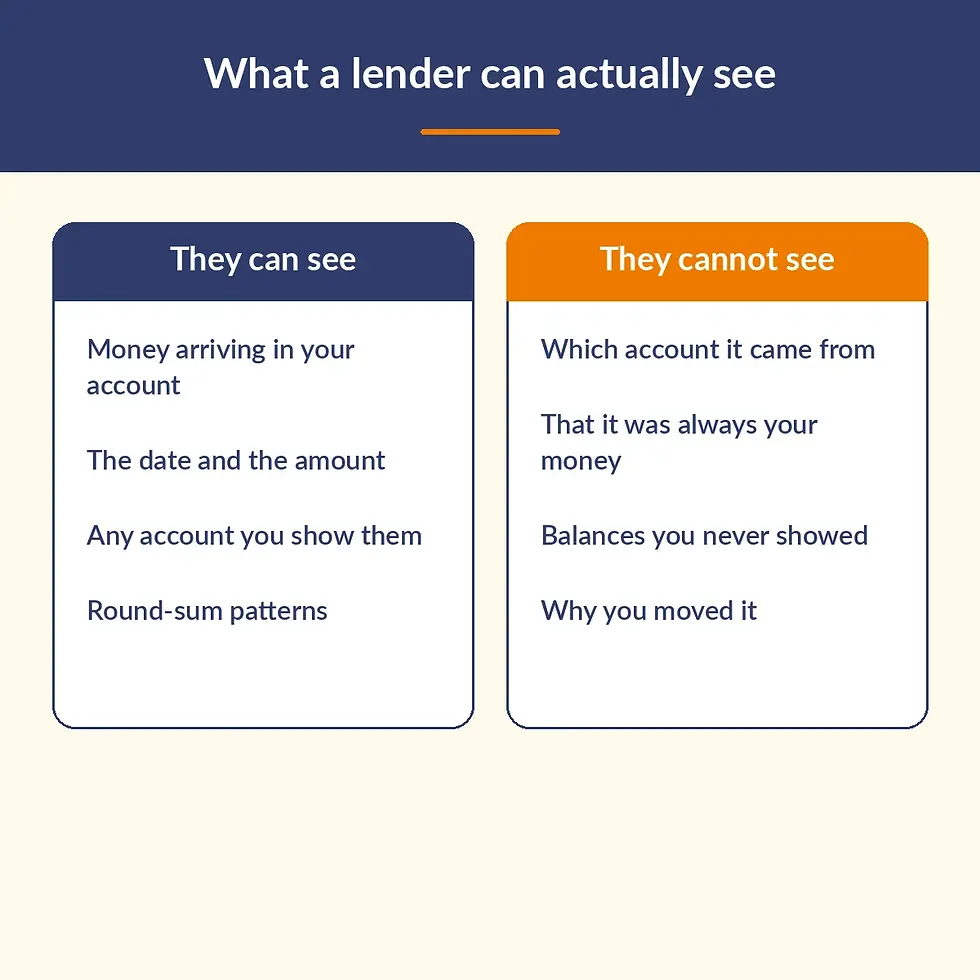
Here is the thing almost nobody explains: an underwriter does not start with a map of your finances. They start with a stack of statements you chose to give them, and nothing else.
On those statements, a 12,000 pound credit from "J SMITH" is just a 12,000 pound credit. The fact that J Smith is you, moving your own savings, is obvious to you and invisible to them.
That asymmetry is the whole problem. It is not that transfers are frowned upon. It is that a transfer, viewed from one side only, is indistinguishable from money appearing out of nowhere.
So the anxiety is misplaced. You are not being judged for organising your money. You are simply being asked to close a gap in the evidence, and the same principle applies to any unexplained credit, as our guide to large or unexplained deposits sets out.
The worry usually comes from forums, where someone's application stalled after a transfer and the transfer took the blame. Almost always the real cause was a missing statement, not the movement of money. The two get conflated constantly.
What an underwriter can and cannot see
Lenders have no general view of your banking. They cannot log in and browse every account in your name, and no rule lets them go looking.
They see what you declare and what appears on the statements you supply. Where you use Open Banking, they see the accounts you connect, not the ones you leave out.
This means the burden sits with you, and that is good news. You control what the picture looks like, provided you supply both halves of every transfer.
It also means an incomplete picture is worse than a messy one. Lenders are comfortable with money spread across several accounts. They are not comfortable with a credit they cannot trace, and they have no way to resolve that on their own.
What you moved | What a lender wants to see |
Savings into your current account | The matching debit on the savings statement |
Money from a joint account | Both names, and whose money it is |
Funds from an ISA or offset | A statement showing the source balance |
A transfer from overseas | Evidence of how the money was earned |
Several small transfers | A short explanation of why, and when |
Transfers from abroad sit in a category of their own, because HM Treasury's Money Laundering Regulations 2017 oblige the firms in the chain to establish where funds originated. Our guide to an overseas gifted deposit covers what that trail looks like in practice.
Case study: three accounts, one confused underwriter
Here is an illustrative example. A couple we will call Priya and Tom were buying with a 60,000 pound deposit. It sat across three places: 34,000 in a joint savings account, 18,000 in Priya's ISA, and 8,000 already in the current account.
Two weeks before applying they swept it all into the current account. Their application supplied the current account statements only. The underwriter saw two large credits from unnamed sources, days apart, immediately before completion of the file. Predictably, it stalled.
Nothing was wrong. They simply had not shown the other two accounts. Once they supplied the joint savings and ISA statements with the matching debits, the case moved on within days. The figures are illustrative only and not a quote, but the lesson is that the delay was self-inflicted and entirely avoidable.
The transfers that genuinely cause problems
A small number of movements do deserve care. Not because moving money is wrong, but because each one leaves a question you will have to answer.
Money from an account you did not declare. This is the big one. The credit is visible, the source is not, and you have already implied the account does not exist.
Transfers routed through someone else. Your money passing through a parent's or partner's account before reaching you stops being a simple internal transfer and starts looking like a gift or a loan.
Money moved in the days before completion. Timing alone invites scrutiny. Late lumps are the ones underwriters query.
Funds arriving from overseas. Expect source-of-funds checks regardless of whose name is on the account.
Cash withdrawn and redeposited elsewhere. This breaks the chain entirely, and it is the one movement that can genuinely cost you, as our guide on how lenders read gambling and cash activity explains.
If you have already made one of these movements, do not panic and do not reverse it. Reversing money simply creates a second unexplained entry on top of the first. Gather the source statements instead, and lead with the explanation when you apply.
How to present multiple accounts cleanly
None of this requires you to reorganise your life. It requires you to hand over a picture that answers itself.
Declare every account holding deposit money. Not every account you own, but every one the money touched.
Supply the source statements unprompted. A statement showing the debit leaving is worth more than any explanation you write.
Move money early. Three months before applying is comfortable. Three days before is not.
Keep the reference obvious. "Transfer to current" beats a blank reference every time.
Avoid a flurry of small movements. One clear transfer reads better than nine, and it also keeps you clear of the overdraft patterns lenders watch.

If your money genuinely is spread widely, that is normal and a wider panel of lenders will take it in their stride. Under the Financial Conduct Authority (FCA) Consumer Duty, in force since 2023, the lender simply has to understand your position, and UK Finance guidance points the same way. Understanding is exactly what a complete set of statements gives them.
Joint applicants should agree who supplies what before submitting. Two people gathering statements independently is how an account gets missed, and a missed account is the only part of this that reliably costs time.
Common myths about moving money before a mortgage
Four beliefs cause most of the needless worry on this topic. Each one is worth retiring before you apply.
Myth: moving money hides it from a lender
It does the opposite. The credit still shows, and now its origin does not. Moving money makes it more visible and less explained, which is precisely the wrong trade. Nothing is concealed by shuffling.
Myth: you should consolidate everything into one account first
Not necessary, and often counterproductive. Sweeping four accounts into one a fortnight before applying creates exactly the unexplained lumps you were trying to avoid. A clean trail beats a tidy balance.
Myth: round-number transfers look suspicious
Round sums are how people actually move money. Nobody transfers 4,983 pounds. An underwriter has never queried a transfer for being round, only for being unexplained.
Myth: a lender will dig through every account you own
They will not, because they cannot. The Bank of England's lending standards require a fair assessment, not surveillance. Their picture is built from what you give them, which is why an undeclared account that surfaces in a statement reference causes far more damage than the account itself ever would.
FAQs
Does moving money between my own accounts look bad to a lender?
No. Internal transfers are completely normal and lenders expect to see them. The only issue arises when they can see the money arrive without being able to see where it left from, which is solved by supplying the source account statement.
How many accounts do I need to declare?
Declare every account that holds or has passed deposit money, plus your main current account. You do not need to list dormant accounts with nothing in them, but anything the deposit touched should be visible.
How long before applying should I move money?
Around three months is comfortable, because it sits outside the statement window most lenders review and lets the balance settle. Moving money days before you apply is what triggers questions, not the move itself.
Can I move money out of a joint account into my sole account?
Yes, though be ready to say whose money it is. If a joint account is shared with someone who is not on the mortgage, a lender may want confirmation that the funds are yours and not a loan from the other party.
Do transfer references matter?
More than people expect. A clear reference such as "savings to current" answers the question before it is asked. A blank or cryptic reference makes an underwriter chase you for something you could have supplied in one word.
What if the money comes from an account abroad?
Expect additional checks. The firms handling your purchase must establish how the funds were earned, not just that they exist, so allow extra time and gather the evidence before you apply.
What if I already moved money without keeping the statements?
You can almost always download them from the source bank, and doing so quickly is the fix. Statements are retrievable for years, so an application rarely fails on this point once the paperwork is produced.
Summary
Moving money between your own accounts carries no penalty with a mortgage lender. Underwriters only see the statements you supply, so an internal transfer viewed from one side looks the same as an unexplained credit. Show both ends, declare the accounts the deposit touched, and move funds well before you apply. In 2026 the delays come from missing statements, never from the transfer itself.
Updated: 16 July 2026
Written by Ben Stephenson, CeMAP-qualified Mortgage Broker.
Manor Mortgages Direct is FCA authorised, FRN 496907, with 25 years trading, is highly positively reviewed, 4.9 rated on Google, and has helped thousands secure the right mortgage. Bristol-based mortgage brokers, assisting clients nationwide.
Sources
Financial Conduct Authority - Consumer Duty (2023). fca.org.uk
The Money Laundering, Terrorist Financing and Transfer of Funds Regulations 2017. legislation.gov.uk/uksi/2017/692
UK Finance - Mortgage Lenders' Handbook. ukfinance.org.uk
FCA Handbook - MCOB 11.6 Responsible lending. handbook.fca.org.uk
Related Guides