
Your Income Is Tax-Free in Saudi Arabia. How Do UK Lenders Treat It?
Updated: Sep 1
See how a UK affordability model handles tax-free Gulf income, and work out where your real borrowing lever actually sits.
Quick Answer
Less generously than you would expect. UK lenders take your gross Saudi salary and deduct notional UK income tax and National Insurance anyway, so tax-free overseas income does not lift a UK affordability assessment. What does move the number is which parts of your package count, the lender's sterling income threshold, and whether it accepts Saudi residents.
The reason is a single line in the FCA rulebook, which tells lenders to assess income net of income tax and National Insurance. Mainstream affordability systems are built to take a gross figure and derive the net one internally using UK tax tables. They have no field for whether the tax was ever paid, so a Riyadh salary meets the same deduction as a Manchester one.
The result is that your genuine spending power is understated by the model, sometimes by a large margin. Tax-free pay still helps, but it helps through the deposit you can build and the loan to value you can reach, not through the loan a calculator offers. For a Saudi-based applicant, the basic-versus-allowance split in the contract and the lender's country list usually matter more.
Reviewed by Ben Stephenson, FCA authorised (FRN 496907) · 25+ years' experience · 4.9★ on Google. Updated: 6 August 2026.
Who Is This Guide For
Best for Saudi-based UK nationals buying at home, Riyadh and Jeddah professionals on split basic-plus-allowance packages, and Gulf expats planning an eventual return, who want to know what a UK affordability model does with income that was never taxed.
Key Points
Lenders deduct notional UK tax from untaxed Saudi income
No UK gross-up for tax-free pay, unlike America
Your basic-allowance split often costs more than tax
Table of Contents
MCOB 11.6.5R: the rule that puts a UK tax bill back into a Saudi salary
What the affordability engine does when handed a gross Riyadh figure
Why the American gross-up rule for untaxed income does not cross the Atlantic
Basic pay, housing and transport: the split that can cost more than the tax question
Sterling thresholds and Saudi residence: two gates before affordability runs
What can realistically be argued with an underwriter about untaxed income
The belief that tax-free pay is worth more to a lender, and what it is really worth

The tax you never paid still comes off your mortgage figure
Most people who move to Saudi Arabia work out fairly quickly what tax-free pay does to a bank balance. What surprises them, often at the worst possible moment, is what it does to a UK mortgage application. The short answer is that it does almost nothing, and the reason is arithmetic rather than attitude.
A UK lender's affordability model asks for one income figure, and that figure is gross. It then applies UK income tax and National Insurance tables to the number it was handed, and works from the net result. It does not ask whether any of that tax was actually paid, and in most cases there is no field in which to record the answer.
So a UK national in Riyadh declaring the sterling equivalent of £100,000 goes through exactly the same deduction as a colleague in Manchester on £100,000. Both applicants arrive at the same net figure inside the model, and both reach broadly the same maximum loan. One of them banks around a third more each month, and the calculation cannot see it.
That is not a lender being awkward about Gulf money. It is a structural feature of how UK affordability rules and UK lending systems fit together, and it applies to any untaxed overseas salary, not only a Saudi one. Understanding the mechanism matters, because it shows you where an argument is worth having and where it is simply not available.
This post stays on that arithmetic: what the model does with your gross figure, what it ignores, and what genuinely moves the number for a Saudi-based applicant. The wider process sits in our expat mortgages guidance.

MCOB 11.6.5R: the rule that puts a UK tax bill back into a Saudi salary
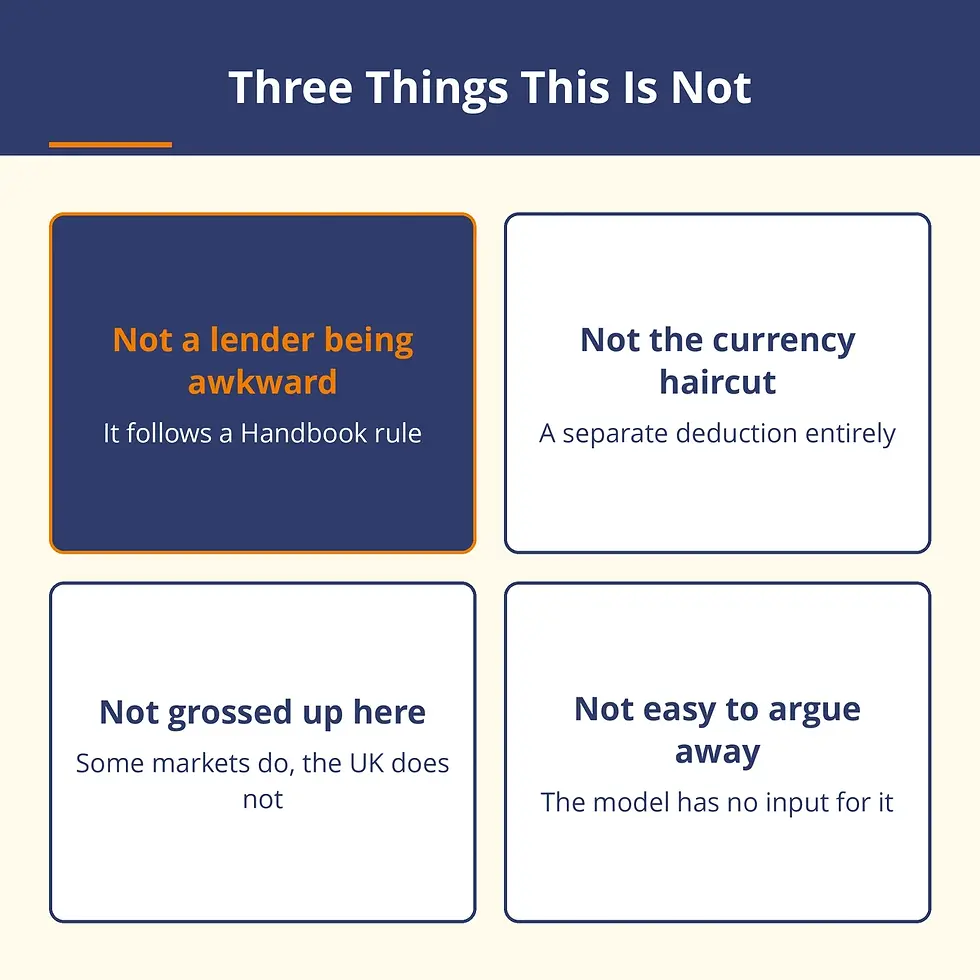
The anchor is one line in the FCA Handbook. MCOB 11.6.5R(2)(a) requires a lender assessing affordability to take full account of "the income of the customer, net of income tax and national insurance" (FCA, 2026). Almost everything a model does with your Riyadh salary flows from those few words.
Read the rule literally and something interesting appears. It says net of income tax and National Insurance. It does not say net of notional UK income tax and National Insurance.
For an employee resident in Saudi Arabia with no UK employment income, those two readings diverge sharply. Saudi Arabia does not impose income tax on earnings derived only from employment there (PwC, 2026), and a non-Saudi employee has no employee-side social insurance deduction beyond an employer-paid occupational hazard contribution (PwC, 2026). On the literal reading, the net figure and the gross figure are the same number.
Lenders apply UK tax tables anyway. They do it because their systems were built for a UK-taxed borrower, and because assuming a tax bill is the prudent direction in which to be wrong. That is a risk-appetite choice layered on top of the rule rather than something the rule compels, and the distinction becomes relevant the moment a human is reading the file.
The practical consequence is blunt. Where a case runs through a mainstream automated calculator, the conversation about your real net income does not exist, because there is nowhere to have it. Where a case is underwritten manually, the conversation exists, even if it rarely ends with the standard arithmetic being set aside.
One boundary before we go further. Whether you are UK tax resident in any given year is determined by HMRC's Statutory Residence Test, which sits outside the scope of mortgage advice, so if you are unsure of your position, speak to a qualified tax adviser before you commit to a purchase (GOV.UK, 2026).
Nothing below is a statement about your tax. Every figure in this post describes a deduction that a lender's model applies to an income figure, and nothing more than that.
What the affordability engine does when handed a gross Riyadh figure
It helps to see the deduction in pounds rather than in principle. The table below is illustrative only. It uses UK income tax and National Insurance rates for the 2026/27 tax year in England, Wales and Northern Ireland (GOV.UK, 2026), and assumes a single applicant with no other income, no pension contributions, no dependants and no credit commitments.
Step in the lender's calculation | Illustrative figure |
Gross annual income handed to the model | £100,000 |
Income tax the model deducts | £27,432 |
Employee National Insurance the model deducts | £4,011 |
Total the model deducts | £31,443 |
Net figure the model then works from | £68,557, about £5,713 a month |
Net income the Riyadh applicant actually receives | £100,000, about £8,333 a month |
Spendable income the model cannot see | £31,443 a year, about £2,620 a month |
The £31,443 sitting in the middle of that table is the entire story of this post. It is money a Saudi-based applicant genuinely receives and genuinely spends, and it is invisible to the assessment. On a rough four-and-a-half times multiple, both the Riyadh applicant and the Manchester applicant land near £450,000, which is the same answer for two households in quite different financial positions.
Income multiples are shorthand, not the calculation itself. Real maximum borrowing depends on the individual lender's model, the stress rate it applies, the loan to value, the term and your committed expenditure. There is also a regulatory cap on how much of a firm's lending may sit at 4.5 times income or above, a limit that has been under consultation during 2026 (Bank of England, 2026).
None of the figures above are a promise of what any lender may offer you. They exist to show the shape of the deduction, not to predict an outcome.
The evidence behind whatever income figure you declare, and how a lender satisfies itself that the figure is real, is a separate subject covered in our guidance on overseas income for expat applicants.
Why the American gross-up rule for untaxed income does not cross the Atlantic
There is a good reason so many Gulf-based applicants expect the opposite result, and it is not wishful thinking. In the United States, adding an uplift to non-taxable income is a published rule, not a rumour. The main secondary-market selling guide instructs a lender that where income is verified as non-taxable and the status is likely to continue, it "should develop an 'adjusted gross income' for the borrower by adding an amount equivalent to 25% of the nontaxable income" (Fannie Mae, 2026).
That rule ranks extremely well in search results, and the pages describing it rarely say which country they apply to. A UK expat in Riyadh reads three articles about grossing up tax-free income for a mortgage and reasonably concludes that a 25 percent uplift is coming. It is not, and this is the single most useful correction we can offer on this subject.
The UK approach runs in precisely the opposite direction. Instead of adding a notional uplift because tax was not paid, the UK rule requires a deduction as though it had been. Same fact pattern, opposite treatment.
It is worth sizing what that means. To take home £100,000 net in the UK in 2026/27, an employee would need a gross salary of roughly £157,000 once income tax and National Insurance are accounted for, on the same illustrative assumptions as the table above. Had a UK lender treated tax-free £100,000 as equivalent to that, a four-and-a-half times multiple would point at around £706,500 rather than £450,000.
No UK lender does this, and that number is not something to ask for. It is here only to show the size of the thing you are not being given, because most readers underestimate it. If an article aimed at a UK audience tells you tax-free income gets grossed up, it is almost certainly describing American practice.
A Riyadh household banking far more than any model can see
The following is an illustrative composite, built from the kind of case that comes through our door rather than from any single client, and the figures are invented to be realistic rather than reported.
A project director in Riyadh holds a package worth the sterling equivalent of £150,000, made up of £90,000 basic with roughly £60,000 in contractual housing and transport allowances, and the household banks around £12,500 a month with no income tax deducted. The first lender approached counted basic pay only, put £90,000 into its model, deducted notional UK income tax and National Insurance of about £27,200, and worked from just under £63,000 net. Maximum borrowing came back near £390,000 against a £780,000 purchase on which they were putting down £260,000, so the £520,000 they needed was a long way out of reach.
Placed instead with a manual-underwriting lender whose published criteria accept a contractual housing allowance in full and part of a transport allowance, the recognised income rose to around £138,000 and the same loan sat comfortably inside the assessment. The case proceeded at £520,000 on a 67 percent loan to value, tested at a stress rate above the pay rate on the fixed product chosen, so the payment the model assumed was higher than the payment due at outset.
Note what solved it, because it is not what the household expected. Nobody persuaded a lender to recognise that the family pays no income tax. The tax deduction was applied in both models, identically and unarguably.
What changed was how much of the package reached the model in the first place. That is the lever available to a Saudi-based applicant, and it is a lender-selection question rather than a negotiation. Our specialist lending work is largely about finding the model whose input rules suit the contract in front of us.
Basic pay, housing and transport: the split that can cost more than the tax question
Here is the part most Saudi-based readers have not considered. The tax-free issue is real, but for many packages it is the second largest problem, and the first is how the contract is written.
A Saudi package is typically split into a basic salary plus separately stated allowances, most commonly housing and transport, with an end-of-service award accruing in the background. Saudi social insurance law itself treats housing as part of the pay base, calculating contributions on basic salary plus housing up to a monthly cap (PwC, 2026), so the allowance is a recognised structural component rather than a bonus.
UK lenders do not treat these components alike, and the variation between them is granular. One published expat criteria set we reviewed accepts basic pay, a housing allowance and the full value of a car allowance, while halving a regular bonus even where it has been evidenced over two years. Another assesses sole basic earned income only, expressly excluding commission, overtime and bonuses.
Run those two through the same contract and the gap is severe. On the composite above, one approach recognises £90,000 and another recognises around £138,000, before either of them applies a single deduction. That is a swing of roughly £216,000 in indicative borrowing at four-and-a-half times, dwarfing anything the tax treatment does.
So a reader who arrives worried about tax-free income should leave worried about the split. If your basic is a modest share of a large package, the question worth asking is not how to argue about tax, but which lenders count allowances and on what evidence.
The end-of-service award is a separate matter and deserves an honest answer. It accrues under Saudi law at half a month's wage for each of the first five years and a month's wage for each year after that (MHRSD, 2020), and it can be substantial by the time you leave. We found no published UK lender criteria addressing how it is treated, and the sensible working assumption is that a lump sum payable on departure is not regular income for affordability purposes, whatever it may do for your deposit.
Sterling thresholds and Saudi residence: two gates before affordability runs
Before any of the arithmetic above happens, a Saudi-based application has to clear two gates that have nothing to do with your monthly earnings.
The minimum income test is set in sterling
Expat lenders almost universally publish a minimum income requirement, and they state it in sterling with local currency income accepted at the sterling equivalent. That sounds administrative, and for a riyal-paid applicant it is not, because the test is applied to a converted figure rather than to your actual salary.
Published thresholds vary far more widely than the internet suggests. Among criteria we reviewed in August 2026, requirements ranged from £18,000 where at least one applicant qualifies on a buy-to-let case, through £25,000 for a main applicant on one home purchase product, up to £50,000 for a sole employed applicant and £75,000 for a residential application from a non-resident. Do not plan around a single number, because there is not one.
Some sets also restrict what counts towards the threshold: one requires income from a single source only, and excludes commission, overtime and bonuses from the qualifying figure. The riyal's peg to the US dollar at 3.75, in place for over three decades (SAMA, 2020), removes some volatility from the conversion, though the sterling leg of it is a separate question we deal with elsewhere.
Iqama sponsorship, employer tenure and the country list
The second gate is simply whether the lender lends to people resident where you live. Gulf residence is not one category to a UK lender. Checking two published lists on the same day in August 2026, one major high street brand accepted applicants resident in Qatar and the UAE but did not include Saudi Arabia among its accepted countries, while an established expat lender's restricted list did not mention Saudi Arabia at all.
That single binary decides more Saudi cases than the tax question ever does, and it is not something an applicant can influence. It is a placement problem, which is the part a broker exists to solve.
Iqama status is worth handling carefully, because there is a lot of confident nonsense about it. We could find no UK lender publishing a rule requiring sight of a Saudi iqama, or a minimum remaining validity on one. What lenders do gate on is country of residence and the expectation that you remain resident outside the UK at completion, plus identity documents.
There is still real underwriting logic in the background. An iqama is employer-sponsored, so your right to remain in the country is tied to one employer, and it would be reasonable for an underwriter to think about income continuity in that light. What is published, and does bite, is tenure: one criteria set requires two years in employment, another permanent employment of over three months with the same employer. If you are planning a move home rather than a purchase from abroad, our returning expat guidance covers a different set of rules again.
What can realistically be argued with an underwriter about untaxed income
Honesty is more useful here than encouragement. The notional tax deduction is not usually negotiable, and any broker who tells you they can have it removed is describing something we have never seen published by a UK lender.
We could find no UK lender publishing a rule that it assesses untaxed overseas earners on their actual net income. That absence matters. It means the honest framing is that some lenders underwrite these cases manually and the arithmetic can at least be discussed, not that a particular lender applies a different calculation.
What is genuinely arguable sits elsewhere, and it is where the effort belongs. Which components of the package are recognised, and at what percentage, is a criteria question with real variation between lenders. Whether an allowance is contractual and stated in the employment contract, rather than discretionary, tends to be the pivot on which recognition turns.
Committed expenditure is the other side of the model and it is often mishandled on expat cases. Overseas commitments, school fees and any UK credit still running are deducted from the model's net figure, so a household with a genuinely larger real net income is being assessed as though those commitments strain a budget they do not strain. Presenting that clearly does not change the model, but it does change how a manual underwriter reads the file.
Finally, loan to value is the lever nobody argues about because it is arithmetic you control. Tax-free pay builds a deposit faster, several expat lenders cap loan to value at around 75 percent, and a larger deposit is often what makes a case possible rather than merely cheaper. Where the deposit is substantial, our large deposit guidance sets out how that changes the lender list.
Be clear-eyed about the trade-off. Specialist and expat lenders typically price above equivalent mainstream products and often charge higher arrangement fees, and several accept business only through an intermediary. A broker fee may also apply. That premium buys access rather than generosity, and it is worth weighing against the alternative of no offer at all.
The belief that tax-free pay is worth more to a lender, and what it is really worth
Gulf-based applicants arrive with a fairly consistent set of expectations about what untaxed income does for them. Most of those expectations are reasonable and most of them are wrong, so it is worth setting each one against the position we can actually evidence.
The belief: tax-free income means a bigger loan. The reality is that the borrowing figure is broadly the same as for a UK-taxed applicant on the identical headline salary, because the model deducts a tax bill that does not exist. The advantage is real, but it is a cash-flow and deposit advantage rather than a borrowing one.
The belief: non-taxable income gets grossed up by 25 percent. That is a published American rule (Fannie Mae, 2026) and it has no UK equivalent. The UK rule requires the opposite treatment.
The belief: you need to be paying UK tax to get a UK mortgage. The reverse is closer to the truth. At least one established expat lender's published criteria state that earned income cannot be subject to UK income tax, so being outside the UK tax net is an entry condition rather than an obstacle.
The belief: all Gulf countries look the same to a UK lender. They do not. As set out above, published country lists checked on the same day treated Saudi Arabia and its neighbours differently, and that difference decides whether a case exists at all.
The belief: the riyal is exotic, so expect punitive treatment. Currency treatment is graded and currency-specific rather than uniformly harsh, and one published criteria guide accepts income from over 70 countries at full value with graded reductions elsewhere. The peg (SAMA, 2020) works in your favour on stability, though the mechanics of conversion are a separate topic.
The belief: my whole package is my income. This is the expensive one. A package worth SAR 500,000 is not an income of SAR 500,000 to a lender, and for many Saudi contracts the recognised proportion costs more borrowing power than the tax deduction does.
Put the beliefs together and a pattern emerges. Tax-free pay is a substantial advantage in life and a neutral in the calculation, and the things that genuinely move a Saudi-based application are contract structure, lender country lists and loan to value.
FAQs
Does tax-free income in Saudi Arabia let me borrow more in the UK?
Generally no. A UK affordability model takes your gross figure and deducts notional UK income tax and National Insurance from it regardless of whether you paid any, so the maximum loan lands close to that of a UK-based applicant on the same headline salary. The genuine benefit is that untaxed pay builds a deposit faster, which improves your loan to value and widens the lender list.
Do UK lenders add 25 percent to non-taxable income the way US lenders do?
No. The 25 percent uplift is a published rule in the United States (Fannie Mae, 2026) and it is why the belief is so widespread online. UK lenders apply no equivalent gross-up, because the FCA rule requires affordability to be assessed on income net of income tax and National Insurance (FCA, 2026).
Will my Saudi housing allowance count towards my income?
It depends heavily on the lender and on how your contract is written. One published expat criteria set accepts a contractual housing allowance in full alongside basic pay, while another assesses basic earned income only. A contractual, clearly stated allowance is treated more generously than a discretionary one, so this is worth checking before you choose where to apply.
Is there a minimum income for a UK mortgage if I live in Saudi Arabia, and is it in riyals?
Thresholds are set in sterling, with riyal income accepted at the sterling equivalent, and they vary widely between lenders. Criteria we reviewed in August 2026 ranged from £18,000 on one buy-to-let basis to £75,000 for a residential non-resident application. Because the test is applied to a converted figure, the conversion basis can matter as much as the salary.
Does not paying UK tax count against my application?
It should not, and for some lenders it is actually required. At least one established expat lender publishes criteria stating that earned income cannot be subject to UK income tax. Whether you are UK tax resident in a given year is a question for a qualified tax adviser rather than a mortgage broker.
Summary
Untaxed Saudi earnings do not lift a UK affordability result, because the lender's model subtracts notional UK income tax and National Insurance from the gross figure it is given. Your real spending power is understated, and the practical levers lie in how much of your package a lender recognises, its sterling income threshold and its country list. If that sounds like your situation, it is worth talking it through before you apply.
Updated: 6 August 2026
Written by Ben Stephenson, CeMAP-qualified Mortgage Broker.
Manor Mortgages Direct is FCA authorised, FRN 496907, has traded for 25 years, is highly positively reviewed, 4.9 rated on Google, and has helped thousands secure the right mortgage. Bristol-based mortgage brokers, assisting clients nationwide.
Sources
Financial Conduct Authority (2026) - https://www.handbook.fca.org.uk/handbook/MCOB/11/6.html - accessed 6 August 2026
GOV.UK (2026) - https://www.gov.uk/income-tax-rates - accessed 6 August 2026
GOV.UK (2026) - https://www.gov.uk/national-insurance-rates-letters - accessed 6 August 2026
GOV.UK (2026) - https://www.gov.uk/tax-foreign-income/residence - accessed 6 August 2026
Fannie Mae (2026) - https://selling-guide.fanniemae.com/sel/b3-3.1-01/general-income-information - accessed 6 August 2026
PwC Worldwide Tax Summaries (2026) - https://taxsummaries.pwc.com/saudi-arabia/individual/taxes-on-personal-income - accessed 6 August 2026
PwC Worldwide Tax Summaries (2026) - https://taxsummaries.pwc.com/saudi-arabia/individual/other-taxes - accessed 6 August 2026
Ministry of Human Resources and Social Development, Saudi Arabia (2020) - https://www.hrsd.gov.sa/en/knowledge-centre/articles/317 - accessed 6 August 2026
Saudi Central Bank (2020) - https://www.sama.gov.sa/en-US/MediaCenter/News/Pages/news-557.aspx - accessed 6 August 2026
Bank of England (2026) - https://www.bankofengland.co.uk/prudential-regulation/publication/2026/april/high-loan-to-income-lending-consultation-paper - accessed 6 August 2026
Related Guides