
Complex Income Mortgages: How UK Lenders Assess Bonus, Contract and Director Pay
Updated: 4 days ago
See how UK lenders assess complex income, from bonus and commission to contract and director pay, and check where your pay fits.
Quick Answer
Yes, you can get a mortgage on complex income such as bonus, commission, contract, dividend or investment income. The outcome turns on three things each lender decides for itself: which elements of your income count, what share of each it uses, and how long a history it needs.
Those three decisions vary far more between lenders than most borrowers expect. One lender may count a regular bonus in full while another counts half of it. One may consider a contractor after three months, and another asks for two years.
That is why two people on the same pay can be offered very different loans, and why the same person can be declined by one lender and accepted by the next. This guide sets out how each type of income is usually treated, and links to a detailed guide for each situation.
How are you paid?
Tap one to start your check. No credit search.
Reviewed by Ben Stephenson, FCA-authorised mortgage adviser (FRN 496907) · 25+ years' experience · 4.9★ on Google. Updated: 16 November 2026.
Who Is This Guide For
Best for employees paid partly in bonus, commission or overtime, contractors and people in new or fixed-term jobs, and company directors or professionals with more than one income stream who want to know how a mortgage lender may read their pay before they apply.
Key Points
Lenders differ on what counts, not on you
A regular bonus may count in full or in part
Evidence over time matters more than the headline figure
Table of Contents

Why the same payslip gets two different answers
Two lenders can read the same payslip and arrive at two different maximum loans. Neither has made a mistake. Each one has its own written policy on which parts of your pay count, how much of each part it uses, and how long you need to have been earning it.
The regulator sets the frame and leaves the method to the lender. Under the FCA's responsible lending rules, a lender must obtain evidence of the income you declare, and that evidence has to support each element of income the lender takes into account. The rules do not say what share of a bonus to use or how many months a contractor needs behind them.
The FCA's guidance goes one step further. It says the evidence needed varies with your employment status, your length of employment and, in particular, any part of your income that is not fixed by contract (FCA, MCOB 11.6.9G). That last group covers most of what this guide is about.
Complex income is a broker's term, not a legal one. It means any income that is more than a basic salary from one permanent job held for a long time. It is not a judgement on you or your finances. It describes how many decisions a lender has to make before it arrives at a figure.
Most complex income falls into one of four groups:
Variable pay on top of a salary: bonus, overtime, commission, allowances and piece work
Pay that depends on a contract: new jobs, probation, fixed-term roles, day rate, umbrella and CIS work
Income you control through a business: salary and dividends, retained profit, partnership and LLP shares
Income tied to a profession, or not paid as a wage at all: private practice, flying pay, investments
For every one of those, a lender answers the same three questions. Does this income count at all? If it does, what share of it is used? And how long a track record is needed before it is used?
The sections below take each group in turn. Each one gives the figures from our own criteria tracker where we hold them, and links to a detailed guide for each situation.
This page sits alongside our guide to specialist mortgages, which covers credit history and property type as well as income. If you work for yourself, the self-employed mortgages guide goes deeper on accounts and tax-year evidence.

Variable pay: bonus, overtime, commission and allowances
Variable pay is the most common kind of complex income, and the one where lenders differ most on percentages. Basic salary is almost always counted in full. Everything paid on top of it is treated according to how regular it is and how well it is evidenced.
How many UK lenders count a regular bonus in full in 2026?
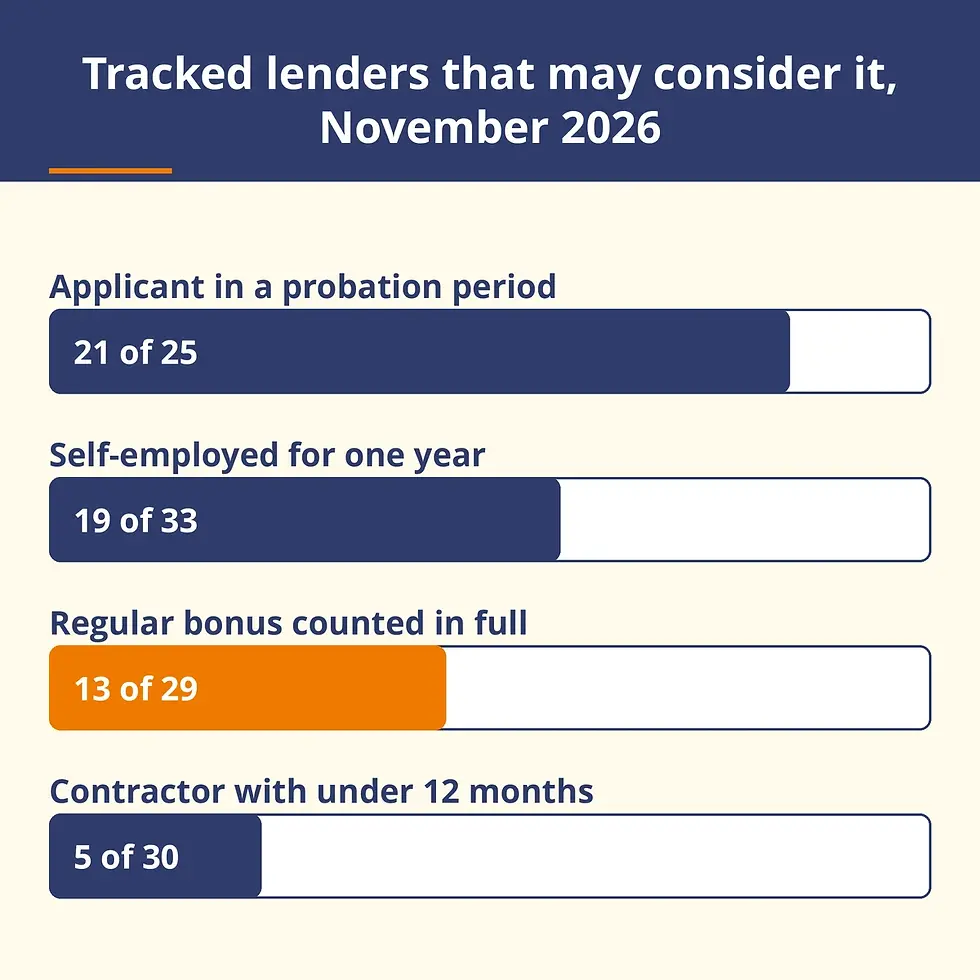
At least 13 of the 44 UK residential lenders whose published criteria Manor Mortgages Direct tracks may count a regular bonus in full, as at November 2026. Of the 29 with a published bonus rule, the rest count a lower share, typically between 50% and 75%.
Source: Manor Mortgages Direct criteria tracker, 44 UK residential lenders, checked November 2026. Each count uses the lender's most flexible published tier. Counts describe the lenders tracked, not the whole market.
Frequency matters as much as size. A bonus paid monthly or quarterly and shown on every payslip is easier to count than a single annual payment. Some lenders that count half of an annual bonus count all of one that is fixed in your contract.
Overtime and commission follow the same logic. Overtime written into your contract is often used in full, while regular but voluntary overtime is usually averaged over several months. Commission is commonly averaged over one or two years, and only some lenders use all of it.
Trend is the other test. Where variable pay has fallen from one year to the next, many lenders work from the lower year instead of the average. Where it has risen, the average usually applies, so a strong recent year does not count in full straight away.
Allowances are less obvious. A car allowance often counts in full as income, yet the finance payment it funds is also counted as a commitment, so the net benefit can be smaller than it looks. Flying pay, shift allowances and location allowances each have their own treatment.
How your pay is described on the payslip can decide which rule applies. Piece work, for example, has no category of its own at most lenders, so it is read as overtime, variable pay or self-employment depending on the paperwork. Weekly and four-weekly pay is simply converted to an annual figure.
Detailed guides on variable pay:
Bonus and overtime income: how regular and contracted payments are treated
100% commission income: averaging, reductions and who uses all of it
Car and other allowances: counted as income, with the finance counted against it
Piece work pay: how the filing of your pay decides the outcome
Weekly and four-weekly pay: how lenders annualise it
New jobs, probation and fixed-term contracts
A change of job does not stop a mortgage, but it changes which lenders can look at the case. The question a lender asks is whether your income is likely to continue, and each one sets its own test for that.
How many UK lenders will consider an applicant in a probation period in 2026?
At least 21 of the 44 UK residential lenders whose published criteria Manor Mortgages Direct tracks may consider an applicant still in a probation period, as at November 2026. Most attach a condition, such as 12 months of continuous employment or a move within the same line of work, and four of the 25 with a published rule do not accept it.
Source: Manor Mortgages Direct criteria tracker, 44 UK residential lenders, checked November 2026. Each count uses the lender's most flexible published tier. Counts describe the lenders tracked, not the whole market.
The conditions matter more than the headline. A lender that accepts probation in principle may still need you to have been employed without a gap, or to have moved into a similar role. A career change during probation is a harder case than a move to a competitor.
Fixed-term contracts are assessed on what is left and what came before. Published minimums for the time remaining on a contract run from none at all to two full years, and a record of renewals often counts in your favour.
Your situation | What lenders typically look for |
|---|---|
New job, not yet started | A signed permanent contract and a start date, often within a set number of weeks |
Still in a probation period | Continuous employment before the move, or a new role in the same line of work |
Fixed-term contract | Time left on the contract, a history of renewals, or both |
Promotion or pay rise | Written confirmation of the new salary from your employer, then the first payslip |
Timing can be worked around. Some lenders can use a signed contract before your first day, and many can use a confirmed promotion once your employer puts the new salary in writing. Applying a few weeks later, after one payslip at the new rate, sometimes opens up more lenders than applying today.
Detailed guides on new jobs and contracts of employment:
Mortgages after a new job offer or promotion: using a contract before the first payslip
Mortgages during probation: the conditions lenders attach
Fixed-term employment contracts: how much time needs to be left
Day rate, umbrella and CIS contractors
Contractors sit between employed and self-employed, and lenders do not agree on which side of the line they fall. The same contractor can be assessed on a day rate by one lender and on two years of accounts by another.
How many UK lenders will consider a contractor with under 12 months of history in 2026?
At least 5 of the 44 UK residential lenders whose published criteria Manor Mortgages Direct tracks may consider a contractor with under 12 months of history, as at November 2026. Of the 30 with a published rule, 21 ask for 12 months and four ask for two years.
Source: Manor Mortgages Direct criteria tracker, 44 UK residential lenders, checked November 2026. Each count uses the lender's most flexible published tier. Counts describe the lenders tracked, not the whole market.
Where a lender assesses on the day rate, it usually multiplies the rate by a set number of working weeks to reach an annual income. That can produce a higher figure than the same contractor's accounts or payslips, particularly for people paid through their own limited company.
Umbrella company workers are paid through payroll, so some lenders treat them as employed and read the payslips and P60. Others look through to the underlying contract and use the day rate. Which is better depends on how your umbrella payslip is laid out.
Construction workers paid under CIS face a similar split. A group of lenders assess CIS income from payment and deduction statements through their employed route, on a short history and without accounts. Others apply full self-employed treatment based on net profit.
Experience in the same industry often counts alongside contracting history. A first contract after years of permanent work in the same field is a stronger case than a first contract in a new one, and several lenders write that distinction into their criteria.
Gaps between contracts are read in context. A break of a few weeks between assignments is normal in contracting, and most criteria allow for it. A longer gap, or a move between very different kinds of work, usually needs explaining.
Detailed guides for contractors:
Umbrella company contractors: day rate or payslips
CIS contractors: employed or self-employed treatment
Company directors and business owners
If you own the business that pays you, a lender has to decide what your income really is. Salary and dividends are the standard measure. For a director who leaves profit in the company, that measure can understate what the business earns.
How many UK lenders will consider one year of self-employed trading in 2026?
At least 19 of the 44 UK residential lenders whose published criteria Manor Mortgages Direct tracks may consider a self-employed applicant with one year of trading, as at November 2026. The other 14 with a published rule ask for two years of trading, or for two years of figures in most cases.
Source: Manor Mortgages Direct criteria tracker, 44 UK residential lenders, checked November 2026. Each count uses the lender's most flexible published tier. Counts describe the lenders tracked, not the whole market.
Some lenders use salary plus your share of the company's net profit in place of salary plus dividends. Where profit has been retained, that method can produce a much higher income from identical accounts. Our guide to using retained profits explains when it applies.
The year a lender uses matters as much as the method. Many lenders average the last two years or take the lower of the two, while others use the latest year when profit is rising. A weaker year is treated very differently from one lender to the next.
Your shareholding can change how you are classed. An employee of a family company with a small stake is usually treated as employed. Above a threshold, which published criteria place between 20% and 33%, the same person is treated as self-employed and assessed on the accounts.
Changing structure does not usually wipe out your history. Moving from sole trader to limited company changes the paperwork a lender reads, but published criteria rarely treat it as a new business. Partners and LLP members are generally assessed on their share of profit, not on drawings.
A typical case: one director, two answers
This is an illustrative composite, not a real client. A director owns all of a small consultancy, takes £50,000 a year in salary and dividends, and leaves a further £40,000 of profit in the company. She has a £60,000 deposit for a £400,000 home, a loan to value of 85%.
A lender using salary and dividends works from £50,000. A lender that also counts her share of retained profit may work from around £90,000, on its own measure of profit. The paperwork is identical in both cases, and any offer still depends on the lender's stress rate, which is set higher than the pay rate.
Detailed guides for directors and business owners:
Salary or dividends: the standard method and its limits
Directors of more than one company: adding income across businesses
Latest year or an average: which figure lenders use
Net profit for the self-employed: how sole traders are assessed
Incorporating your business: what happens to your trading history
Working for a family business: when a shareholding changes your status
LLP members: drawings and profit share
Accountant's projections: when a forecast can be used
Professions with their own rules
Some occupations have pay structures that standard criteria do not describe well. Lenders respond in two ways. A few publish dedicated ranges for named professions, and many more write specific rules for the unusual parts of the pay.
Professional ranges are aimed at qualified people whose income is expected to rise, such as doctors, dentists, solicitors, accountants and vets. They can offer a higher multiple of income than the same lender's standard range. The list of qualifying professions differs between lenders, and so does the stage of qualification required.
Second incomes are common in these occupations. A consultant with a private practice, or a GP who also works locum sessions, has two or three incomes that each need their own evidence. A lender that accepts one part may still leave out another.
For other occupations the issue is one element of pay. The table shows what usually needs explaining.
Occupation | What usually needs explaining |
|---|---|
NHS consultants | Private practice and award income on top of NHS pay |
GP partners | A share of practice profit, not drawings |
Cabin crew | Flying allowances, which lenders count at very different rates |
Seafarers | The currency you are paid in and how your UK position is evidenced |
Professional sportspeople | The time left on a playing contract |
Property developers | Uneven profit and where the accounting year ends |
In each case the income is acceptable to a number of lenders. The work is in presenting it the way those lenders read it, and in avoiding the ones whose rules were written for a monthly salary.
Detailed guides by occupation:
Professional mortgage ranges: which professions qualify
NHS consultants: private practice income
GP partners: how partnership profit is assessed
Cabin crew: flying allowances
Seafarers: working at sea and living in the UK
Professional sportspeople: contract length and career stage
Property developers: borrowing on development profit
Income that does not arrive as a wage
Not all income is earned month to month. Investments, pension pots and irregular self-employed earnings can all support a mortgage, although the method a lender uses is often not the one a borrower expects.
Investment income is a good example. Several lenders do not look at the income a portfolio actually pays. They convert the value of the pot into a notional annual income at a fixed percentage, and your age and the type of investment decide whether that route is open.
Salary sacrifice works the other way. Your income has not fallen, but the figure in the gross pay box on your payslip may have, and that is the figure many lenders read. Some lenders also count the sacrificed amount as a monthly commitment.
Irregular income needs time more than anything else. A lender wants to see that earnings which rise and fall still hold up across a year or two, so the pattern is usually averaged. The same approach applies to anyone paid in a few large amounts through the year.
How are you paid?
Tap one to start your check. No credit search.
Interest-only borrowing adds a further test. Many lenders set a minimum income before they consider an interest-only mortgage, and published minimums vary widely. Complex income is counted toward that minimum on the same terms as it is counted for affordability.
What a lender takes off your income matters as much as what it adds. Childcare, student loan deductions and maintenance payments all reduce the amount available for a mortgage. Our guides to childcare costs, student loans and paying maintenance cover each one.
Some household income is counted by one lender and ignored by the next. Child benefit and maintenance you receive are the clearest cases, and pay during parental leave is another. See child benefit and maintenance as income and applying on maternity leave.
Detailed guides on other income:
Living off investments: how a pot is turned into income
Salary sacrifice: the payslip figure lenders read
Irregular self-employed income: averaging uneven earnings
Minimum income for interest-only: the thresholds lenders publish
Before you apply: a checklist for complex income
Complex income cases are won or lost on evidence. A lender can only count what it can see, and a missing document usually means the income is left out, not that the application is paused while you find it.
Gather the evidence before you choose a lender. The same documents answer most lenders' questions, and having them to hand makes it possible to compare how each one would read your income.
Your last three months of payslips, or the last six if your pay varies from month to month
P60s for the last two years, which show bonus, commission and overtime as an annual total
Your employment contract, and any letter that sets out a bonus scheme, allowance or contracted overtime
For contractors, the current contract and the previous 12 months of contracts or payslips
For directors and the self-employed, two years of accounts with matching tax calculations and tax year overviews
Three months of bank statements showing the income arriving
Check that the documents agree with each other. A payslip that shows one employer name and a contract that shows another, or accounts that do not match the tax calculation, slows a case down more than almost anything else.
Look at your credit file as well. Income is only one part of the assessment, and a missed payment or a default changes which lenders are available. If that applies to you, our bad credit mortgage guide explains how the two interact.
Then decide when to apply. If a pay rise, a contract renewal or a new set of accounts is a few weeks away, waiting can change the answer. If your latest year was weaker than the one before, applying before the new figures are filed may be the better course.
How a complex income case gets placed
Placing a complex income case means matching your pay to the lender whose written rules read it most favourably. That is a different task from finding the lowest rate, and it is done before any application is made.
The starting point is to break your income into its parts. Salary, bonus, commission, dividends and any second income are listed separately, each with the evidence behind it. A lender's policy is then applied to each part in turn to see what figure it produces.
The differences can be large. Two lenders using the same payslips can be tens of thousands of pounds apart on the loan they may offer, simply because one counts a share of variable pay that the other leaves out.
Presentation is part of the work. An application that explains how a bonus scheme operates, or why profit dipped in one year, gives an underwriter what they need to use the income. One that leaves the question open often has the income reduced or left out.
There is a cost to consider. Lenders with the most flexible income rules are often specialist lenders, and their pricing and fees may be higher than a high street lender's. Where a mainstream lender can count your income in full, that is usually the better route, and a specialist lender is worth its cost only when it changes what you can borrow.
It is also worth avoiding a string of applications. Each full application leaves a search on your credit file, and a decline tells you little about what the next lender may do. A criteria check first carries no charge and avoids unnecessary searches on your file.
Manor Mortgages Direct tracks the published criteria of UK lenders and uses them to shortlist before anything is submitted. If your income does not fit one lender's rules, that says more about the rules than about you.
FAQs
What counts as complex income for a mortgage?
Complex income is any income beyond a basic salary from one long-held permanent job. It includes bonus, commission, overtime, contract and day rate work, dividends, retained profit, partnership shares and investment income. Lenders can usually use it, but each one sets its own share and its own minimum history.
Can I get a mortgage if most of my pay is bonus or commission?
Often, yes. Lenders usually average variable pay over one or two years and then use a share of the average, and some may use all of it where it is regular and well evidenced. Payslips and P60s covering the full period are the key documents.
How long do I need to be in a new job before applying for a mortgage?
There is no single rule. Some lenders can use a signed contract before you start, others want one or more payslips, and some need a probation period to be finished. Your employment history before the move often matters more than the time in the new role.
Do lenders treat contractors as employed or self-employed?
It depends on the lender and on how you are paid. Some assess a contractor on the day rate in the contract, some read umbrella payslips as employed income, and others ask for accounts as they would for any self-employed applicant. The same person can fit one lender's rules and not another's.
Does complex income mean paying a higher interest rate?
Not necessarily. Many mainstream lenders count variable and contract income, and where one of them can use your income in full the pricing is usually the same as for any other borrower. A specialist lender may cost more, which is worth weighing against the extra borrowing it allows.
Summary
Complex income does not stop you getting a mortgage, but it does mean lenders reach different figures from the same paperwork. Each one decides which elements of pay count, what share to use and how long a history to ask for. Knowing how your bonus, contract or director income is likely to be read, and having the evidence ready, puts you in a stronger position. If you would like your income checked against lender criteria, we can help.
Reviewed by Ben Stephenson, FCA-authorised mortgage adviser, CeMAP-qualified.
Manor Mortgages Direct is FCA authorised, FRN 496907, has traded for 25 years, is highly positively reviewed, 4.9 rated on Google, and has helped thousands secure the right mortgage. Bristol-based mortgage brokers, assisting clients nationwide.
Sources
FCA Handbook, MCOB 11.6: Responsible lending and financing, rules 11.6.8R and 11.6.9G, accessed 16 November 2026
Manor Mortgages Direct, self-employed income study, lender criteria research, September 2026
Cite this page: Manor Mortgages Direct, "Complex Income Mortgages: How UK Lenders Assess Bonus, Contract and Director Pay", checked November 2026, manormortgagesdirect.com/complex-income-mortgages
Related Guides