
Do Student Loan Repayments Affect Your Mortgage Affordability?
Work out how much your student loan repayment really costs your borrowing, and whether clearing it helps.
Quick Answer
Yes, but less than most graduates expect. Lenders treat your monthly student loan deduction as a committed outgoing, exactly like a car payment. They almost always ignore the balance you owe. In practice the deduction commonly trims borrowing by roughly ten to twenty thousand pounds.
That is because affordability starts from what reaches your account after deductions. A payslip showing a slice of your income going out each month simply leaves less to service a mortgage.
The practical upshot in 2026 is that clearing a student loan early rarely works as a mortgage strategy. The same money put toward your deposit almost always does more for you.
Reviewed by Ben Stephenson, FCA authorised (FRN 496907) · 25+ years' experience · 4.9★ on Google. Updated: 16 July 2026.
Who Is This Guide For
Best for graduates buying a first home, professionals repaying Plan 2 or Plan 5, and anyone carrying a postgraduate loan alongside an undergraduate one, who wants to know whether the deduction is quietly costing them borrowing power.
Key Points
Lenders count the monthly deduction, not the balance.
Most plans deduct 9% above a threshold.
Clearing the loan rarely beats a bigger deposit.
Table of Contents

Why your student loan quietly shrinks your mortgage
Graduates worry about the wrong number. The balance on your annual statement, often tens of thousands of pounds, feels like the obstacle. To a mortgage lender it is very nearly irrelevant.
What counts is one line on your payslip. The deduction leaves your pay before you ever see it, and affordability is calculated from what is left behind.
This produces a result that surprises people. A graduate with a large balance and a modest monthly deduction is in a stronger position than someone with no student loan at all but a sizeable car finance payment. Lenders count outgoings, not history.
The balance feels frightening because it is the only number anyone ever shows you. Nobody sends you a statement of your monthly deduction, so the figure that actually drives your mortgage is the one you never look at.
It also explains the most common own goal: throwing savings at the balance to clear it before applying. That trades deposit for a slightly larger monthly surplus, and deposit is usually worth considerably more.
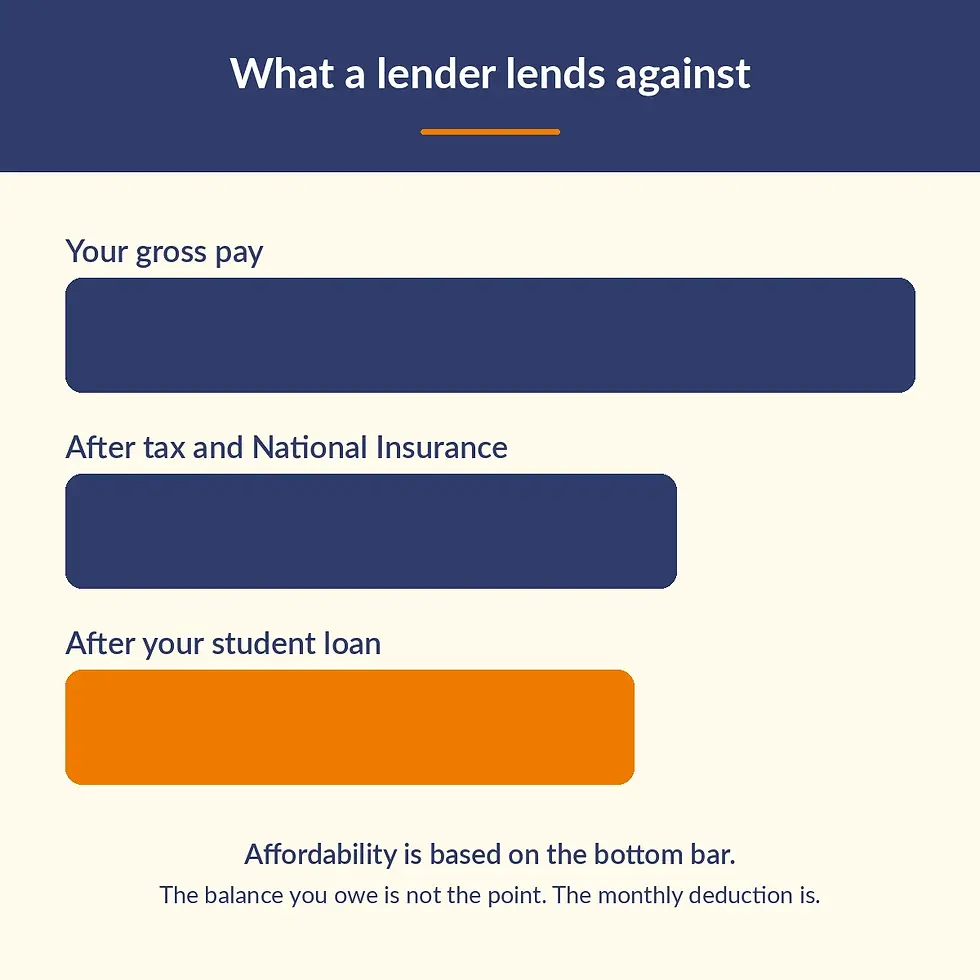
How lenders treat a student loan deduction
Under the Financial Conduct Authority (FCA) Consumer Duty, in force since 2023, a lender must satisfy itself that you can genuinely afford the payments. Committed outgoings sit at the centre of that test.
Your student loan goes in the committed expenditure section of the application, next to car finance and credit commitments. It is verified from your payslips, or from your tax return figures if you are self-employed.
Student loan factor | How lenders treat it |
Monthly deduction on your payslip | Counted as a committed outgoing |
Total balance outstanding | Usually ignored completely |
Your plan type | Sets the percentage and threshold |
A postgraduate loan on top | Adds a second deduction |
Repayment when self-employed | Taken from your return, not a payslip |
As a rough rule of thumb, every 100 pounds a month of committed outgoing tends to reduce maximum borrowing by around 20,000 pounds. Every lender runs its own affordability calculator, and UK Finance members differ considerably, so treat that as a guide rather than a promise. The same logic applies to any regular commitment a lender can see on your bank statements.
Which plan you are on changes the maths
Not every student loan deducts the same amount. The percentage is fixed by plan, but the threshold it applies above is not, and the threshold is what moves your monthly figure.
Plans 1, 2, 4 and 5 each deduct 9% of income above their own threshold. A postgraduate loan deducts 6% above a lower threshold, and it stacks on top of any undergraduate plan you already hold, which is why some applicants see two separate lines on a payslip.
Plan | Deducted above the threshold |
Plan 1 | 9% |
Plan 2 | 9% |
Plan 4 (Scotland) | 9% |
Plan 5 | 9% |
Postgraduate Loan | 6% |
If you are unsure which plan you are on, your payslip and your online student loans account both show it. It matters more than it sounds, because two graduates on identical salaries can have different deductions purely because they started their courses in different years.
Thresholds change every April, so check the current figure on gov.uk rather than trusting a number in an article. The mechanism is stable; the threshold is not. If you are on two plans, expect both deductions to be counted.
Case study: same salary, two different loan positions
Here is an illustrative example. Two applicants we will call Aisha and Dan both earn 42,000 pounds and both have clean credit. Dan has no student loan. Aisha repays around 105 pounds a month on Plan 2.
On paper they look identical. In the affordability calculator they are not. Aisha's deduction is treated as a committed outgoing, and on the rough rule of thumb above it reduced her maximum borrowing by roughly 21,000 pounds compared with Dan.
Aisha had 8,000 pounds in savings and asked whether clearing part of the loan would close the gap. It would not have moved her deduction by a penny, because the deduction follows income rather than balance. Putting the same 8,000 pounds into her deposit improved both her loan-to-value and her rate options. These figures are illustrative only and not a quote, but the ranking of the two choices holds in almost every case we see.
Should you overpay or clear the balance before applying?
This is the question graduates ask most, and the answer is usually no.
Clearing the loan outright does remove the deduction, which genuinely lifts affordability. The catch is that it costs you a lump sum, and that lump sum was almost certainly going to be your deposit.
Deposit does two jobs at once. It shrinks the loan you need and it moves you into a lower loan-to-value band, which tends to open better pricing. Removing a modest monthly deduction rarely competes with that.
Partial overpayments are poorer value still. They reduce the balance without changing the monthly deduction at all, because the deduction is set by what you earn, not what you owe. You spend the money and your affordability does not move.

There are exceptions worth testing. If you are within a year of clearing the loan anyway, or the deduction is unusually large because of a high income, the arithmetic can tip. That is a case for running the numbers properly with a wider panel of lenders rather than guessing, because affordability models vary more than most people realise.
One further wrinkle: if you do clear the loan, do it early enough that a payslip shows the deduction gone. Underwriters work from the evidence in front of them, so clearing the balance the week before you apply may not appear at all, and the same evidencing logic applies to the deposit money itself.
Hidden costs: what else quietly trims your borrowing
The student loan rarely travels alone. Most graduate applications lose more borrowing to commitments nobody thinks to mention than to the loan itself.
Car finance. Usually the single biggest drag. A monthly payment several times the size of a student loan deduction does several times the damage.
Buy now, pay later. Small, regular and increasingly visible through Open Banking. A handful of active plans reads as reliance rather than convenience.
Season ticket loans and salary sacrifice. These leave your pay before you see it, so they behave exactly like the student loan and are counted the same way.
Pension contributions above the minimum. Treatment varies between lenders more than almost any other outgoing, which is where advice earns its keep.
Overdraft use. Not a fixed outgoing, but it colours the whole picture, as our guide on moving money between accounts and everyday account habits explains.
The Money and Pensions Service publishes free budgeting tools that help you see these in one place. The Bank of England's lending standards mean they get counted whether or not you volunteer them, so it is better to know your own numbers first.
If affordability is tight, the fix is rarely the student loan. It is usually clearing a car finance agreement, closing unused credit, or improving your deposit, and our notes on improving affordability as a first-time buyer set out the order to tackle them in.
FAQs
How much does a student loan reduce my mortgage by?
Commonly by roughly ten to twenty thousand pounds, though it depends on your income and plan. Lenders work from your monthly deduction, so a higher salary means a larger deduction and a larger reduction in borrowing.
Do lenders look at my student loan balance?
Almost never. The balance is not treated like a normal debt because repayment is tied to income rather than to the amount owed. What lenders want is the monthly figure from your payslip.
Should I pay off my student loan before applying for a mortgage?
Usually not. Clearing it removes the deduction but spends money that would otherwise be deposit, and deposit generally improves both your loan size and your rate band. Run both options before deciding.
What if I have both an undergraduate and a postgraduate loan?
Both deductions apply and both are counted. A postgraduate loan takes 6% above its threshold on top of the 9% from your undergraduate plan, so the combined effect on affordability is larger.
Do I have to declare my student loan on a mortgage application?
Yes, and there is no point not doing so. It shows on your payslips and through Open Banking, so an undeclared deduction simply looks like an error or an omission when the underwriter finds it.
How is it assessed if I am self-employed?
From your tax return rather than a payslip. The deduction is calculated on your assessed income, so lenders take the figure from your submitted returns alongside the rest of your income evidence.
Summary
Student loan repayments do reduce mortgage affordability, but through the monthly deduction on your payslip rather than the balance you owe. Most plans take 9% of income above a threshold, with 6% for postgraduate loans, and lenders count that as committed expenditure. In 2026 the deduction commonly costs roughly ten to twenty thousand pounds of borrowing, and clearing the loan rarely beats putting the same money into your deposit.
Updated: 16 July 2026
Written by Ben Stephenson, CeMAP-qualified Mortgage Broker.
Manor Mortgages Direct is FCA authorised, FRN 496907, with 25 years trading, is highly positively reviewed, 4.9 rated on Google, and has helped thousands secure the right mortgage. Bristol-based mortgage brokers, assisting clients nationwide.
Sources
GOV.UK - Repaying your student loan: how much you repay. gov.uk/repaying-your-student-loan/what-you-pay
House of Commons Library - Student loans: interest rates and repayment thresholds. commonslibrary.parliament.uk
Financial Conduct Authority - Consumer Duty (2023). fca.org.uk
FCA Handbook - MCOB 11.6 Responsible lending. handbook.fca.org.uk
Related Guides