
Semi-Commercial Mortgages: How UK Lenders Decide in 2026
Updated: 2 hours ago
See how lenders treat a semi-commercial property, and check what the mix of uses means for your mortgage.
Quick Answer
A semi-commercial mortgage is a loan secured on a building with both business and residential parts, such as a shop with a flat above on one title. Specialist and commercial lenders may consider one. They assess the rent or business income, the commercial lease, the split between the uses and your experience.
Most residential and buy-to-let lenders will not lend on a building with a commercial element. The lenders that do usually ask for a larger deposit than on a house, and they value the property on a commercial basis, which looks closely at the tenant and the lease.
Whether the loan is regulated depends on who lives in the residential part and how much of the building it takes up. This guide covers the definition, the regulation, how lenders decide and the paperwork.
What do you need?
Tap one to start your check. No credit search.
Reviewed by Ben Stephenson, FCA-authorised mortgage adviser (FRN 496907) · 25+ years' experience · 4.9★ on Google. Updated: 17 November 2026.
Who Is This Guide For
Best for investors buying a shop, office or restaurant with flats above, business owners who want to buy the premises they trade from and live upstairs, and landlords who have been told a standard buy-to-let lender cannot help.
Key Points
One title with business and residential parts
The commercial lease drives the valuation
Living there can make the loan regulated
Table of Contents

What semi-commercial property is
Semi-commercial property, also called mixed-use property, is a single building or title that combines business premises with somewhere to live. The familiar example is a high street shop with one or two flats above. Others include a pub with living accommodation, an office with a flat, or a guest house where the owner lives on site.
What matters to a lender is that the uses share one title. If the flat above a shop has its own long lease and is being mortgaged alone, that is a residential or buy-to-let case with a commercial neighbour. Our guide to a flat above a shop covers that situation.
When the shop and the flat are bought together on one title, the lender is taking security over both. The commercial part brings a business tenant, a commercial lease and a different kind of valuation. That is what moves the case away from ordinary mortgage lenders.
The split between the uses shapes everything that follows. A building that is mostly residential with a small shop is treated more gently than a large commercial unit with a small flat. Lenders ask for the floor areas early for that reason.
Common kinds of mixed-use building
The shop with flats above is the most common, but lenders see many variations. A ground floor office with a maisonette, a doctor's or dentist's surgery with a flat, and a public house with rooms upstairs all count. So does a farm building or a workshop with a house attached, although land brings its own questions.
Each kind is judged on its own merits. A building in a busy parade with long-standing tenants is very different security from an isolated unit that has stood empty. Lenders ask for photographs, a description of the location and details of what trades nearby.
When the mortgage is regulated
Most semi-commercial lending is unregulated business lending. It becomes a regulated mortgage in a specific situation, and the test is set out in the Financial Conduct Authority's guidance on what counts as a regulated mortgage contract.
The guidance says that a mortgage is regulated where at least 40% of the land is used, or intended to be used, as or in connection with a dwelling by the borrower or a related person. A baker who buys a shop and lives in the larger flat above it may therefore need a regulated mortgage. An investor letting both parts to tenants would not.
The distinction changes which lenders can help. Regulated lending carries consumer protections and can only be offered by lenders with the right permissions. Fewer lenders offer regulated loans on mixed-use buildings than offer unregulated ones.
It also changes how income is assessed. A regulated loan is tested on your personal affordability, much like a residential mortgage. An unregulated investment loan is tested mainly on the rent the building produces.
Tell the lender at the start who will live in the residential part. A change of plan later, such as moving into the flat yourself, can breach the terms of an unregulated loan.
Who lends on semi-commercial property
Three kinds of lender are active. Commercial banks lend on mixed-use buildings as part of their business lending. Specialist lenders offer semi-commercial mortgages alongside buy-to-let. Bridging lenders provide short-term loans where speed matters or the building is not yet ready for a term mortgage.
Our criteria tracker covers residential, buy-to-let and bridging lenders, not the commercial banks. The bridging figures give a sense of how widely mixed-use security is accepted in the short-term market.
How many UK bridging lenders may consider semi-commercial property in 2026?
At least 10 of the 13 UK bridging lenders whose published criteria Manor Mortgages Direct tracks may consider commercial or semi-commercial property as security, as at November 2026. Of the 11 that publish a position, 1 lends on residential security only.
Source: Manor Mortgages Direct criteria tracker, 13 UK bridging lenders, checked November 2026. Each count uses the lender's most flexible published tier. The other 2 lenders publish no position and are not counted. The tracker does not cover commercial banks. Counts describe the lenders tracked, not the whole market.
Short-term lenders are comfortable with mixed-use security because they lend against value and exit, not long-term income. That makes bridging a common first step, with a term mortgage following once the building is let and settled. Our guide to bridging mortgages explains how those loans work.
For term lending, criteria differ sharply. Some lenders want the residential part to be at least half the building. Others have no fixed split but price the loan according to the type of business downstairs.
Experience counts with most lenders. An investor who already owns rental property, or who has run a business from similar premises, will find more lenders willing to look. A first purchase of mixed-use property is possible, but the deposit asked for may be higher.
Location matters more than it does for a house. Lenders look at how easily the commercial unit could be let again if the tenant left, and that depends on the street, the town and the demand for that type of space. Secondary locations with empty units nearby are valued cautiously.
How lenders assess the building
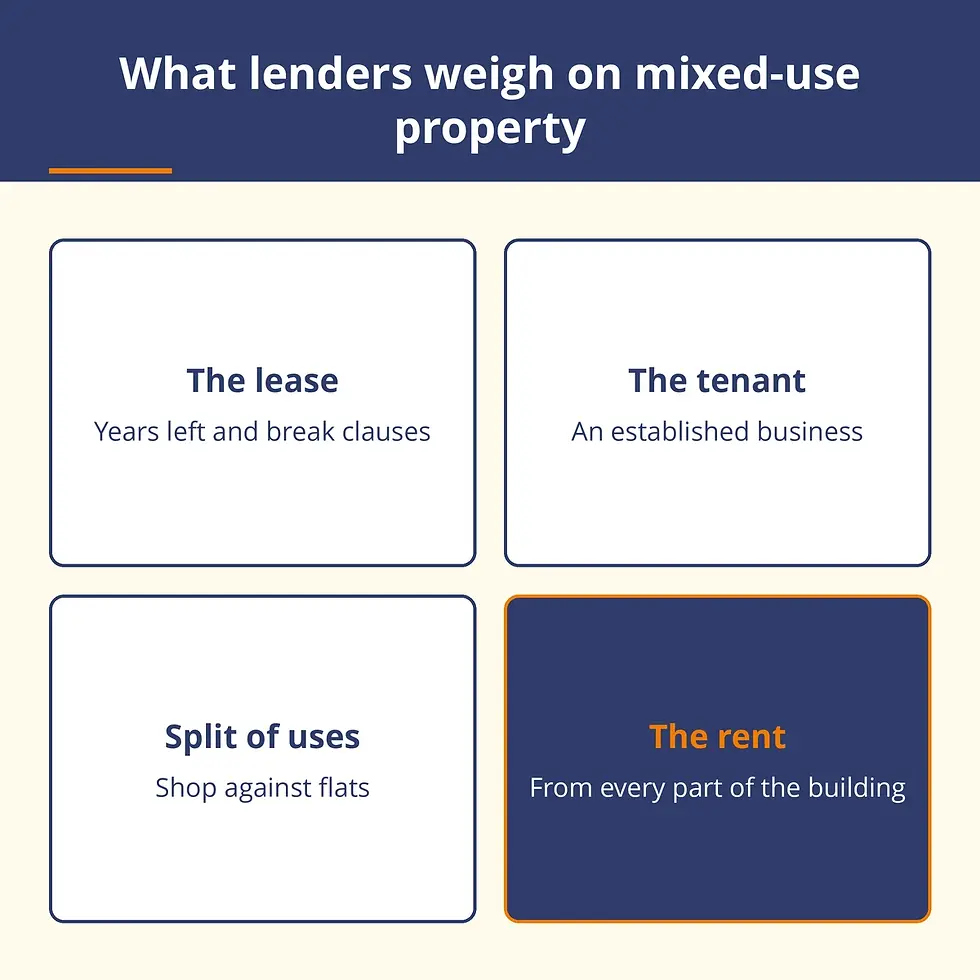
A semi-commercial valuation is a commercial valuation. The valuer looks at the rent each part produces, the terms of the leases and what an investor would pay for that income. The bricks and mortar value with no tenants, known as vacant possession value, is reported as well.
What lenders look at | Why it matters |
|---|---|
Commercial lease | Length left to run, break clauses and rent reviews decide how secure the income is |
The business tenant | An established trader is stronger than a new one; some trades are restricted |
Residential tenancies | Standard tenancies on the flats are expected |
Split of uses | A larger residential share widens the choice of lenders |
Condition and access | Separate access to the flats is preferred, and often required |
The commercial lease carries the most weight. A shop let for ten years to a sound tenant supports a higher value than the same shop on a rolling arrangement. Where the lease has only a year or two left, lenders may value closer to the vacant figure.
The type of business matters too. Offices and ordinary shops are widely accepted. Hot food takeaways, pubs and late-night venues are harder, because of noise, smells and fire risk to the flats above.
An empty commercial unit is the hardest case for a term lender. Without a tenant there is no commercial rent to assess. Short-term finance, or a lender willing to lend on the residential income alone, may be the only routes until it is let.
Why vacant possession value matters
Lenders usually ask the valuer for two figures. One is the investment value, based on the rent and the leases in place. The other is the value with vacant possession, as if the building were empty and for sale.
The loan is often limited by the lower of the two, or by a percentage of each. Where a strong lease pushes the investment value well above the empty value, a cautious lender will lean towards the lower figure. That protects it if the tenant leaves, and it explains why the loan offered can be less than the headline valuation suggests.

Deposits, rates and terms
Deposits are larger than on a house or a standard buy-to-let. Lenders commonly advance up to around two thirds or three quarters of the value, and less where the commercial part dominates or the tenant is weak. The exact figure depends on the lender and the building.
Pricing reflects the extra risk. Rates and fees on semi-commercial loans are generally higher than on comparable buy-to-let mortgages, and they vary more from lender to lender. Arrangement fees are often a percentage of the loan.
Terms are flexible. Interest-only and repayment are both available, and loan terms can run from a few years to twenty-five or more. Commercial lenders sometimes review a loan every few years, which is different from a residential mortgage that runs untouched to the end of its term.
Rental cover is tested across the whole building. The combined rent from the shop and the flats must exceed the interest by the lender's margin. Lenders may discount the commercial rent in that calculation if the lease is short.
Costs at the start are higher than for a house purchase. A commercial valuation costs more than a residential one, and the lender's legal fees, which the borrower pays, reflect the work of reviewing leases. Budget for these before you make an offer.
Timescales are longer as well. A term loan on a mixed-use building commonly takes two to three months from application to completion, because of the valuation and the lease review. Where a purchase has to complete sooner, short-term finance can bridge the gap and be repaid when the term loan is ready. Ask the seller's agent early for copies of the leases, since waiting for them is a common cause of delay.
Many investors hold mixed-use buildings in a limited company, and lenders are used to that. Our limited company buy-to-let guide explains how company borrowers are assessed, and much of it applies here.
Buying your own business premises
Business owners often buy the building they trade from, with living space above. Lenders call this an owner-occupied loan, and they assess it on the profits of the business as well as the property.
Expect to provide two or three years of accounts. The lender wants to see that the business can afford the repayments, usually by comparing profit before certain costs with the annual loan payments. A new business without accounts has fewer options and will usually need a larger deposit.
If you will live in the flat and it makes up enough of the building, the regulated test described above comes into play. That narrows the choice of lenders but brings consumer protections.
A typical case: the shop and two flats
This is an illustrative composite, not a real client. An investor agrees to buy a corner shop with two flats above for £420,000. The shop is let to a convenience store with six years left on its lease, and both flats are let on standard tenancies.
Her buy-to-let lender declines at once, because of the shop. A specialist lender looks at the lease, takes the full rent from all three parts and offers 70% of the value on a semi-commercial mortgage. The residential share of the floor area, at just over half, helped.
Had the shop been empty, the same lender would have assessed the flats' rent alone and offered less. She would then have needed a larger deposit or a short-term loan until a tenant was found.
Paperwork and common obstacles
Semi-commercial applications ask for more documents than a buy-to-let. Having them ready is the simplest way to speed things up.
What do you need?
Tap one to start your check. No credit search.
Leases and tenancy agreements. The commercial lease in full and each residential tenancy.
Rent schedule. What each part pays and when.
Floor areas. The split between commercial and residential space.
Planning use. Evidence of the permitted use of each part.
Accounts. For an owner-occupied loan, the business accounts for the last two or three years.
Planning is a frequent obstacle. The commercial unit must have the right permitted use for the business in it, and any flats created from former storage or offices need their own consent. Lenders' solicitors check both.
Converting part of the building changes the case. Turning upper floors into flats can add value, but the work has to be funded and signed off first. Our guide to refurbishment bridging loans covers funding works, and our guide to mortgages for mixed residential and commercial properties looks at the split in more detail.
Repairs are another point to check. Many commercial leases make the tenant responsible for repairs and insurance, which protects the landlord's income. Where the landlord is responsible, lenders may allow for that cost when they assess the rent.
Semi-commercial lending in 2026
Commercial premises turn up in our work more often as a neighbour than as the security itself. Of the 569 cases on our records to November 2026, 21 involved a home above or beside commercial premises, and two involved a building with commercial use of its own. Our direct experience of full semi-commercial cases is therefore limited.
The lender figures point the same way. Most residential and buy-to-let lenders we track publish cautious rules on homes near commercial premises, and few will take a title that includes the business unit. Among the short-term lenders, by contrast, mixed-use security is widely accepted.
That pattern explains why so many purchases start with bridging. The short-term lender completes quickly on the building as it stands. The term mortgage follows when the leases, the tenants and any works are in order.
For the wider range of unusual properties, our pillar guide to specialist mortgages sets out the options. Blocks of flats without a business element are covered in our guide to multi-unit freehold block mortgages.
How to apply
A short preparation makes the first conversation with a lender far more useful.
Measure the split. Note the floor area of the commercial and residential parts.
Read the lease. Check the term remaining, the rent, any break clause and who pays for repairs.
Decide who will live there. If you or your family will occupy a flat, say so at the start.
Gather the income evidence. Rent schedule for an investment, accounts for an owner-occupied loan.
Check criteria before applying. Match the building, the lease and your plans to lender criteria first.
From there, an agreement in principle confirms the lender's view before you commit to a commercial valuation, which costs more than a residential one. Allow more time than for a buy-to-let, because the lender's solicitor reviews every lease.
FAQs
What is a semi-commercial mortgage?
A loan secured on a building with both business and residential parts on one title, such as a shop with flats above. It is offered by commercial and specialist lenders, not by standard residential lenders.
Is a semi-commercial mortgage regulated?
Usually not. It is regulated where at least 40% of the property is used as a home by the borrower or a related person. Loans to investors who let both parts are unregulated.
How much deposit do you need for semi-commercial property?
More than for a house. Lenders commonly advance up to around two thirds or three quarters of the value, depending on the lease, the tenant and the split between the uses.
Can you get a buy-to-let mortgage on a shop with a flat above?
Not normally, where the shop and the flat are on one title. Most buy-to-let lenders will not lend on a building with a commercial element. A semi-commercial mortgage is the usual route.
What if the commercial unit is empty?
Fewer term lenders will help, because there is no commercial rent to assess. Some lend on the residential income alone, and short-term finance can cover the period until a tenant is found.
Summary
A semi-commercial mortgage covers a building with business and residential parts on one title. Lenders look at the commercial lease, the tenant, the split of uses and the rent, and they ask for a larger deposit than on a house. Who lives in the residential part decides whether the loan is regulated. If you would like your building and plans matched to lender criteria before you apply, the check takes a few minutes and involves no credit search.
Reviewed by Ben Stephenson, FCA-authorised mortgage adviser, CeMAP-qualified.
Manor Mortgages Direct is FCA authorised, FRN 496907, has traded for 25 years, is highly positively reviewed, 4.9 rated on Google, and has helped thousands secure the right mortgage. Bristol-based mortgage brokers, assisting clients nationwide.
Sources
Financial Conduct Authority Handbook: PERG 4.4, What is a regulated mortgage contract?, accessed 17 November 2026
Cite this page: Manor Mortgages Direct, "Semi-Commercial Mortgages: How UK Lenders Decide in 2026", checked November 2026, manormortgagesdirect.com/semi-commercial-mortgages
Related Guides